Google Search Agents Change What Being Found Means
Google I/O 2026 introduced 24/7 search agents, Gemini 3.5 Flash in AI Mode, and agentic booking. Here's what shifts for business discoverability.
By Springvanta
At Google I/O 2026, the search engine that handles roughly 8.5 billion queries a day announced something that shifts the ground under every business that depends on being found online: search agents that run 24/7 in the background, monitoring the web on behalf of users.
Liz Reid, VP and head of Google Search, described it as "the era of Search agents" -- a moment where Google stops being a place you visit and starts being something that works for you continuously.
This matters because the old contract between businesses and Google was straightforward: publish good content, earn links, rank for keywords, and people would click through to your site. Search agents rewrite that contract entirely.
What Google Announced
The I/O 2026 Search updates fall into four buckets, each with distinct implications for how businesses get discovered:
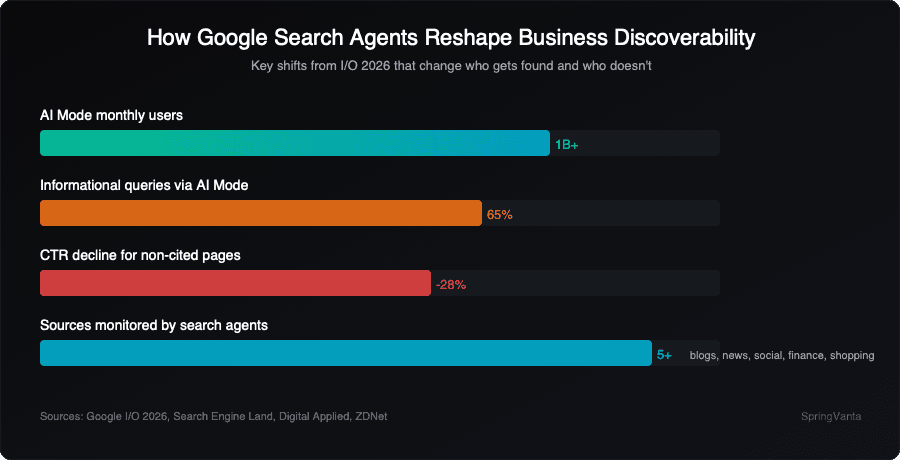
1. Gemini 3.5 Flash powers AI Mode globally. Google claims over one billion monthly AI Mode users. The new model handles complex, multi-step queries with real-time reasoning across sources. Users can now move from an AI Overview into a full conversational session without losing context. The search box itself has been redesigned for the first time in 25 years to accept natural language, images, files, and videos -- not just keywords.
2. Information agents monitor the web continuously. This is the headline change. Users describe what they want , apartment listings, product launches, competitive moves -,and Google creates a persistent agent that scans blogs, news, social posts, and live data feeds around the clock. When it finds a match, it sends a synthesized notification. These agents launch first for Google AI Pro and Ultra subscribers this summer.
3. Agentic booking reaches local services. Search can now assemble real-time pricing and availability for local services and, in categories like home repair, beauty, and pet care, Google will call the business on your behalf.
4. Agentic coding and mini-apps inside Search. Google brought its Antigravity coding platform directly into Search. Users can ask Search to build interactive dashboards, trackers, and visualizations on the fly --,ulling live data from maps, weather, and reviews.
Why This Changes Discoverability
The shift from keyword matching to agent-driven discovery means three things for businesses that rely on search traffic:
Agents read everything, not just your page. An information agent scanning for "reliable HVAC repair near me" pulls from reviews, social mentions, forum discussions, news coverage, and competitor listings. Your own website is one signal among many. This makes off-site reputation -- structured reviews, consistent NAP data, active social presence , as important as on-page SEO.
The citation economy intensifies. Roughly 65% of informational queries now route through AI Mode, where Gemini synthesizes answers and cites specific sources. Pages that earn citations maintain visibility; those that don't see declining impressions regardless of their traditional ranking. Only 19% of AI Overview sources overlap with Google's top 10 organic results, meaning the old ranking ladder and the new citation ladder are different climbs.
Speed and freshness become ranking-level signals. When agents monitor continuously, the most recently updated, most factually precise content wins. A pricing page last updated six months ago gets bypassed in favor of a competitor whose site reflects today's availability. Structured, answerable content with current dates and specific figures earns disproportionate citation rates -,up to 3x more than long-form narrative without clear answer units.
What to Do Right Now
If your business depends on Google for leads, here's where to focus:
-
Audit your entity signals. Make sure your Google Business Profile, schema markup, and third-party directory listings are consistent and current. Agents triangulate across sources -- contradictions hurt you.
-
Structure content around answerable questions. Each page should address a specific question with a clear, factual answer that includes concrete numbers, dates, and locations. This is the format Gemini cites most reliably.
-
Build off-site authority deliberately. Since brands are 6.5x more likely to be cited through third-party sources than their own domains, invest in earned mentions: industry publications, local news, professional directories, and review platforms.
-
Track citation appearances, not just rankings. Traditional rank tracking tells you less each month. Use Search Console's AI Mode reporting section and purpose-built GEO tools to measure whether your content appears in synthesized answers.
-
Prepare for agentic booking. If you offer local services, ensure your booking infrastructure (scheduling links, real-time availability, clear pricing) is structured and accessible so that Google's agents can complete bookings on your behalf.
The businesses that treat search agents as a new channel , not just an upgrade to the old one -,will be the ones that get found when a billion users ask Google to go find things for them.
--, Sources:
- Google I/O 2026 Search announcements (Google Blog, May 19, 2026)
- Google Search gains information agents (Search Engine Land, May 19, 2026)
- Google's new AI Search box is here (ZDNet, May 19, 2026)
- Google Search enters 'agentic era' (LiveMint, May 19, 2026)
- Google AI Mode: Gemini 3 Rankings Impact (Digital Applied, March 2026)