72 Hours, Four Deals: AI Crossed From Front Desk to Back Office
HomeLight's AI escrow agent, Superlegal's licensed AI law firm, Realtor.com's Gemini-powered home search, and Legora's CRE acquisition all landed in one week. Here is what changed.
By Springvanta
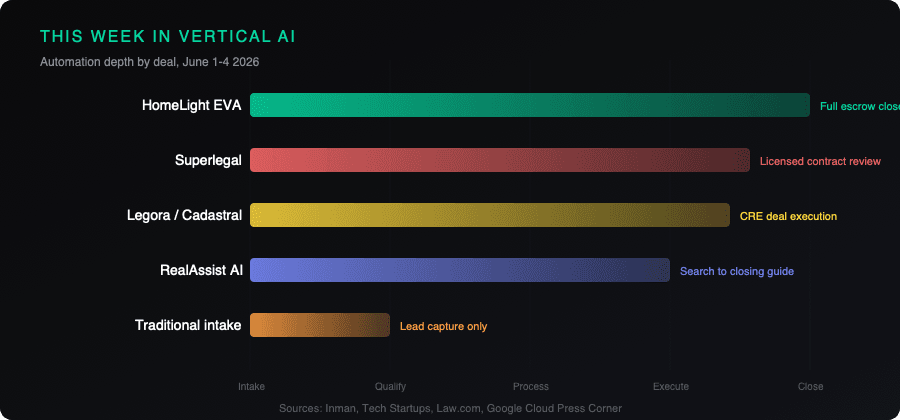
Between June 1 and June 4, four companies in three industries announced that AI had moved past answering phones and capturing leads. It is now closing transactions.
HomeLight launched EVA, an AI escrow agent that opens orders, pulls HOA documents, contacts agents for missing information, and wires funds. Backed by $40 million from BlackRock. Realtor.com shipped RealAssist AI, built with Google Gemini, that walks home buyers from "where do I even start" all the way to closing. Superlegal opened what it calls America's first AI-powered law firm, authorized under Utah's legal sandbox to review contracts at $117 each. And Legora, the Stockholm-based legal AI company valued at $5.55 billion, acquired Cadastral, a New York startup whose AI handles commercial real estate deal workflows.
None of these are intake tools. None of them capture leads. They execute the actual transaction.
The escrow agent that uses a credit card
HomeLight's EVA is probably the most concrete example of what this looks like in practice. A residential escrow involves roughly 120 discrete tasks. EVA handles most of them.
The system monitors the escrow officer's inbox, opens incoming order requests, extracts 20-plus data points from PDFs, and enters them into the system of record. When information is missing, EVA emails the agent directly, waits for a reply, and updates the file. It searches state HOA databases, purchases documents using HomeLight's company credit card, kicks off title searches, sends intake forms to buyers and sellers, and tracks earnest money deposits.
HomeLight CEO Drew Uher told Inman that accuracy started at 25-30% in early 2025, stalled at 80-90% for six months, then hit what he calls "effectively 100%" across four major workflows between February and May 2026. His definition is worth noting: it's fine if EVA escalates a corner case it can't handle. What's not fine is EVA guessing wrong on something that involves people's life savings.
The $40 million from BlackRock funds national scaling. Victor Lund at WAV Group framed the longer play: the data exhaust from automating escrow at scale could be worth more than the escrow fees themselves.
From search to closing in one conversation
Realtor.com's RealAssist AI takes a different angle on the same shift. Instead of automating back-office work, it reconstructs the buyer's front-end experience.
Traditional real estate search gives you a box and filters. RealAssist takes natural language: "Find me homes that feel like a private retreat, lots of natural light, not a fixer-upper, under $650K." It remembers priorities across sessions, walks buyers through affordability calculations, compares neighborhoods, and prepares questions for agent meetings. The Google Gemini integration gives it conversational depth that filter-based search can't match.
The product launched June 2 in beta for logged-in users on desktop, app, and mobile web. Realtor.com CEO Damian Eales called it "the AI era in real estate" during the announcement.
The structure matters here. Realtor.com isn't replacing agents. It's building an AI layer that makes the agent conversation more productive by the time it happens. That's the same pattern HomeLight is banking on for escrow officers.
An AI firm licensed to practice law
Superlegal's June 3 announcement is harder to categorize because it doesn't fit neatly into "legal tech." The company isn't selling software to lawyers. It is the lawyer.
Authorized under the Utah Supreme Court's Legal Services Innovation Sandbox, Superlegal operates as an AI-powered law firm. Construction companies submit contracts. AI reviews them. A licensed attorney signs off. Turnaround is under 24 hours at $117 per contract.
The customer validation is specific. David Fitzhugh, director of contract strategy at Western Partitions Incorporated, said his company spends roughly a tenth of what it used to spend on outside counsel. Turnaround went from days to hours. The AGC reports 61% of construction firms are using or planning AI investments, up from 44% in 2024.
The structural bet here: most legal AI companies sell tools to lawyers who still bill $500/hour. Superlegal hires itself out directly. The Utah sandbox gives it regulatory cover that most states don't offer yet.
Legal AI acquires real estate AI
Legora's acquisition of Cadastral on June 2 connects two of the three verticals in this story. Legora, valued at $5.55 billion after a $600 million Series D, built an agentic operating system for legal workflows. Cadastral built an AI agent for commercial real estate deals: document drafting, investment memos, data room analysis, financial modeling.
Together, they represent what Legora CEO Max Junestrand called the company's "initial foray into commercial real estate" within its Legora aOS platform. CFO David Eckstein told Law.com the company is actively pursuing more acquisitions in IP, patent, trademark, and litigation.
This is Legora's fourth acquisition in 2026 alone (Graceview in Australia, Qura in Sweden, Walter AI in Canada, now Cadastral in New York). The pattern: horizontal legal AI acquiring vertical specialists to build practice-area depth.
What changed this week
Four launches in 72 hours, across legal and real estate, share one structural trait. The AI is not sitting between the customer and the professional anymore. It is the professional, or it handles the work the professional used to do.
If your AI strategy stops at intake forms and lead capture, you're a year behind what shipped this week. HomeLight automates 120-task escrow processes. Superlegal practices law. The front-office layer is no longer where the competitive advantage lives.
Every launch this week was vertical-specific. EVA handles escrow, not generic document processing. Cadastral handles CRE deals, not generic contract review. Superlegal handles construction contracts, not all legal work. Domain knowledge is the moat. Horizontal tools don't get you there.
Utah's sandbox gave Superlegal a path to operate as a law firm. More states will follow. The question isn't whether AI can do the work; it's whether the regulatory structure allows it. That's the binding constraint for the next 12 months.
HomeLight's Uher was direct about who remains: the humans handle agent-facing accountability ("a throat to choke") and edge-case judgment. Everything else is automation territory. That's not a prediction. It's what shipped this week.
Sources: Inman, Tech Startups, Law.com, Realtor.com / Google Cloud