AI Coding Subscriptions End. Metered Billing Takes Over.
Four billing changes in one week: Anthropic splits Agent SDK credits, Cursor adds spend controls, GitHub goes metered, and the Linux Foundation creates token standards.
By Springvanta
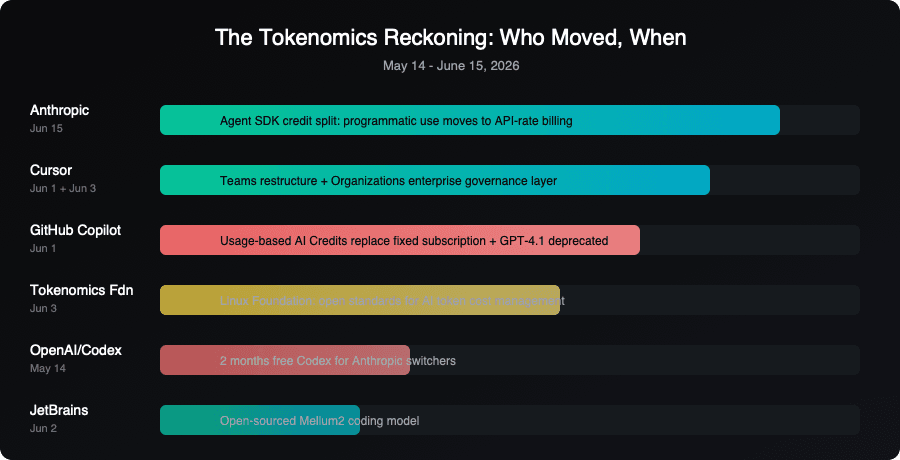
Three billing changes landed in the same week. GitHub Copilot retired its fixed subscription on June 1. The Linux Foundation announced the Tokenomics Foundation on June 3. Cursor restructured Teams pricing and launched an enterprise governance layer on June 4. Anthropic's own billing split, arriving June 15, is the fourth.
The flat-rate AI coding subscription is done. What replaces it is still taking shape.
What Anthropic is doing on June 15
Starting June 15, Anthropic moves all programmatic Claude usage out of the shared subscription pool and into a separate monthly credit. This covers the Claude Agent SDK, the claude -p headless command, Claude Code GitHub Actions, and any third-party app that authenticates through your subscription.
The credit amounts track the subscription price: $20/month for Pro users, $100 for Max 5x, $200 for Max 20x. Once the credit runs out, automated requests stop. No fallback to a cheaper model, no queue, no real-time notification. The only escape valve is enabling "usage credits," an overflow billing toggle that continues charging at standard API rates. It is off by default.
Interactive use of Claude, including Claude Code in the terminal and Claude Cowork, is unaffected.
This is Anthropic's third attempt to solve the same problem in five months. In January, they blocked subscription OAuth tokens from third-party tools and reversed the decision within days. In April, they banned third-party agents from using subscription credentials outright, then reversed that too. The credit-pool structure announced May 14 is the one that survived.
The numbers explain why. One community analysis found OpenClaw users extracting roughly $236 of API-equivalent compute per month from a $20 Pro subscription. That is a 12-to-1 subsidy ratio. At the Max 20x tier, independent estimates put it at 175 to 1. Boris Cherny, Head of Claude Code at Anthropic, said the company's systems are "highly optimized for one kind of workload" and that subscriptions "weren't built for the usage patterns of these third-party tools."
Cursor: cheaper seats, more controls
Cursor moved on June 1 with a two-part response.
First, it restructured Teams pricing. Every seat now has two separate usage pools: one for Cursor's own Composer model and Auto mode, and one for third-party models from Anthropic and OpenAI. A new Premium seat at $120/month ($96 annual) gives five times the Standard seat's usage at three times the price. The Standard seat dropped to $32/month on annual plans. The goal is to stop cross-subsidizing the small group of power users who drive most compute spend.
Second, on June 3, Cursor launched Organizations, an enterprise governance layer. One dashboard, multiple teams, per-department budgets, restricted model access by function, configurable agent permissions. An engineering team gets the full model roster and generous spending headroom. A marketing team might get cheaper models, lower ceilings, and a requirement that agents need human sign-off before running commands.
The Composer pool matters here. Composer 2.5, Cursor's own model, costs $0.50 per million input tokens and $2.50 per million output tokens. Claude Opus 4.8 runs at $5.00/$25.00. That is a tenfold difference. By giving Composer its own allowance and automatically falling back to it when third-party allocation runs out, Cursor is pushing users toward inference it controls and protecting its margins. The New Stack called it "structurally nudging users toward cheaper inference."
GitHub Copilot: usage-based billing and the backlash
GitHub's move to usage-based billing on June 1 drew the sharpest reaction. Some subscribers reported projected monthly bills jumping tenfold overnight. The switch from a fixed subscription to AI Credits metered by consumption was called a bait-and-switch across forums and social media, particularly by developers who had built workflows around the old pricing.
GitHub also deprecated GPT-4.1 across all Copilot experiences starting June 1. The credit-based system is harder to predict than the flat-rate model it replaces.
The Tokenomics Foundation
On June 3, the Linux Foundation announced plans to launch the Tokenomics Foundation, backed by Google, Microsoft, Salesforce, and JPMorgan Chase. It will operate as a sibling to the FinOps Foundation, extending cloud cost governance into token-based AI workloads.
Enterprise AI budgets grew from $1.2 million per year in 2024 to $7 million in 2026, according to reporting by The Next Web. Per-token prices fell 98% in the same period. But agentic tools drove consumption 18.6 times higher per developer. Tokens got cheaper. Usage got bigger. Bills went up.
Jim Zemlin, the Linux Foundation's CEO: "Tokens have become the new unit of technology spend." The Foundation plans open standards for AI token billing, new metrics including cost-per-intelligence and tokens-per-watt, and a canonical definition of "tokenomics," which currently means something different at every vendor.
J.R. Storment, executive director of the FinOps Foundation, said organizations currently have no consistent way to compare costs across providers.
What to do before June 15
The Anthropic credit split takes effect June 15. If you run claude -p in CI pipelines, scheduled scripts, or any headless automation, calculate how much API-equivalent compute those workflows consume. The $20 Pro credit will not last long under heavy use.
Turn on overflow billing before you need it. The default is for automated requests to fail silently when credits run out. A CI pipeline stopping at 2 AM with no notification is the scenario to avoid. Enable "usage credits" in your Claude account settings, or migrate those workloads to direct API billing.
Use the new spend controls. Cursor's Organizations dashboard and GitHub's AI Credits reporting exist because enterprise buyers demanded them. Set per-team budgets, configure alerts, and review which teams actually need the most expensive models.
Greyhound Research's Sanchit Vir Gogia predicts that over the next 12 to 24 months, every major vendor will create separate consumption pools for agents, premium models, tool use, and background tasks: "Some will call them credits. Some will call them requests. Some will hide the meter inside bundles. The vocabulary will vary because marketing departments need hobbies. The direction will not."
Paul Chada, co-founder of Doozer AI: "Stop optimizing for the subsidy and start optimizing for the token. Treat prompt caching, context discipline, and model selection as first-class engineering."
Every company that treated AI coding tools like an all-you-can-eat subscription is about to get the actual bill.
Sources: InfoWorld, Tech Times, The New Stack, Cursor Blog, PR Newswire / Linux Foundation, The Next Web, Anthropic Help Center