AI Coding Tools Hit a Pivot Point in 72 Hours
Three things happened in AI coding in 72 hours: Cursor absorbed the open-source champion, Claude went dark, and Claude Code's creator stopped prompting.
By SpringVanta
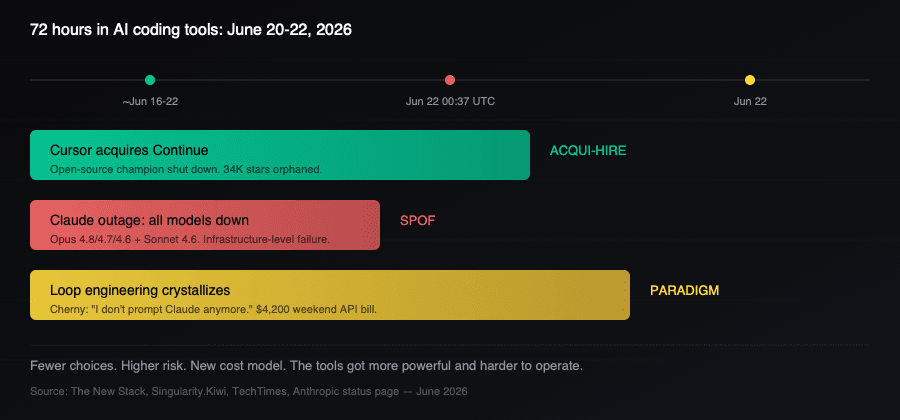
Three things happened in AI coding tools between June 20 and June 22 that, taken together, describe where this market is going.
Cursor quietly absorbed Continue, the leading open-source alternative to proprietary coding assistants, and shut the product down. Claude went down across every model and every product surface simultaneously. And Boris Cherny, the person who built Claude Code, said publicly that he doesn't prompt anymore. He writes loops.
Each of these is a story on its own. Together they sketch a market where your options are narrowing, your dependencies are getting riskier, and the way you use these tools is changing faster than most teams have adjusted for.
Cursor ate the open-source alternative
Continue had 34,300 GitHub stars, 4,800 forks, and roughly $5 million in funding when Cursor acquired it. The product is now shut down. Users have until July 15 to export their data. Billing is disabled. The homepage reads: "Continue has been acquired by Cursor."
This was an acqui-hire, not a product integration. Co-founder Nate Sesti is joining Cursor. The other co-founder, Ty Dunn, departed in May. Two founding engineers went to OpenClaw instead. The team pushed a final 2.0.0 release, removing telemetry, stripping authentication, tidying the code, and handed the Apache 2.0 codebase to the community as a parting gift.
The pitch was data sovereignty. "When you use Continue, you get to keep your data," Dunn told TechCrunch in early 2025. The selling point was that you could pool developer data in your own infrastructure instead of handing it to a black-box SaaS. Sixteen months later, the open-source champion for data control is owned by one of the most proprietary players in the space. Which is itself now owned by SpaceX, meaning Elon Musk's rocket company is the ultimate parent of what was sold as a transparent, community-owned coding tool.
This is Cursor's third acquisition in 18 months, following Supermaven and Graphite. At the same conference, Cursor unveiled Origin, an agent-native code hosting platform that takes direct aim at GitHub. The pattern is clear: fewer independent tools, more capabilities concentrated in fewer hands.
The codebase survives. Apache 2.0 means anyone can fork it. But a fork without a funded team maintaining it is a graveyard, not a product. The open-source AI coding tool movement just lost its best-funded champion.
Claude went down and the open-models argument went mainstream
At 00:37 UTC on June 22, Anthropic's status page confirmed elevated error rates across Opus 4.8, Opus 4.7, Opus 4.6, and Sonnet 4.6. Not one model hiccuping. Every model, simultaneously. Claude.ai, the API, Claude Code, and Claude Cowork, all degraded. The breadth pointed to infrastructure-level failure, not a model-specific bug.
For teams running production workloads on Claude, there is no workaround when the provider is down. You wait, or you switch to a backup model that may not have the same context window or capabilities. Teams that batch AI work overnight discovered the failure when they checked morning results.
The timing was uncomfortable for Anthropic. The same day, a blog post titled "There is minimal downside to switching to open models" hit the front page of Hacker News. The author, Andrew Marble, framed the switch from Claude to open models as comparable to switching from Windows to Linux in 2024. The gap had narrowed from "professional risk" to "minor adjustment." He wasn't arguing open models are better. He was arguing the penalty for using them had dropped below the threshold where vendor lock-in is worth the risk.
This landed differently than the usual open-source advocacy because it came from a pragmatist doing cost-benefit math, not an ideologue. Anthropic had also recently paused Claude Agent SDK billing changes after developer backlash, and rolled out an ID verification requirement starting July 8 that has been controversial in developer communities. The compounding friction (outages, billing chaos, verification requirements) is exactly the kind of pressure that makes the open-models argument credible to people who would have dismissed it six months ago.
None of this means Anthropic is unreliable. Every cloud service has outages. The point is structural: any single provider is a single point of failure, and the cost of maintaining a backup has fallen fast enough that not having one is becoming the riskier choice.
The person who built Claude Code stopped prompting
Boris Cherny, creator and head of Claude Code, told interviewers in June 2026: "I don't prompt Claude anymore. I have loops running that prompt Claude and figuring out what to do. My job is to write loops."
That quote, echoed by OpenAI engineer Peter Steinberger and then structured into a framework by Google engineer Addy Osmani in a widely shared essay, crystallized something developers had been building toward. The interaction model for AI coding tools is shifting from turn-by-turn prompting to loop design. You build a system that holds context externally, decides what to prompt, dispatches agents, and checks whether the work meets a defined standard.
The primitives now ship as first-party features. Claude Code has /loop, /goal, /schedule, and /workflows. OpenAI Codex added matching commands. The architecture maps across tools. Different names, identical shape.
The economics are the part most teams haven't reckoned with. Agent loops don't cost the same as prompts. Every tool call in a loop adds context that gets re-sent on every subsequent call. By iteration 20, cumulative input per call can exceed 50,000 tokens. At Opus 4.8's pricing of $5 per million input tokens, a single late-loop step costs roughly $0.25. A 200-iteration session on an open-ended task can run $80 or more. One developer hit $4,200 in API fees over a single weekend. Uber reportedly burned through its entire 2026 AI budget for Claude Code in four months, with per-engineer costs between $500 and $2,000 monthly.
Anthropic formalized this on June 15. Automated workloads through the Agent SDK, claude -p scripts, and GitHub Actions now bill against a separate credit pool. $20 for Pro subscribers, up to $200 for Max. When that pool runs out, automated requests stop.
The maker-checker problem is the architectural challenge underneath all of this. A loop without a verifier is a machine that produces work with high confidence but no quality gate. Claude Code's /goal command uses a separate, faster model to check whether a completion condition holds after each turn. The agent that wrote the code is not the agent evaluating it. Without that separation, a loop can run for many turns producing work that satisfies none of the actual requirements.
What this means for teams choosing tools
The three stories sketch a market getting harder to navigate, not easier. The leading open-source coding tool is gone as a product. The proprietary platforms are buying competitors. A single-provider outage still takes down your entire stack, and most teams haven't built a fallback. The move from prompting to loops changes the cost model from per-seat to per-loop, and the per-loop numbers can be an order of magnitude higher.
If you're evaluating AI coding tools right now, the questions have shifted. Which providers can you switch between without retraining your team? What happens when your primary model goes down? How much does an autonomous loop cost to run, and what checks the output?
The tools got more powerful this week. They also got more concentrated, more fragile, and more expensive to operate. Those things are connected.
Sources:
- Cursor quietly acquires Continue — Paul Sawers, The New Stack, June 22, 2026
- Claude Goes Down, and the Case for Open Models Gets Harder to Ignore — Singularity.Kiwi, June 22, 2026
- Claude Code Loop Engineering: Stop Prompting, Start Designing Autonomous Agent Workflows — Kyle Belmonte, TechTimes, June 22, 2026
- Continue (acquired by Cursor) — Continue homepage, June 2026