AI Overviews changed how people search your brand name
Analysis of 846K Google sessions shows AI Overviews don't just reduce clicks. They change how users read, compare, and decide before visiting your website, especially on brand searches.
By Springvanta
Someone types your company name into Google. In the old model, they'd be on your website in under five seconds. Not anymore.
A study published May 26 analyzed 846,000 U.S. Google search sessions from February and March 2026, tracking cursor movements, scroll behavior, and engagement timing at one-second intervals. The research, conducted by ClickStream Solutions using anonymized data from Surfer SEO, is the largest behavioral look at what AI Overviews do to the search results page. And the results challenge the standard narrative that AI Overviews simply steal clicks.
The bigger change is behavioral. AI Overviews turn the search page from a doorway into a reading room.
Brand searchers changed the most
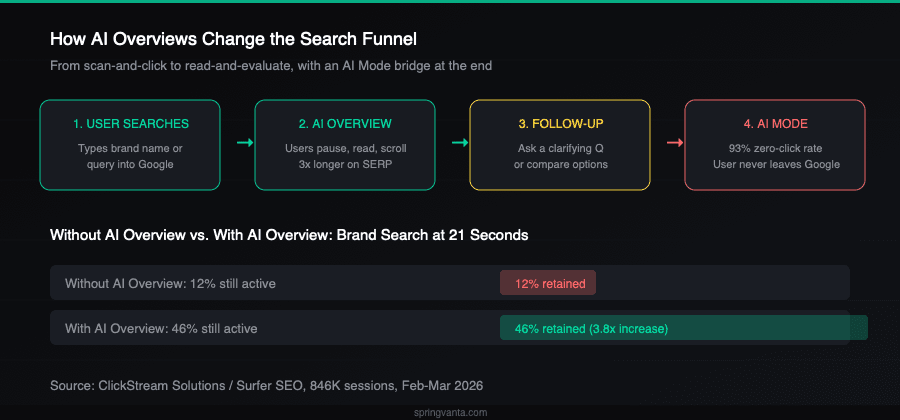
Navigational queries, where someone types a brand name or URL directly into Google, have been the most reliable source of organic traffic for any business. These people already know where they want to go. Without an AI Overview, only 12% of navigational searchers were still on the results page at 21 seconds. Most had already clicked through to their destination.
With an AI Overview present, that number jumps to 46%.
Users who would have been on your site in seconds are now spending 15 or 20 seconds reading Google's AI summary, scanning competitors, and scrolling back and forth before deciding. Cursor spread for these users tripled, from 8% of the viewport to 27.5%. They went from a focused scan to reading the entire page.
This is not just slower traffic. These visitors arrive at your site having read a summary of what you do, compared you to alternatives, and decided you're worth a closer look. That's a different kind of visitor than someone who reflexively clicked the first result.
Five search types, one behavior pattern
Without an AI Overview, search intent types behave nothing like each other. Navigational searchers leave fast. Local searchers linger. Informational searchers are somewhere in between. At 21 seconds, retention ranges from 12% (navigational) to 32% (local).
With an AI Overview, those differences collapse. All five intent types show 92-93% retention at 3 seconds and 42-49% at 21 seconds. The AI Overview makes everyone behave the same way: reading, pausing, evaluating.
Reading, not scanning
Users with AI Overviews kept their cursors still 44% of the time versus 29% without. That sounds like disengagement, but their cursors covered 83% of the visible page versus 66% without. More stillness, more ground covered. The researchers describe this as a shift from "scanning and clicking" to "reading and evaluating."
Back-scrolling tells the same story. Among users who reversed scroll direction, those with AI Overviews spent 47.5% of their scrolling going back up the page, compared to 27% without. For navigational searchers specifically, back-scrolling nearly doubled from 23% to 44%.
Your search listing might get looked at three times before someone decides what to do. The old "scan the top three results and click one" model is giving way to something slower and more deliberate.
The bridge to AI Mode
This behavioral data landed on the same day as Press Gazette's report that Google is building a direct path from AI Overviews into AI Mode. Users can now ask a follow-up question from any AI Overview and flow into a full conversational search session.
Google says the transition is optional. Blue web links stay. But the direction is clear. Lily Ray, founder of Algorythmic, told Press Gazette that while businesses can "breathe a small sigh of relief" that AI Mode isn't default, "all of these new search features will absolutely continue to cut into organic traffic across the board."
Her prediction for when AI Mode becomes the default: "once they figure out how to drive as much ad revenue from AI Mode as they currently generate from organic search."
Jibon Kumar Jith, an SEO manager at Rooy SEO, described the follow-up prompt as a way to "aggressively lock users into a zero-click loop." The traditional search page handles the initial query; a single clarifying question funnels users into AI Mode, where Semrush data shows 93% of searches end without a click to any website.
What this means for businesses
The search results page is becoming an evaluation environment, not a transit hub. A few consequences worth tracking:
Your title tags and meta descriptions matter more now, not less. Users are reading them carefully and comparing them to competitors. Generic copy that survived the old scan-click model won't survive read-and-compare.
Watch conversion rates from branded organic search, not just click counts. If brand searchers spend 3x longer on Google before arriving, the ones who do click through are more deliberate. You may see fewer visits but higher intent per visit. That could actually be good for conversion.
The bridge to AI Mode is optional today. Barry Adams, a news SEO consultant, told Press Gazette that breaking news is "relatively safe" because AI "still needs human reporters to report the news." But for how-to, comparison, pricing, and evaluation content, start measuring which of your pages get cited in AI Overviews and which get summarized without attribution.
Sources
- 846,000 Google Searches Reveal How AI Overviews Are Changing User Behavior - Search Engine Journal, May 26, 2026
- What Google AI Mode push means for publishers - Press Gazette, May 26, 2026
- What Google Search's New AI Mode Means for B2B Discovery - PYMNTS, May 26, 2026