Your Analytics Lie About AI Traffic. The Fix Just Became Urgent.
Four studies in 72 hours prove AI recommendations drive 2.5x more site visits, but 55.9% arrive via branded search uncredited. Google's spam update makes the gap urgent.
By SpringVanta
Your Analytics Lie About AI Traffic. The Fix Just Became Urgent.
Three things landed in the same 72 hours at the end of June, and together they answer a question every marketing team has been asking: does AI visibility actually produce measurable business value, and if so, why can't you see it?
The attribution gap nobody could prove
Similarweb published the first clickstream study to connect AI recommendations to real downstream behavior on June 23. The methodology was clean: they tracked thousands of opted-in U.S. desktop users who asked ChatGPT industry questions in finance, travel, and beauty, received a named brand recommendation, and then watched what they did for seven days. They excluded anyone who had already visited the brand in the prior four weeks, or who named the brand in their prompt. Genuine influence, not confirmation bias.
The headline number: users who received a ChatGPT recommendation were 2.5 times more likely to visit that brand's website within seven days. In finance, 7.2% of users visited American Express after an AmEx recommendation versus 3.1% who went to Capital One. After a Capital One recommendation, 14.2% visited Capital One while 3.8% went to AmEx. The pattern held across all three verticals.
Here is where it gets uncomfortable for marketing teams. 55.9% of those AI-influenced visits arrived via branded search. Not AI referrals. Search. A user asks ChatGPT for a recommendation, reads the answer, closes the tab, and three days later Googles the brand name. Your analytics logs a branded search visit. The AI recommendation gets zero credit.
Rand Fishkin, founder of SparkToro, compared it to how advertisers measured billboards and TV ads in the 20th century: "Whether we're talking about a brand's visibility on the side of a highway in 1926 or its presence in an AI tool's response in 2026, it's clear that influence is happening."
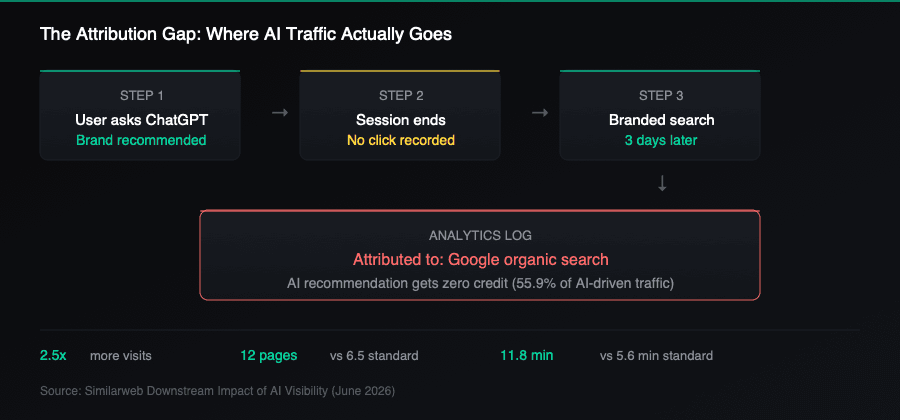
The engagement data makes this worse. AI-influenced visitors viewed an average of 12 pages and spent 11.8 minutes on site, compared to 6.5 pages and 5.6 minutes for standard visitors. These are not casual browsers. They arrive pre-qualified, because the AI already answered their question and they chose to click through anyway. They are the highest-intent traffic source most companies cannot track.
The academic paper that confirms it
A preprint posted to arXiv by Scrunch AI researchers, covered more broadly in late June, arrived at the same conclusion through a different methodology. Instead of tracking panel users, they joined opt-in clickstream data to the same users' actual ChatGPT, Claude, and Gemini conversations. They used a pre-trend event study, a stance classifier, and non-customer conditioning to isolate the effect of an AI recommendation from existing customer behavior.
The numbers: an AI brand recommendation produced a 4.3 percentage-point increase in same-name Google searches, a 2.4 percentage-point increase in visits to the brand's own site, and a 1.0 percentage-point increase in brand-specific retailer-page visits over matched backward placebos. When the AI merely mentioned a brand in passing instead of recommending it, the effect was roughly half: 1.8, 1.1, and 0.3 points.
The distinction matters. Recommendations move behavior. Mentions barely do. The study also found that brands named first, or framed as "best" or "top" in the response, saw the biggest downstream surge. ChatGPT drove a larger post-answer intent spike than Gemini. Platform, placement, and framing all mattered.
What actually earns those recommendations
On the same day Similarweb published its traffic study, Goodie released version 4 of its AEO Periodic Table, built from 1.13 million prompts run through six AI surfaces: ChatGPT, Claude, Perplexity, Grok, Gemini, and Google AI Mode. Fourteen factors, scored per engine and weighted by overall contribution.
One finding stands out: the off-site corpus pulls about as hard as on-page content. Earned citations (coverage on third-party sites) and social and community citations (Reddit, YouTube, forums, review sites) both sat in the top tier, and together outweighed any single on-page content factor. The report's author, Mostafa ElBermawy, put it bluntly: "To an AI model, a brand is more than what it says about itself on its own website."
Two new factors entered the table in V4. Search and Fan-out Rank, which measures how a brand's pages perform in the underlying web search that AI engines use for grounding, became the single strongest correlate of citation for engines that run live retrieval. Originality and Information Gain, split out from generic "content quality," showed that derivative-but-well-structured content underperforms original research by a wide margin. The takeaway: the content that earns AI citations tends to contain information that did not exist before that page was published.
This is where the attribution paradox connects to the optimization paradox. If off-site reputation drives AI citations, and AI citations drive real but misattributed traffic, then most GEO work targets the wrong layer. The traffic is real. The work that produces it is not what most teams are doing.
The paid mention problem
Gaetano DiNardi, writing on Search Engine Land on June 26, named what happens when that insight gets weaponized. He audited the work of several top-rated GEO vendors and found a pattern.
These vendors sell "brand mention outreach" programs. The pitch: AI visibility is driven by third-party mentions, so you need more of them. The execution: paying for placements on Private Blog Networks at 10 to 15 times the cost of a typical SEO backlink, mass-posting brand mentions across irrelevant subreddits using aged accounts, and selling topically irrelevant placements. One example DiNardi documented charged $250 for a brand mention on a page that also hosted outgoing commercial anchors to competing products. The structural signature of paid links, repackaged for the AI era.
Lily Ray put it in historical context: "Going back to the first Penguin update in 2012, when Google began systematically suppressing inorganic links, paid mentions on low-quality sites have been treated as exactly what they are: another evolution of spammy link building. It's naive and irresponsible to assume the search and AI platforms won't eventually catch on too."
The reason some of these tactics appear to work right now is that LLM citation systems are still immature compared to Google's spam detection. But as DiNardi noted, that creates a temporary window of effectiveness, perhaps one to two years, before AI platforms refine their authority signals. Marketers who prioritize mention volume over brand safety risk confusing LLMs about their entity or permanently damaging their reputation.
Google closed the enforcement loop
Forty days before the June 2026 spam update rolled out, Google rewrote its spam policy on May 15 to name a new offense: manipulating generative AI answers in Search. On June 24, the enforcement engine caught up. The spam update, confirmed by Google and completed June 26, ran through SpamBrain, Google's AI-based spam prevention system. Barry Schwartz confirmed with Google that this update did not target link spam or site reputation abuse specifically. It targeted sites violating general spam policies, which now explicitly include manipulating AI Overviews and AI Mode.
The cadence is accelerating. The August 2025 spam update ran for 27 days. The March 2026 update finished in under 24 hours. The June 2026 update took two days. Google is compressing the gap between policy and enforcement, which kills the playbook of doing something borderline, riding the rankings, and cleaning up only when an update lands. When enforcement compresses from a month to a day, there is no window to ride.
Google's own framing for AI optimization, published June 5, was direct: "Optimizing for generative AI search is optimizing for the search experience, and thus still SEO." The mythbusting section declared unnecessary: llms.txt files, content chunking, special schema.org markup, AI-specific writing styles, and artificial mentions. Several services sold under the GEO label target levers that Google itself says do nothing.
What to actually do
The Similarweb and Scrunch studies prove AI visibility produces real, measurable business value. The Goodie V4 data shows that value flows from off-site reputation and original research, not on-page tricks. The DiNardi piece exposes the fraud in the GEO vendor market. And the spam update makes gaming the system a policy violation.
Three moves follow from this.
First, stop looking at AI referral traffic in isolation. It is the smallest signal of AI's actual impact. Branded search volume is the better proxy. If ChatGPT recommends your brand, branded search rises within seven days. Track branded search trends alongside any AI visibility investment. The Similarweb study found 55.9% of AI-influenced visits arrive through search, not AI referrals.
Second, invest in the off-site layer. Wikipedia accuracy, Reddit presence managed by community guidelines, G2 and Crunchbase completeness, podcast appearances, trade press coverage. Goodie's 1.13M-prompt study found these surfaces shape AI answers as much as your own website. Original research, published on your domain, is the one on-page lever that consistently outperforms: the Information Gain factor showed that content containing new data earns disproportionately more citations than well-structured derivative content.
Third, audit any GEO vendor selling "brand mention outreach." If they cannot show you the exact pages, name the publishers, and demonstrate topical relevance between the placement and your category, the placements are likely PBN inventory. FTC guidelines require disclosure of paid placements. Google's spam policy now treats AI-answer manipulation as a violation. The risk of getting caught is rising while the window of effectiveness is closing.