Bots Are the Majority. Users Are Delegating. Now What?
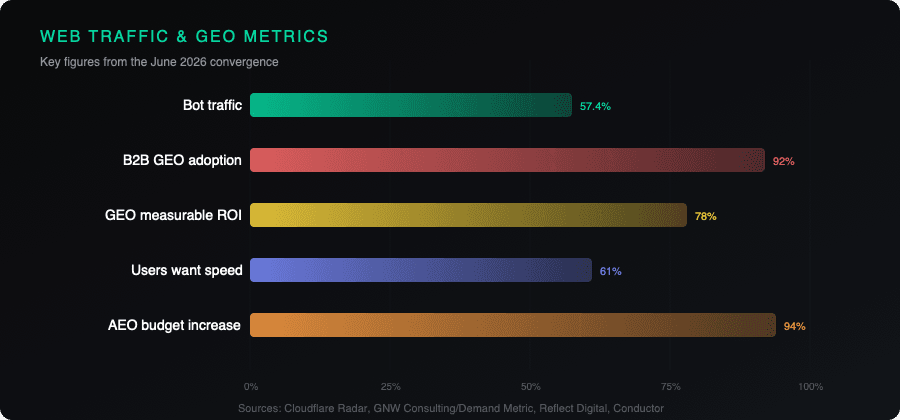
Cloudflare says bots are 57.4% of web traffic. 92% of B2B orgs are running GEO programs. Users are outsourcing search decisions to AI. Three data points, one conclusion.
By Springvanta
Three things happened in the same week, and together they tell you more about where the web is headed than any single one of them could.
First, Cloudflare CEO Matthew Prince posted on X that bot traffic had officially surpassed human traffic for the first time in internet history. Cloudflare's Radar dashboard puts bots at 57.4% of all HTTP requests. Prince had been predicting this crossover for late 2027. We hit it in June 2026, eighteen months early.
Second, a new study from GNW Consulting and Demand Metric found that 92% of B2B organizations are now experimenting with or actively running GEO (Generative Engine Optimization) programs, and 78% of those investing report measurable ROI.
Third, Search Engine Land published a piece on "delegation search" — the idea that users are no longer using search to retrieve information. They're outsourcing decisions to AI, asking it to compare, recommend, and narrow things down.
Separately, these are data points. Together, they describe a web that's being rebuilt around a fundamentally different assumption: most of your visitors aren't human anymore, and the humans who remain are increasingly asking AI to visit websites on their behalf.
Bots are the majority now
The Cloudflare numbers are worth sitting with. 57.4% bot traffic versus 42.6% human. During any given day, bots account for somewhere between 52% and 62% of all requests. Prince told NBC News he's "stunned by the rate of growth."
The driver isn't scrapers or search crawlers in the traditional sense. It's agentic AI — bots acting on behalf of users. A human shopping for a camera might visit five websites. The AI agent doing the same task visits 5,000. HUMAN Security's 2026 State of AI Traffic report found AI-driven traffic growing eight times faster than human traffic across 2025. Agentic AI made up 1.7% of automated traffic at the start of last year. By December, that category had grown 8,000%.
This has real implications for anyone whose business model depends on human attention metrics. Bot visits don't generate pageviews, session times, or conversion events the way analytics platforms expect. An AI assistant visiting 5,000 URLs on someone's behalf produces zero human impressions. Programmatic ad pricing, conversion rate benchmarks, traffic-based KPIs — all of these were built for a human-majority web.
Thales's 2026 Bad Bot Report adds a security wrinkle: 40% of all internet traffic is now classified as malicious bots, and AI agents operating maliciously are behaviorally indistinguishable from legitimate ones. Only half a percentage point separates benign from malicious automation rates, according to HUMAN Security. The old "bot or not" binary doesn't work anymore.
Delegation search is the behavioral flip
Meanwhile, human users aren't just clicking less. They're asking AI to do the browsing for them.
Becky Simms at Search Engine Land describes this as "delegation search." Instead of opening multiple tabs, comparing sources, and cross-referencing reviews, users ask AI to synthesize, recommend, and narrow down. Search behavior is shifting from retrieval to decision outsourcing.
Reflect Digital's SearchPulse research found that 61% of AI tool users cite speed and ease as their primary motivation. They're not looking for every possible answer. They want confidence that the answer is sufficient, delivered faster.
This isn't uniform across all searches. Someone planning a Tuscany itinerary might delegate the whole thing to AI ("five days, wine tasting, scenic towns, minimal driving"). But choosing the vacation itself may still involve browsing and visual exploration. Delegation is contextual. It depends on the task, the audience, and how much cognitive load the user wants to shed.
The implication for content strategy: you now need two types of content. Search-support content for humans who are still exploring (comprehensive, detailed, comparison-heavy). And decision-support content for AI systems making recommendations (synthesized, structured, clear about who it's for and why). Most businesses have plenty of the first and almost none of the second.
B2B is moving fast on GEO
The GNW Consulting and Demand Metric study, published June 3, surveyed 225 B2B marketing and revenue leaders. The headline numbers: 92% are experimenting with or operationalizing GEO. 78% of those investing report measurable ROI. Organizations allocating more than 5% of marketing budget toward GEO reported even higher returns.
Other findings from the study:
- 88% of SEO agencies now claim to offer GEO services, but 37% describe those services as "loosely defined"
- 22% of respondents say AI-driven traffic accounts for more than 5% of total website traffic, well above the commonly cited industry benchmark of under 1%
- Fewer than 15% of organizations have a dedicated GEO owner, despite widespread activity
The Presenc AI State of GEO 2026 report adds context: GEO budgets grew 340% year-over-year from 2025 to 2026. The average monthly spend across all company sizes is $4,200. Tool spending accounts for only 22% of that. The bulk goes to content creation (34%) and agency fees (28%).
Conductor's State of AEO/GEO report found that 94% of enterprises plan to increase AEO investments in 2026, and visitors from LLMs convert at twice the rate in one-third the number of sessions compared to traditional channels.
What this means in practice
If you're running a business that depends on web visibility, here's where the three threads converge.
Your website now serves two audiences: humans who are exploring and AI agents who are deciding. The humans are a shrinking share of your traffic. The agents are the ones increasingly influencing what gets purchased.
The GEO data suggests this isn't theoretical anymore. B2B companies are investing real budget and getting real returns. The median ROI across industries is 3.2x within the first 12 months, according to Presenc AI's cross-industry analysis of 318 companies. SaaS and e-commerce see payback in under six months.
But there's a gap between activity and structure. Most organizations don't have a dedicated GEO owner. Agencies are offering "loosely defined" services. And the content audit that Search Engine Land recommends — asking "if an AI landed on this page, would it understand what we recommend and who it's for?" — is something most businesses haven't done.
Cloudflare's Prince has called this transition comparable to desktop-to-mobile, except "mobile took a decade; this is taking months." He's also betting on a new business model: charging bots for content access, which could make the web free for humans again. Cloudflare already blocked over 416 billion AI bot requests at site owners' request and launched Pay Per Crawl for publishers who want to monetize scrapers.
The practical takeaway isn't complicated, even if the execution is. You need content that AI agents can parse, structure, and recommend. You need to track visibility in AI answers, not just search rankings. And you need to assume that a growing chunk of your "traffic" will never see your carefully designed landing pages, because an agent read them on someone's behalf and summarized the answer in a chat window.
Sources: