Coding Agents Leave the Terminal. Three Platforms Embed Them in 48 Hours.
GitHub Agentic Workflows, Linear coding sessions, and OpenAI's Ona acquisition all landed in 48 hours. Coding agents are becoming embedded infrastructure.
By Springvanta
Three things happened between June 11 and 12 that add up to a single shift: coding agents moved out of standalone tools and into the platforms where teams already work.
GitHub shipped Agentic Workflows in public preview — coding agents running inside GitHub Actions, triggered by Markdown files, sandboxed behind a compile step. Linear launched coding sessions — its agent now writes code using Claude Code and Codex, resolving about 30% of incoming bugs on the first pass. And OpenAI acquired Ona (formerly Gitpod) to run Codex inside the customer's own cloud, keeping data, credentials, and audit trails under the customer's control.
Separately, these are product announcements. Together, they mark the point where coding agents stopped being a tool you open and became infrastructure you configure.
GitHub: agents inside Actions, compiled like code
GitHub Agentic Workflows has been in closed technical preview since February. Public preview opened June 11 to all Copilot subscribers.
The mechanism is straightforward. You write a .md file in .github/workflows/ describing what you want in natural language — issue triage, CI failure analysis, documentation updates, test coverage monitoring. Then you run gh aw compile, which converts your Markdown into a deterministic Actions YAML lockfile (.lock.yml). The lockfile is the contract: the agent operates within the boundaries it defines and cannot rewrite it at runtime.
GitHub principal researcher Eddie Aftandilian called it "Continuous AI" — the agentic evolution of continuous integration. CI automated builds. CD automated deployments. This automates the judgment calls.
The security model separates agent intent from execution. Agents get read-only permissions by default and run inside a sandboxed container behind what GitHub calls the Agent Workflow Firewall. No personal access token is required anymore — the workflow uses COPILOT_GITHUB_TOKEN natively.
Four agent engines are available: Copilot, Claude (via ANTHROPIC_API_KEY), Codex (via OPENAI_API_KEY), and Gemini (via GEMINI_API_KEY). Teams already committed to Anthropic or Google contracts don't have to switch.
Start with issue triage. It's low-stakes, high-visibility, and the kind of reasoning-heavy task where agents outperform scripts.
Linear: 30% of bugs fixed before an engineer sees them
Linear's progression is methodical. Linear Agent launched in March for planning and coordination. Code Intelligence came in May. MCP support followed in April. Coding sessions, launched June 11, close the loop: the agent can now write code using Claude Code and Codex.
You start a session by assigning an issue to Linear, or asking for a change in a chat, comment, or Slack thread. The session pulls in issue details, history, customer requests, and related work. When the change is ready, Linear returns a diff for review with shareable preview links.
The internal number that matters: Linear says it resolves roughly 30% of incoming bug reports this way, mostly on the first pass. The agent gathers evidence from Sentry or Datadog through MCP, traces the root cause, and produces a fix before the issue reaches an engineer.
Coding sessions are available on Basic, Business, and Enterprise plans, requiring a GitHub connection and AI credits.
OpenAI + Ona: the enterprise trust problem
OpenAI acquired Ona (formerly Gitpod) on June 12, folding the German company's secure cloud development platform into Codex. Terms were not disclosed.
The acquisition addresses a specific enterprise objection: agents with write access to production code need somewhere to run that the enterprise controls. Ona's "customer-controlled execution" lets agents run inside the company's own cloud. OpenAI provides the intelligence; the customer keeps the data, credentials, and audit trail.
Codex has 5 million weekly active users, up 400% since early this year. The work is getting longer — codebase modernization and vulnerability patching stretch from minutes to hours or days. Those long jobs need persistent cloud environments where the agent keeps working after the developer closes the laptop.
Ona co-founder Johannes Landgraf: "Agents need more than intelligence; they need a trusted workspace."
The timing is not accidental. Both OpenAI and Anthropic filed confidentially for IPO in the same week. Enterprise credibility feeds the investor story.
Why this convergence matters
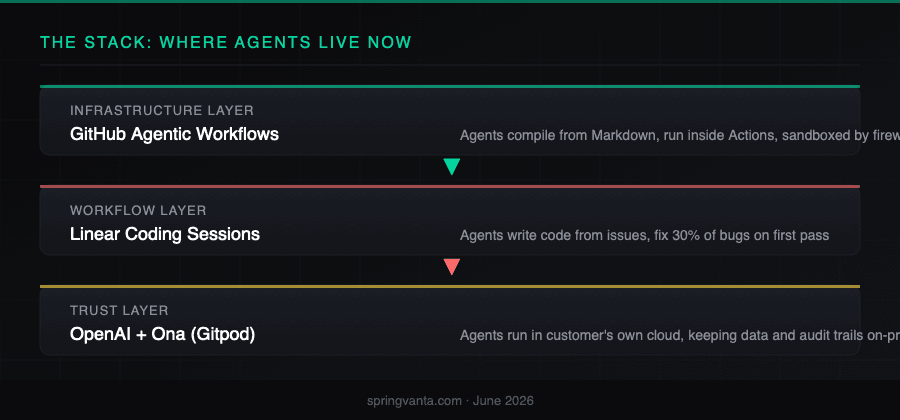
Each announcement targets a different layer:
- GitHub embeds agents in CI/CD, the infrastructure layer
- Linear embeds agents in project management, the workflow layer
- OpenAI/Ona embeds agents in the enterprise cloud, the trust layer
The pattern is consistent. Coding agents are becoming embedded infrastructure rather than standalone applications. Teams don't open a separate tool to use them — the agent is already wired into the system where the work happens.
For teams evaluating AI coding tools, the question is shifting. It's no longer "which agent should I use?" but "which platform should I wire agents into?" The agent is becoming a commodity layer. The platform that holds your issues, code, and deployment pipeline is where the lock-in happens.
Sources: GitHub Changelog, ByteIota analysis, Linear Changelog, The Next Web, GitHub Blog