Agent-Scale Coding Broke the Infrastructure: Cursor Origin vs Claude Code
Cursor rebuilt Git for thousands of agents. Claude Code shipped five releases of safety guardrails. Same 72-hour window, same problem.
By SpringVanta
Cursor bet $60 billion that the next bottleneck in AI coding isn't the model. It's the Git server. Three days of Claude Code releases prove Anthropic agrees — they just chose a different fix.
Two things happened in the same 72-hour window this week. Cursor detailed its plan to build a new version control platform called Origin, designed for thousands of AI agents hammering the same repository simultaneously. And Claude Code shipped five releases — v2.1.183 through v2.1.191 — almost entirely focused on stopping autonomous agents from causing damage when they run unsupervised.
One company is rebuilding the pipes. The other is installing circuit breakers. Both started from the same observation: infrastructure designed for human-paced development breaks when agents work at machine speed.
Cursor Origin: a Git forge where agents are the primary user
At Cursor's Compile conference on June 16, co-founder Tomas Reimers demoed Origin, a Git-compatible code hosting platform built on the Graphite acquisition. The pitch was blunt: what if the primary users of your version control system are no longer human?
Git was designed around human cadence. You write for an hour, push, open a pull request, someone reviews it the next morning. Cursor's argument is that agentic coding broke that cadence. When dozens of background agents commit in parallel, the bottlenecks move, and a forge tuned for human review throughput starts to creak.
The demo leaned hard on throughput numbers. A single repo absorbed 22.6 commits per second. Around 296,000 clones per hour. About 81,000 pushes per hour. Global sync latency under 400 milliseconds. Automatic failover in about 10 milliseconds.
Read those as staged benchmarks on a purpose-built demo repo, not promises about your monorepo on a bad day. They are still a useful signal of what Origin optimizes for. GitHub does not advertise "commits per second" because nobody was asking a human team to commit 22 times a second.
The architecture puts S3 object storage underneath Git, with NVMe-based fileservers in front for speed and what Cursor calls "infinite replicas" for global sync. If a fileserver dies, another replica is already warm. The 10ms failover claim comes from that design.
The genuinely interesting part is the interface. Origin exposes an API and an MCP server, so an agent can operate the forge directly: open a pull request, read review state, resolve a conflict, retry a failed build. The agent gets a structured, machine-readable way to ask "what's blocking this PR?" and act on the answer. Review and merge state become something a machine reads and edits, not just something a human clicks through.
There is no pricing yet, no general-availability date past "this fall," and no published security or data-handling terms. The waitlist is at cursor.com/origin.
The 1.5 trillion parameter elephant
Cursor also confirmed it is training its first fully self-built model from scratch — 1.5 trillion parameters, pre-trained on xAI's Colossus supercomputer cluster in Memphis using over 100,000 GPUs. Every prior Cursor model was built on an open-source base (Kimi K2.5 from Moonshot AI). This one starts from a blank initialization, meaning Cursor controls the entire training pipeline.
Co-founder Michael Truell said the model is "on par with Opus and GPT in size" and uses 10-20x more compute than any previous Cursor model. It is designed to work beyond coding. Training is underway, with shipping expected within weeks.
The model matters, but it is not the interesting bet. If you already have access to Colossus-scale compute, training a frontier model is expensive but well-understood. Building a new version control system and betting that developers will move their source code to a platform owned by xAI through SpaceX's acquisition — that is the contrarian move. The model is the expected play. Origin is the one that changes the game.
Claude Code's reliability wave: circuit breakers for autonomous agents
While Cursor rebuilds the infrastructure, Claude Code spent the same week hardening what happens when autonomous agents run inside it. Five releases between June 20 and June 24, each addressing a different failure mode that emerges when agents operate without supervision.
v2.1.183 shipped the most consequential change: destructive Git commands are now blocked by default in auto mode. git reset --hard, git checkout -- ., git clean -fd, and git stash drop are blocked when you did not ask to discard local work. git commit --amend is blocked when the commit was not made by the agent this session. terraform destroy, pulumi destroy, and cdk destroy are blocked unless you named the specific stack. This is not a permission prompt — the commands simply do not execute.
v2.1.187 added sandbox.credentials, a setting that blocks sandboxed commands from reading credential files and secret environment variables. If an agent is running inside a sandbox and tries to read ~/.aws/credentials or an API key from the environment, the sandbox now refuses. The release also added org-configured model restrictions: administrators can pin specific models in the picker, CLI flags, and environment variables, with a "restricted by your organization's settings" message when a user tries to select a locked model.
The same release fixed a problem that will sound familiar to anyone running agents at scale: remote MCP tool calls that hang for five minutes with no response. They now abort with an error instead of blocking indefinitely. There is an override via CLAUDE_CODE_MCP_TOOL_IDLE_TIMEOUT.
v2.1.191, shipped June 24, fixed background agents resurrecting after being stopped. Previously, stopping an agent from the tasks panel did not always stick — the agent would come back. The fix makes stopping permanent. The release also added /rewind, which lets you resume a conversation from before a /clear was run, and reduced CPU usage during streaming responses by about 37% by coalescing text updates to 100ms intervals.
Put together, these releases form a pattern. Each one addresses something that breaks specifically when agents run autonomously at scale — not when a developer types a command, but when an agent decides to type one. Blocking destructive Git commands, isolating credentials from sandboxed processes, pinning models at the org level, killing MCP calls that hang, and making sure stopped agents stay dead. These are circuit breakers.
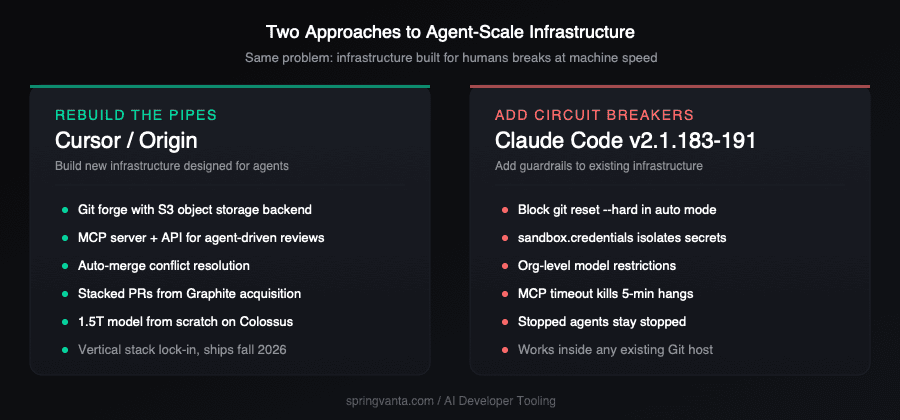
Two philosophies, one problem
Cursor and Anthropic identified the same problem from different angles. When you have dozens or hundreds of AI agents writing code simultaneously, the infrastructure around them was not designed for that load. The question is what you do about it.
Cursor's answer is to build new infrastructure. If Git hosting breaks under agent traffic, build a Git host that does not. If review workflows bottleneck at machine speed, build an API and MCP server so agents can drive the review process directly. The bet is vertical: own the model, the editor, the Git platform, and the mobile management surface. Accept the lock-in concerns and the unanswered security questions in exchange for a stack where every layer was designed for agents from the start.
Claude Code's answer is to add guardrails to existing infrastructure. If agents sometimes run git reset --hard when you did not ask, block it. If sandboxed commands can read your credentials, isolate them. If MCP servers hang, time them out. If background agents will not stay stopped, fix the lifecycle. The bet is horizontal: make Claude Code safe enough to run inside whatever Git platform, CI system, and cloud provider you already use. No migration, no new hosting relationship.
Neither approach is wrong. Cursor's vertical integration will produce a smoother experience for teams that commit to the whole stack. Claude Code's guardrail approach will work for the majority of organizations that are not moving off GitHub or GitLab this quarter. The market will probably split along exactly that line: teams building their workflow around Cursor end to end, versus teams running Claude Code inside an existing infrastructure footprint.
What to check before you scale agents
If you are running or evaluating AI coding agents at any volume, three questions from this week's releases are worth asking:
Can your version control handle the load? If you plan to run 10+ agents in parallel against the same repo, your Git server is going to feel it. Origin is not available yet, but the question is real today. Monitor clone times, push latency, and merge conflict frequency under agent load.
What destructive operations can autonomous agents execute? Claude Code now blocks git reset --hard and infrastructure destroy commands by default. If your agent platform does not have equivalent guardrails, find out what happens when an agent decides to clean up "unneeded" branches or retry a failed deployment by destroying and recreating infrastructure.
Who can read your credentials from inside a sandbox? The sandbox.credentials setting exists because Anthropic discovered sandboxed commands could read secret files. Check whether your current agent setup isolates credentials from sandboxed processes, or whether an agent running a test script can accidentally exfiltrate API keys.
Cursor Mobile: the control surface
The third piece of Cursor's announcement was Cursor Mobile, an iOS beta that lets you manage cloud agents from your phone — unblock stuck tasks, review screenshots, and remotely control agents running on your local machine. It is essentially a control panel for the fleet, which is the right framing. If agents are going to run in the background while you are away from your desk, you need a way to intervene from wherever you are. Claude Code has been building toward the same thing with its background agents panel and claude agents CLI.
The mobile angle is small compared to Origin and the safety features. But it reflects the same shift: agent development is becoming a fleet management problem, not a coding session problem.
Sources: The Decoder, TechTimes, Logic Decode, Developers Digest, Claude Code GitHub releases, Claude Updates