Databricks Agent Bricks: building agents is 1% of the work
Databricks shipped Agent Bricks at DAIS 2026. Dataiku launched Cobuild. Claude 4 retired. The infrastructure around agents is now the product.
By SpringVanta
Three things happened in the same 72-hour window this week, and together they say something specific about where AI agent adoption stands.
On June 15, Anthropic retired Claude Sonnet 4 and Opus 4. If your production agent was pinned to either model ID, it stopped working. No grace period, no redirect. The next morning, Databricks used its Data + AI Summit keynote to relaunch Agent Bricks as a full developer platform for building and operating agents. The same day, Dataiku announced Cobuild, an AI agent that builds governed data projects for business teams.
Each is a story on its own. Together they sketch the actual shape of the agent market in mid-2026: the model call is the easy part. Everything around it is where teams stall.
Databricks Agent Bricks: the platform play
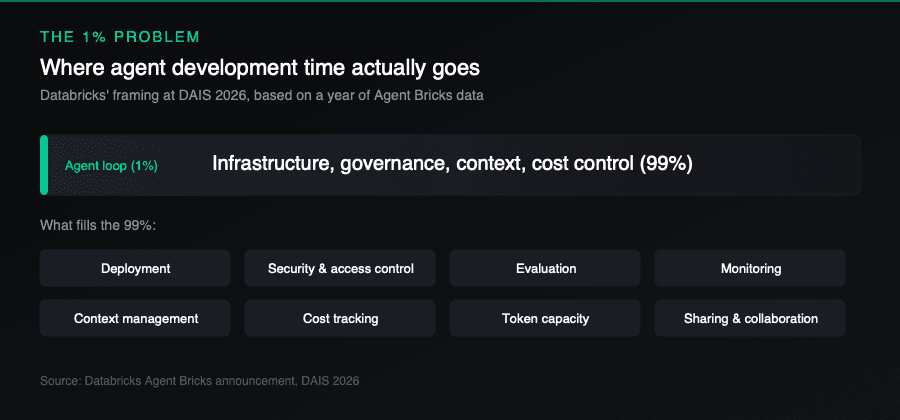
Databricks launched Agent Bricks at DAIS 2025 as a way to build agents that reason over your data. A year later, they are calling it a comprehensive developer agent platform and framing it around a claim that resonated with me: the core agent loop, the part where the model decides what to do next, is about 1% of the work. The other 99% is what they call hidden technical debt. Deployment. Security. Evaluation. Monitoring. Context management. Cost tracking.
That framing checks out. You get a prototype working in an afternoon. Then you spend weeks on token budgets, access controls, evaluation harnesses, and figuring out why the agent occasionally deletes things it should not touch.
Agent Bricks organizes the platform around three pillars: choice, context, and control.
Choice: models and harnesses
Agents need different models for different subtasks. A frontier model for complex reasoning, a cheaper fast one for classification. Agent Bricks supports OpenAI, Anthropic, Gemini, Qwen, and now Kimi and Grok via a SpaceX partnership. You can also train custom models on your enterprise data using reinforcement learning. Databricks claims an RL-trained custom data agent matches Opus and Sonnet quality on internal Genie benchmarks at a fraction of the cost per query.
On the harness side, Agent Bricks supports any framework: LangGraph, Agno, CrewAI, Claude Code SDK, OpenAI Agent SDK. They also open-sourced Omnigent, a meta-harness that orchestrates multiple agent frameworks under a single control plane. If your team uses three different agent frameworks by accident rather than design, Omnigent is trying to manage them together.
Context: the hard problem
This is the most interesting part of the announcement. Databricks added MCP support to Unity Catalog, so agents can connect to Google Drive, JIRA, Slack, and GitHub through governed tool calls instead of ad-hoc API integrations. A new component called Genie Ontology continuously builds a knowledge graph from your data, learning what "churned customer" means in your business, when your fiscal year starts, who runs sales. The agent memory service persists context across sessions via Lakebase. Databricks Sandbox spins up secure VMs with downscoped data access for code execution and subagent isolation.
The MCP-in-Unity-Catalog move is significant on its own. MCP servers have proliferated fast, but most teams run them with no governance, no access control, and no audit trail. Putting them under Unity Catalog means every tool call your agent makes flows through the same permissioning system that governs your data warehouse. That is not a sexy feature. It is the kind of thing that prevents a data breach.
Control: governance and cost
Unity AI Gateway is the governance layer. Catalog every agent, model, MCP server, and skill. Configure fine-grained access controls. Monitor cost and enforce per-user budgets. Route traffic based on reliability or budget policies.
The contextual policies feature lets you write rules in SQL. If an agent accesses customer data containing PII, prevent publishing it to a website. Allow emailing it to a coworker. Require human approval before updating Salesforce. These policies hold state and react to the specific data and context of each request, not just static allow/deny rules.
One pricing detail worth noting: Genie, the business-team-facing product built on Agent Bricks, has no seat-based pricing. Organizations get $10 free per user per month and pay only for actual usage. That is a shot across the bow at the per-seat SaaS model that most enterprise AI tools still charge.
Dataiku Cobuild: governed building for business teams
Databricks is targeting developers building agent infrastructure. Dataiku is aiming at the other end of the building: business teams who want AI projects without writing code or sidestepping governance.
Cobuild, announced June 16 and generally available June 18, takes a plain-language business objective and turns it into a complete Dataiku project. Data pipelines, ML models, agents, and apps, all rendered as a visual flow that stakeholders can inspect before anything reaches production. It runs within Dataiku's existing governance framework and connects to Snowflake Cortex, OpenAI, Anthropic, Bedrock, Gemini, Microsoft Foundry, and Databricks AI Gateway.
The positioning from Dataiku CTO Clement Stenac was pointed: "AI-assisted development only matters if the output can survive contact with the enterprise." That is a critique of the gap between code-generation tools, which produce output that governance teams cannot review, and standalone agent builders, which produce prototypes that live outside enterprise infrastructure.
Pfizer's Neil Patel backed this up from the buyer side. In pharma, the output has to be "explainable, auditable, and safe to put into production." Not just impressive.
The Claude 4 retirement: a forced migration
While Databricks and Dataiku were announcing platforms, anyone running Claude in production had a more immediate problem. On June 15, Anthropic retired claude-sonnet-4-20250514 and claude-opus-4-20250514. API calls to those model IDs now return errors. The recommended replacements are claude-sonnet-4-6 and claude-opus-4-8, the latter being Anthropic's current flagship with a 1M token context window, 128k output tokens, and adaptive thinking.
This is standard Anthropic practice. Sixty days notice, then hard cutoff. But it illustrates the exact problem Agent Bricks and Cobuild are built to solve. If your agent was pinned to a specific model string in a config file or routing layer, it broke on June 15. And the fix is not just changing the string. Opus 4.8 dropped support for temperature, top_p, and top_k parameters. Code that sets those returns 400 errors.
TheRouter.ai noted that Anthropic has retired eight Claude models in twelve months. The cadence is predictable: new generation ships, previous generation gets a 60 to 90 day window, then shutdown. OpenAI follows a similar pattern. This is the new normal, and it is exactly why abstraction layers like Unity AI Gateway and Dataiku LLM Mesh exist. They let you swap model strings without touching application code.
What to do with this
If you are evaluating AI automation for your business, the signal from this week is straightforward. The model is a commodity input. The infrastructure around it is the actual product, and vendors are finally building platforms to handle it.
Three questions worth asking before your next agent project:
-
Where does governance live? Can you audit what your agents accessed, what they produced, and what they cost, broken down per user and per team? If the answer is no, you are running ungoverned agents, and the first incident will be expensive.
-
How do you handle model rotation? If a model gets retired tomorrow (and it will), can you swap it without touching application code? If your model ID is hardcoded in a config file, you are one retirement away from a production incident.
-
Where does context come from? Is your agent reasoning over governed enterprise data, or guessing from whatever documents it can find? The difference between a useful agent and a confident liar is usually the quality of the context it operates on.
Sources: Databricks Agent Bricks blog, Databricks Genie One press release, Dataiku Cobuild announcement, Anthropic model deprecations, TheRouter.ai migration guide.