Five Platforms, Five Days: AI Agents Ate the Front Office
Microsoft, HubSpot, Salesforce, Coldi, and Capacity all shipped AI agent features for support, CRM, and lead qualification in the same week. Here is what changed.
By Springvanta
Between May 21 and May 26, five companies shipped AI agent features aimed at the same narrow target: front-office work. Microsoft made computer-using agents generally available in Copilot Studio. HubSpot declared its CRM an "agentic customer platform." Salesforce rolled out Agentforce Coworker across every surface its customers touch. Coldi launched a turnkey voice agent stack for outbound lead management. Capacity shipped an AI analytics assistant for CX teams.
None of these are demos. All of them run in production.
Something shifted this month. The agent conversation moved from "what if" to "which one." If your business runs customer support, lead qualification, intake, or CRM operations, these launches are not hypothetical anymore.
Microsoft Copilot Studio: agents that click through legacy apps
Microsoft's May update to Copilot Studio is the most technically interesting of the bunch. Computer-using agents, now generally available, can operate websites and desktop applications through the user interface. Not through APIs. Through the actual screen.
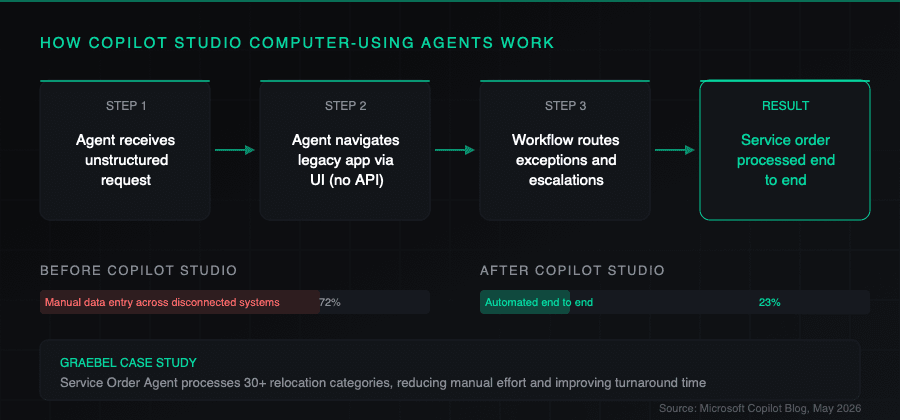
This matters because most enterprise software still lacks APIs. Graebel, a global relocation company, processes thousands of employee relocation requests each year. Their proprietary Global Connect platform has no API. Before Copilot Studio, they tried traditional automation and it broke constantly because relocation requests arrive as unstructured emails with unique edge cases.
Graebel's Service Order Agent now reads incoming emails, validates them against business rules, operates Global Connect directly through its UI, and escalates exceptions through workflows. It handles 30+ relocation service categories. Matt Brownlee, Graebel's CRO, said it reduced manual effort and improved turnaround consistency.
Copilot Studio also shipped real-time voice agents (GA in North America through Dynamics 365 Contact Center), a redesigned visual workflow builder, and Work IQ extensibility via REST API and MCP server support. The new orchestration layer improved evaluation performance by roughly 20% while cutting token consumption by 50%, according to Microsoft's usage data.
The voice agents can identify callers, answer questions, take actions mid-conversation, and hand off to live agents with full context preserved. Microsoft published a governance guide alongside the release, covering escalation testing, monitoring, and compliance.
HubSpot: context as the platform
HubSpot CEO Yamini Rangan published a post on May 22 that framed the problem differently than most vendor announcements. "It writes great emails," her customers tell her. "But are they converting?" Not really.
Her argument: AI without business context produces generic output. The agentic customer platform she described has three layers: a context layer (Smart CRM with 250,000 companies' data), an action layer (Marketing, Sales, and Service hubs plus Breeze agents), and a coordination layer (agent management with @mentions and task assignment).
The positioning is worth paying attention to. HubSpot is arguing that the AI model itself is becoming a commodity, and the real value lives in the proprietary data and context the platform holds. Breeze agents can research accounts, enrich data, answer support questions, and qualify leads. Breeze Assistant acts as a go-to-market expert for every employee.
Whether the execution matches the vision is an open question. But the framing, that context is the moat, is something any business evaluating AI tools should think about.
Salesforce: Agentforce Coworker goes cross-surface
Salesforce dropped two things at once. The Summer '26 release (shipping June 15) includes multi-agent orchestration, 50+ out-of-the-box IT service agents deployed in Slack, Teams, and IT Service Desk, and Tableau MCP for letting AI agents query analytics directly.
Separately, on May 21, Marc Benioff launched Agentforce Coworker in beta. Coworker embeds inside Salesforce, Slack, Microsoft Teams, ChatGPT, and mobile. It reads across CRM, ERP, and support systems and answers questions that, according to Salesforce community leader Andrew Russo, previously took "45-60 minutes of swivel chairing."
The timing is not subtle. Salesforce reports earnings on May 27, four days after launch. But the product is real: APQC research puts the average knowledge worker's information-search time at 1.8 hours per morning. If Coworker recovers even a fraction of that, the ROI calculation changes.
Coldi and Capacity: the specialists
Not every launch came from a platform giant.
Coldi, a voice communications company, launched a full-stack outbound platform on May 26. It combines AI voice agents with complete telecom infrastructure, global carrier coverage, and what they call a Campaign Brain: an outbound engine that handles dial timing, timezone logic, voicemail detection, retry cadence, and DNC compliance.
Most voice AI tools give you the agent and leave you to figure out the telephony yourself. Coldi's bet is that outbound calling at scale fails not because the AI voice sounds bad, but because the orchestration around it breaks. Lead prioritization, attempt history, CRM integration edge cases. The platform includes analytics like "Attempts Breakdown" and "Calls heatmap" to surface where conversion actually happens.
Capacity, a CX automation platform, launched an AI Analytics Assistant on May 26. It lets CX and operations leaders ask questions about interaction data in natural language and get charts and reports back instantly. Questions like "Why did call volume spike last Wednesday?" or "What issues are driving the most escalations?" The assistant draws from transcripts, ticket metadata, workflow performance, and bot usage data. It can pin outputs to dashboards, export as PDFs for QBRs, and schedule automated report delivery.
What the convergence means
Five companies. Five days. All targeting the same layer of work: intake, support, qualification, and CRM operations.
Microsoft is betting on UI-level automation for legacy systems. HubSpot is betting on context as the differentiator. Salesforce is betting on cross-surface ubiquity. Coldi is betting on outbound orchestration. Capacity is betting on analytics access.
None of these are mutually exclusive. A mid-size company could reasonably run Copilot Studio for legacy system automation, HubSpot for CRM and marketing, and Coldi for outbound voice. The question for buyers is no longer "should we use AI agents?" It is "which processes, on which platform, with what guardrails?"
If you are evaluating intake automation, voice AI, or CRM agent features right now, you have more production-ready options than you did a month ago. The hard part is choosing.
Sources: