Google Reports AI Impressions Without Clicks. Microsoft Builds Search for Agents.
Google's new GSC AI report shows impressions but no clicks. Microsoft's Web IQ builds a search engine for AI agents. Both launched within 48 hours. Here's what it means for your search strategy.
By Springvanta
Two things happened in the first week of June 2026 that describe where AI search is headed. They landed 48 hours apart, and they pull in opposite directions.
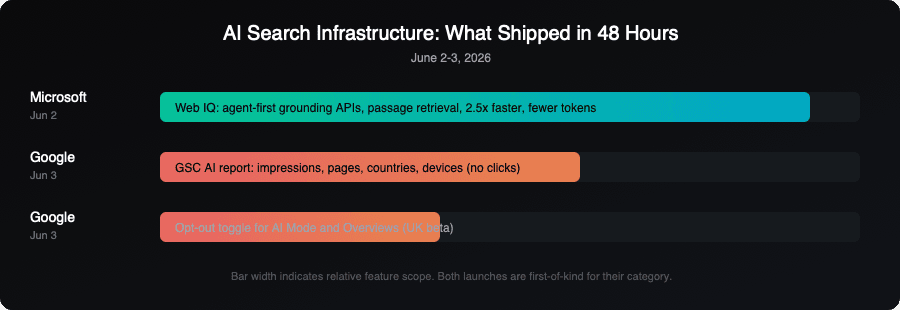
On June 2, Microsoft launched Web IQ, a search engine built for AI agents. On June 3, Google rolled out a new Search Console report showing website owners how often their pages appear in AI Mode and AI Overviews, but without any click data to go with it.
One company is building infrastructure so agents can search the web without human help. The other is giving site owners a dashboard to watch it happen. Together, they sketch the new shape of search: one system for machines, one set of reports for the people who used to own the traffic.
What Microsoft's Web IQ actually does
Web IQ is a suite of grounding APIs built on Bing's index, rebuilt from scratch for how AI agents search. The existing Bing search APIs that Copilot and ChatGPT originally used were built for humans: type a query, get ranked results, pick one. Agents work differently. They fan out across dozens of queries in a single session. They pull passages from documents rather than clicking through to pages. They need speed and token efficiency more than they need a ranked list of blue links.
Jordi Ribas, President of Search and AI at Microsoft, told Search Engine Land that the entire stack was re-architected, from indexing to retrieval to passage selection, to match how agents operate. The system returns passages rather than full pages. Microsoft claims it runs roughly 2.5x faster than the next best alternative and uses fewer tokens per call. "Fewer tokens in, better answers out, lower cost per call" is how the company puts it.
Web IQ is already live inside Microsoft Copilot and ChatGPT. Access is currently limited to large platforms, with a waitlist for broader availability.
This matters because it confirms something the SEO industry has been debating in abstract terms for months: AI agents search differently from humans, and the infrastructure to serve them specifically is now shipping. The "agentic web" is not a concept on a slide deck. The API layer for it launched this week.
What Google's new AI report shows, and what it hides
Google's Search Generative AI performance report landed in Search Console on June 3. For the first time, site owners can see how often their URLs appear inside AI Mode and AI Overviews, broken down by page, country, device, and date. The data goes down to hourly granularity. There are dedicated views for Search and for Discover.
The catch: there is no click data. No average position. No CTR. No query-level breakdown. The report tells you when your pages showed up in AI-generated responses. It does not tell you whether anyone visited your site because of them.
A Google spokesperson told Search Engine Land the team is "continuing to work with website owners to understand what insights will be most helpful to inform their strategies, and we'll introduce additional metrics over time." Clicks may arrive later. For now, impressions only.
Google also began testing an opt-out toggle that lets site owners block their content from appearing in AI Mode and AI Overviews. The company says opting out will not affect traditional organic rankings. The toggle is rolling out to a subset of UK site owners first, with broader availability planned.
Why these two launches belong in the same conversation
Both companies are responding to the same shift. AI search is now large enough to need its own measurement layer and its own infrastructure, and both arrived within 48 hours.
Google's AI Overviews has over 2.5 billion monthly active users. AI Mode surpassed 1 billion monthly users. These are Google's own figures, and even if the counting methodology inflates the numbers somewhat, the scale is real. When more than a billion people get answers from AI-generated summaries, the old assumption that search equals click-through breaks down fast.
Microsoft's Web IQ addresses the other side. If agents are doing the searching instead of humans, the entire feedback loop changes. Agents do not click ads. Agents do not browse. Agents extract information and move on. The web was not built for this, and Microsoft is one of the first companies to explicitly build for it.
For businesses figuring out their AI search strategy, the takeaway is direct: you need to measure AI visibility separately from organic search, and "visibility" now means "being cited by an AI system" rather than "ranking on page one." Google's new report gives you the visibility half. Web IQ is a signal that the traffic half is being redesigned for a different kind of user entirely.
What to do this week
If you run a website that depends on search traffic, here are the steps worth taking right now:
Check Search Console for the new AI report. It is rolling out to UK sites first, with broader access coming. If you have access, pull a baseline: which pages appear in AI features, where geographically, on which devices.
Pair the GSC data with GA4's AI Assistant channel. GA4 added a native channel group on May 13 that separates traffic from AI chatbots including ChatGPT, Gemini, and Claude. Together, the two tools give you a rough picture of "appeared in AI results" plus "got traffic from AI sources."
Do not rely on Google's report alone for cross-platform visibility. The report covers Google's AI surfaces. It will not tell you whether ChatGPT, Perplexity, or Claude are citing your content. Research from Passionfruit shows citation volumes can differ by orders of magnitude across platforms. If you are only tracking Google, you are missing most of the picture.
Think hard before opting out. Google's toggle lets you disappear from AI features without hurting traditional rankings. For subscription publishers and ad-funded content where summarization replaces the click, opting out might make sense. For most businesses, vanishing from AI surfaces is a bad trade. The brand exposure from being cited in AI responses is worth more than the click you lose.
Start structuring content in passage-sized units. Microsoft's Web IQ returns passages, not pages. AI agents extract specific answers from specific sections. If your content is structured so that a passage can stand on its own and answer a question without the surrounding context, it is more likely to be surfaced by agent-driven search.
Search is now two systems
AI search spent 2025 as a debate topic. The first week of June 2026 is when it started getting its own plumbing. Google built a dashboard. Microsoft built an API. Neither is finished: Google's report is impressions-only, and Web IQ access is still gated. But both companies are treating AI search as a separate system with its own rules, not an extension of the old one.
The businesses that learn to be visible in both systems: the one where humans click and the one where agents extract, and measure both independently, will have a real advantage over those still optimizing for the old feedback loop alone.
Sources: