Google's AI Search Opt-Out Arrives Without the Numbers to Use It
Google shipped a publisher opt-out for AI search and new GSC reports. But the click data publishers need to decide whether to stay is missing. Three moves this week show why the gap matters.
By Springvanta
Three things happened in the same week this June, and together they say more about where AI search is headed than any single announcement could.
On June 3, Google began testing a toggle in Search Console that lets website owners pull their content out of AI Overviews, AI Mode, and AI Overviews in Discover without affecting regular search rankings. The same day, the UK's Competition and Markets Authority imposed a conduct requirement on Google, legally obligating it to give publishers this kind of control. And Google rolled out new AI performance reports in Search Console, showing sites how often their pages appear inside AI-generated answers.
Then on June 4, Google CEO Sundar Pichai told the New York Times Hard Fork podcast that the transition from classic search to AI Mode is a "continuum," that "sources and links will always be there as part of it," and that Google would be "comfortable between a combination of subscription and ads" if people stop using the ten blue links entirely.
And on the same day Google's opt-out shipped, Similarweb published data showing ChatGPT ads have already hit $100 million in annualized revenue, with only 1.5% of ChatGPT conversations currently showing an ad. The AI search advertising market is projected to reach $26 billion by 2029.
Three different signals. One question underneath: can publishers make informed decisions about AI search participation when the data they need does not exist yet?
The opt-out, explained
Google's Search Console toggle is straightforward in concept. A website owner can exclude their entire domain from appearing in AI Overviews, AI Mode, and AI Overviews in Discover. Google says this will not affect regular organic rankings. Page-level controls are not available yet; the CMA has given Google until March 2027 to build those.
This is the first time there has been a clean mechanism to separate AI search visibility from traditional search visibility. Before this week, the Google-Extended tag let you opt out of AI model training, but your content could still surface in AI Overviews. The nosnippet tag affected AI Overviews and regular search at the same time. You could not pick one without losing the other.
The CMA's conduct requirement adds a regulatory backstop. Google must let publishers withhold content from AI features, clearly attribute domains in AI responses with clickable links, and not penalize sites that opt out. The requirement applies in the UK first, but Google says it plans to roll the controls out globally. The EU's Digital Markets Act and the DOJ's proposed antitrust remedies in the US cover similar ground.
The data problem
The opt-out gives publishers an exit door. The AI performance reports show what it would cost to walk through it. That framing comes from freelance SEO consultant Natalie Arney, who connected the two announcements on LinkedIn.
The problem is that the reports only show impressions. How often your pages appeared inside AI features, broken down by page and country. No clicks. No click-through rate. No revenue data. No way to see what queries triggered the appearance, or what happened after someone saw your content in an AI answer.
The CMA's interpretive notes explicitly list three types of data Google should provide: impressions, click-throughs (including a way to "assess their quality"), and click-through rate. The notes also say this data should be separated from organic search results. Google's reports cover the first category. The other two are absent.
SEO consultant Aleyda Solis noted that the reports do not "seem to include prompts / topics information or clicks data but it's a start." Joy Hawkins of Sterling Sky was more blunt: "I can only imagine why they wouldn't include clicks." Glenn Gabe captured the reaction: "AI reporting coming to GSC! Awesome! No click data. NOT Awesome."
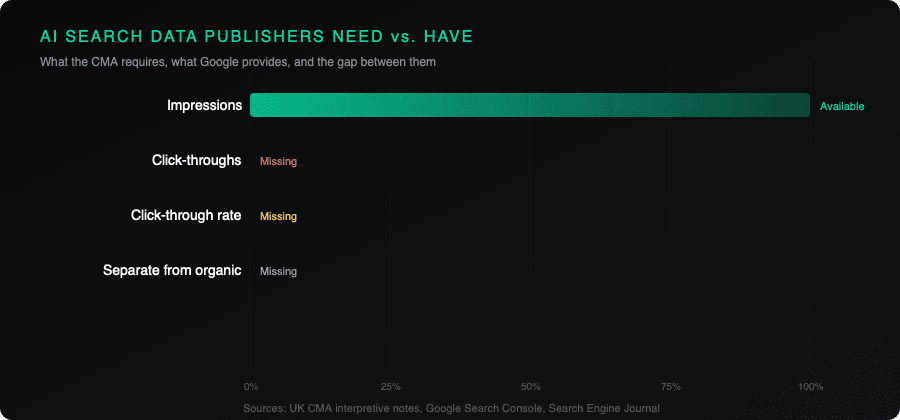
This is not a new complaint. Google has been adding more links to AI results for months without releasing click data. Google VP of Search Liz Reid has described AI Overviews as removing "bounce clicks" rather than useful traffic. Without click data, publishers cannot test that claim. The difference now is that the missing data sits inside a formal regulatory process, not just an industry feedback loop.
Pichai's "continuum"
In the Hard Fork interview, Pichai was asked directly whether Google would eventually "rip the band-aid off" and go full AI Mode. His answer was telling, even by careful CEO standards.
He called it a "continuum." He said people are "responding positively" and Google can "see it in the long-term metrics." He confirmed that "sources and links will always be there as part of it."
What he did not say is how those links will perform as referral traffic. And that is the gap that matters to every publisher and business relying on Google for visitors.
AI Overviews now has 2.5 billion monthly active users. AI Mode has surpassed 1 billion monthly users. A Pew Research Center study found that when an AI summary appears on a Google search page, users click traditional results at about half the rate they do without one: 8% versus 15%. Similarweb has measured zero-click rates of roughly 80% when AI Overviews are present.
Pichai's phrasing, "sources and links will always be there," is technically accurate. Links appear inside AI responses. But appearing in an AI answer and getting someone to click through to your site are two different things. Google is preserving the appearance of attribution while the economic value of clicks keeps dropping.
He also mentioned, perhaps for the first time, that Google could monetize the AI search era through "a combination of subscription and ads." That is a shift from the current model where search is free and ad-supported. Where it leaves publishers who built their businesses on Google referral traffic is an open question.
The AI search ad counterpoint
The day before Pichai's interview, Similarweb published extensive data on AI search advertising. The numbers are worth sitting with.
ChatGPT reached $100 million in annualized ad revenue less than two months after launching its advertising pilot. Only about 1,000 brands are active. Ads appear in just 1.5% of ChatGPT conversations globally, peaking at 2% on weekdays. Google AI Mode's ad penetration is even lower at 0.09%. The room for growth is enormous.
ChatGPT ads work differently than anything in traditional search. 83% of the prompts that trigger an ad would never trigger a Google Shopping ad, because the last message before the ad fires is often a single word or a conversational reply. The platform reads the entire conversation, not just the last query. Only 44% of ads fire on the first turn; 56% appear deeper, once intent has developed.
The performance numbers are real. Overall CTR sits at 0.68%, with peak performance hitting 5.4%. For context, display advertising averages 0.35%. The implied CPC based on a $60 CPM works out to roughly $12, compared to $2-4 for traditional search, but the conversion quality appears higher. Perplexity referral traffic converts at roughly 11x the rate of organic search, according to CiteMetrix.
For businesses trying to get found in AI search, the picture is this: organic visibility is becoming harder to measure, paid visibility is early and cheap but growing fast, and the two channels reward different things. Organic rewards authority and structured content. Paid rewards conversational intent and context.
What this means for your business
If you run marketing for a business that depends on search traffic, here is what I would do right now.
First, check your new AI performance reports in Search Console. Even impressions-only data tells you something. If your pages appear in AI features thousands of times but you have no click data, that is useful to know. It means Google values your content enough to surface it, but you cannot yet measure what that exposure is worth.
Second, hold off on the opt-out toggle unless you have a specific reason to use it. The toggle is UK-first and still in testing. Once click and CTR data arrive, you will be able to make an informed decision. Flipping the switch now means giving up visibility you cannot evaluate.
Third, start tracking AI citations outside of Google. Tools like CiteMetrix, Semrush's AI Visibility Toolkit, and Ahrefs' new AI search features can show you how often your brand appears in ChatGPT, Perplexity, and Claude responses. That data is independent of what Google chooses to share.
Fourth, if you are in a market where ChatGPT ads are available (US, with Canada and Australia also live), the early data suggests the economics are favorable. Low competition, high-intent audiences, and a learning curve that gets steeper the longer you wait. The brands spending on ChatGPT ads now are building institutional knowledge that latecomers will have to buy at higher prices.
Sources
- Google: New opportunities, control and insights for website owners (June 3, 2026)
- Search Engine Journal: Google Gives Sites AI Search Opt-Out, But Not The Data To Use It (June 6, 2026)
- Search Engine Journal: Google CEO Sundar Pichai Is OK With AI Mode Replacing Classic Search (June 4, 2026)
- Similarweb: AI Advertising: What's Actually Working on ChatGPT, Google AI Mode, and AI Overviews (June 3, 2026)
- Semrush: Google's AI search optimization guide: what to do next (June 4, 2026)
- CiteMetrix: The State of AI Search 2026 (May 2026)