Healthcare Bet on Data. Legal Bet on Orchestration. Both Went Platform in 72 Hours.
Assort Health raised $120M at $1.2B. Perplexity launched Computer for Counsel. Infinitus hit 0% under-triage. Two industries built platforms in opposite directions.
By SpringVanta
$120M bought the front door of healthcare. In the same 72 hours, 20 frontier models showed up at the law firm.
Assort Health raised a $120 million Series C at a $1.2 billion valuation on June 24. Thomson Reuters shipped a rebuilt CoCounsel powered by Anthropic's Claude on June 23. Perplexity launched Computer for Counsel with model routing across 20+ AI models on June 24. Infinitus announced Clinical Escalations with a 0% under-triage rate on June 25.
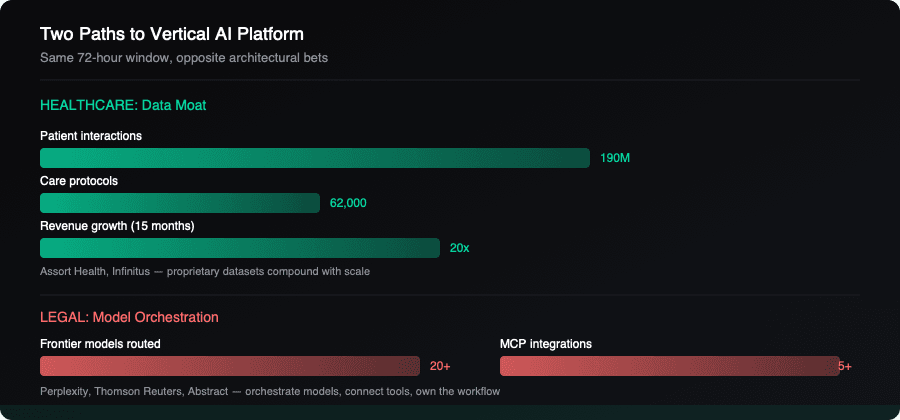
Four platform launches across two regulated industries, same window. What makes them worth reading together is that healthcare and legal took completely different architectural paths to get to the same destination. Healthcare's platforms are built on proprietary data moats. Legal's platforms are built on model orchestration. Which path your industry takes determines what you should be buying.
Healthcare's bet: own the data, own the platform
Assort Health's $120 million Series C, led by Menlo Ventures, values a company that started in November 2023 at over a billion dollars. The numbers explain why. Assort has processed 190 million patient interactions across more than 20 specialties. Its proprietary model, Synapse, is trained on 62,000 care protocols and 1.6 million decision pathways. Revenue grew 20x in 15 months.
The platform now spans four products. Concierge handles inbound calls, triage, scheduling, and intake. Activate does outbound outreach to close referral loops and recover no-shows. Orchestrate runs backend administrative work and writes data back into the EHR. Empower gives staff a copilot for complex patient access needs. Patient Journey Memory connects all four, maintaining context across interactions so a patient who called about scheduling and mentioned a medication issue doesn't have to repeat themselves when the system follows up.
Co-founder Jon Wang, a Stanford ML researcher who attended UCSF medical school, frames the strategy bluntly: "This market is going to consolidate in the same way every other one has. Provider groups know it, and the smart ones aren't buying another point solution. They want one partner with the capital and the engineering depth to transform how they operate over the long run."
John Muir Health is deploying Assort across its Epic and Athena environments. Customers report a 5% lift in appointment volume, 115% increase in labor capacity, and 4.3 out of 5 patient satisfaction.
The structural insight here is about data. Assort's moat isn't the voice AI technology. It's 190 million interactions worth of specialty-specific workflow patterns that no competitor can replicate without years of deployment. Each new customer adds edge cases. The model gets sharper for the next deployment. That compounding loop is what Menlo Ventures is paying $1.2 billion for.
Infinitus launched Clinical Escalations the next day, and it reveals the same logic applied to a different problem. Infinitus has powered 100 million minutes of healthcare conversations. Its new system detects when a routine administrative call becomes a clinical emergency, regardless of what the patient originally called about. It uses turn-by-turn clinical classification based on the Schmidt Thompson Call Prioritisation Index, scoring every exchange in real time and logging the reasoning for human review.
The claim that got attention: 0% under-triage rate. Zero missed patient emergencies in real-world settings. Erin Palm, medical lead at Infinitus, framed the problem as preventing patients from being "left in an administrative queue when they should be speaking to clinical staff." Azalea Kim, chief product officer at Accompany Health, confirmed the system is being used to enhance triage capabilities for their at-home and virtual care teams.
Both Assort and Infinitus are building on the same foundation: proprietary healthcare interaction data that compounds with scale. The technology layer is replaceable. The data isn't.
Legal's bet: orchestrate everything, own nothing
While healthcare doubled down on proprietary data, legal AI went the opposite direction.
Perplexity's Computer for Counsel, launched June 24, is an LLM-agnostic agentic system that routes across 20+ frontier AI models. It doesn't care which model wrote your contract review. It picks the right model for each task: research, reasoning, drafting, citation checking. The platform connects to legal tools via MCP connectors: DocuSign for contracts, DeepJudge for document search, Midpage for case law and statutes, LegalZoom for templates, Deel for employment compliance data.
The Microsoft 365 integration means Computer for Counsel can draft documents in Word, retrieve files from SharePoint, and pull context from Outlook. It handles NDA intake and review, regulatory dashboards, legal research with source-linked outputs, and contract triage. Available for Perplexity Enterprise and Max users.
Gunderson Dettmer, an early adopter, reported 80% of its lawyers using Perplexity Enterprise as a research layer alongside existing tools. That adoption number matters because it suggests lawyers will actually use an orchestration layer if it removes enough friction.
The same day, Thomson Reuters announced what it called a "total rebuild" of CoCounsel. The new version runs on Anthropic's Claude and is positioned as "fiduciary-grade AI." You describe a matter in plain language. CoCounsel creates a plan, dives into legal authority across Westlaw and Practical Law, retrieves relevant precedents from the firm's internal data, and drafts with citations. When new information changes the picture, it adapts. Thomson Reuters representatives compared the output to what a senior associate would produce.
The framing matters. Thomson Reuters didn't call it "AI-assisted research." They called it fiduciary-grade. That language targets the specific concern that has slowed legal AI adoption: partners need to trust the output enough to put their name on it. By grounding every step in authoritative knowledge sources and requiring the system to show its reasoning, TR is trying to solve the trust gap that killed earlier legal AI tools.
Abstract, a regulatory intelligence platform, launched Abstract Workers the same day. These are custom-built AI agents that automate end-to-end workflows: scanning legislation across all 50 states, drafting briefings, logging items to trackers, producing daily PDF monitoring reports, and auto-filing client emails into the right case in Clio. The agents connect to Google Suite, Microsoft Suite, SharePoint, Slack, and Adobe. Abstract's pitch is that they build and maintain the agents for you, so legal teams don't have to learn prompt engineering or agent orchestration.
The structural insight for legal is about orchestration, not data. None of these platforms are betting on a proprietary dataset the way Assort is. They're betting that the bottleneck in legal AI isn't having the best model or the most data. It's connecting the right model to the right tool at the right moment, with enough transparency that a lawyer will actually trust the output.
Two paths, one decision
If you're evaluating AI platforms in a regulated industry, the healthcare and legal convergence this week gives you a diagnostic question.
Is your bottleneck data depth? If your workflows involve thousands of specialty-specific edge cases, complex routing rules, and years of accumulated domain knowledge, the healthcare model applies. You should be looking for platforms with proprietary datasets that compound with scale. Ask vendors how many real-world interactions their models are trained on. Ask whether each new deployment makes the platform better for existing customers. The answer determines whether you're buying a tool or joining a network.
Is your bottleneck tool breadth? If your workflows involve coordinating across disconnected systems, pulling data from multiple sources, and routing work to the right person at the right time, the legal model applies. You should be looking for orchestration layers that connect to your existing stack via open protocols. Ask vendors which tools they integrate with natively. Ask whether they route across multiple models or lock you into one. The answer determines whether you're buying a platform or a prison.
The companies that built these platforms this week are betting that their vertical will consolidate around a single layer. Assort is betting healthcare consolidates around the patient interaction dataset. Perplexity is betting legal consolidates around the model orchestration layer. Both bets could be right. Both could be wrong. But the fact that both industries produced platform-grade launches in the same 72 hours tells you the point-solution era in vertical AI is ending. The question is which architecture wins, and whether your industry's bottleneck looks more like healthcare's or legal's.
Sources
- Assort Health, "Assort Health Raises $120 Million Series C," June 24, 2026
- MobiHealthNews, "Assort Health lands $120M to scale patient journey AI agents," June 25, 2026
- AIntelligenceHub, "Assort Health raises $120M Series C to scale its voice AI platform," June 25, 2026
- Infinitus Systems, "Infinitus Introduces Clinical Escalations," PR Newswire, June 25, 2026
- Law.com, "Perplexity AI Launches Computer for Counsel," June 24, 2026
- Above the Law, "Perplexity Jumps Into Legal With 'Computer For Counsel'," June 24, 2026
- Above the Law, "Thomson Reuters Rebuilt CoCounsel: A Pivot," June 24, 2026
- Law.com, "Abstract Launches AI Agent Service to Automate Regulatory Workflows," June 24, 2026