Legal AI Had Its Platform Moment
Legora landed three firm deployments in one week while Shoosmiths built custom AI with Microsoft and Centari shipped deal reasoning. Legal AI is splitting structurally.
By SpringVanta
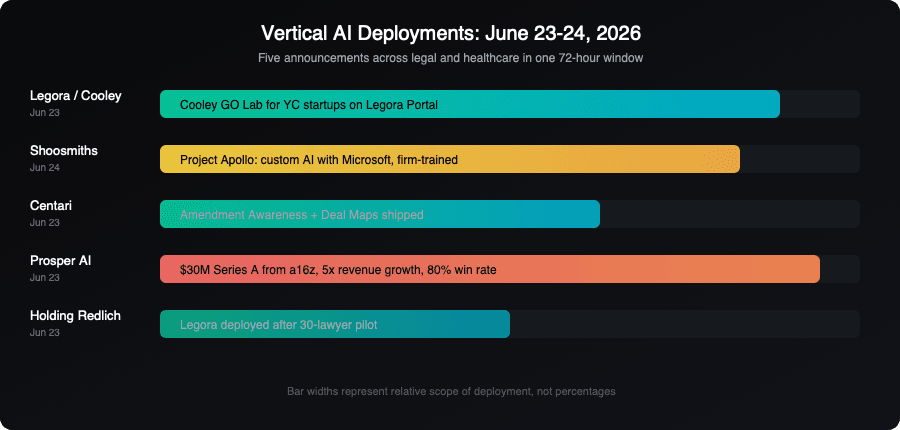
Legora now has 100,000-plus legal professionals using its platform across 1,200-plus firms in 50-plus markets. In a single week, three major firms announced deployments built on it: Cooley used Legora Portal to launch an AI workspace for Y Combinator startups, Holding Redlich rolled it out across transactional practices after a 30-lawyer pilot, and Legance deployed it firm-wide across Italy.
But Legora was only half the story. In the same 72-hour window, Shoosmiths launched "Project Apollo," a custom AI tool built with Microsoft and trained on the firm's own lawyers. Centari shipped Amendment Awareness and Deal Maps, extending its deal reasoning engine beyond single-document review. And Prosper AI closed a $30 million Series A from Andreessen Horowitz to run the entire patient journey in healthcare.
Vertical AI is splitting into distinct strategies. The firms that announced this week are placing very different bets on which one wins.
The platform play: Legora as legal AI infrastructure
Cooley GO Lab is the most interesting deployment of the bunch, and not because of the technology. It is a law firm building a product for its clients on top of an AI platform. Startups in YC's summer 2026 cohort can upload corporate documents, ask the AI agent questions about their specific filings, and compare NDAs and contractor agreements against market terms that Cooley's lawyers curated.
That distribution model did not exist before in legal services. Law firm knowledge, typically billed at hourly rates and delivered through meetings and memos, gets packaged into a self-service workspace. Cooley shapes the content. Legora provides the infrastructure. Startups get answers in seconds.
Max Junestrand, Legora's co-founder and CEO, called it a full-circle moment: Legora itself was founded through Y Combinator. Gustaf Alströmer, a YC general partner, was blunt about the need: "Early-stage YC startups are growing faster than ever and need legal information earlier than they used to."
The Holding Redlich and Legance deployments show the same platform working internally rather than client-facing. Holding Redlich's pilot covered M&A due diligence, post-completion transaction management, and real estate transactions. Participating lawyers noted that Legora adapted to their existing tools: browser, Word add-in, or Outlook. No workflow disruption required.
Legance's rollout was the first of its kind in the Italian market in both process and scale. Three months from implementation to firm-wide deployment.
The build-your-own counter-bet: Shoosmiths and Microsoft
Shoosmiths went the opposite direction from Legora. Instead of adopting a third-party platform, the firm spent a year building Project Apollo with Microsoft. The tool is trained on insights from Shoosmiths' own lawyers, including its M&A practice. Clients include Mercedes-Benz, Travelodge, and Blackstone. CEO David Jackson described it as letting the firm "deploy its collective dealmaking expertise at scale."
This is the moat strategy. A firm-specific AI trained on proprietary deal history creates something competitors cannot copy. No two firms have the same client base, drafting conventions, or negotiation patterns. Shoosmiths is betting that its AI, knowing what its lawyers know, produces better outputs than a platform shared across 1,200 firms.
The risk is real and well-documented. City AM noted in the same report that Pinsent Masons was criticized by a High Court judge in May after a junior lawyer submitted false AI-generated information to the court. Lawyers for Lush's former CEO were raising fees partly because senior lawyers, not juniors, were needed to train the case-specific AI model. Shoosmiths confirmed that a senior lawyer will always review and sign off on AI outputs. That human-in-the-loop requirement is the hidden cost of building your own.
The data layer underneath: Centari
Centari's CEO Kevin Walker is explicit about not competing with Harvey or Legora. "We want to help them create data that they can trust when it matters to clients," he told LawSites. Centari's customers include Ropes and Gray, Willkie, Fried Frank, and Wilson Sonsini.
The new Amendment Awareness feature tracks how an amendment changes the meaning of a deal over time. Not just how the text differs, but how the operative terms shift when a new document supersedes or modifies an existing one. Deal Maps generates a visual graph showing document relationships across a closing set: which agreement supersedes which, which satisfies which obligation.
This addresses legal AI's persistent weakness: context blindness. Standard LLMs read documents as text at a fixed point in time. Transactional attorneys read a deal as a system, following cross-references and tracking modifications. Centari is building the structured data layer so that whichever application a firm uses, the underlying deal data is reliable.
Healthcare's $30 million parallel
The same "own the workflow" thesis just got funded in healthcare. Prosper AI raised $30 million in a Series A led by Andreessen Horowitz, with participation from Base10, Emergence Capital, Y Combinator, and Company Ventures.
Prosper does not just schedule appointments. The platform answers patient calls, schedules directly in the EHR, verifies insurance benefits, automates patient billing, and calls insurers on the phone when additional information is needed. The company claims 40-percent-plus reduction in administrative costs for providers.
The growth numbers: 5x revenue growth in six months, 40-plus healthcare organizations as customers, 150,000-plus providers on the platform, and $1.3 billion in patient care managed. Prosper wins 80 percent of competitive evaluations.
Jonathan Banta, CEO of The 44 Group, a PE-backed dermatology group, said after evaluating seven vendors through a full RFP process: "We concluded that Prosper AI had the most comprehensive platform." The evaluation criterion is the same one SpringVanta buyers face. Not which tool has the best single feature, but which platform owns the workflow end to end.
What buyers should take from this week
The legal and healthcare deployments map a decision framework.
Adopt a platform if you want immediate access to cross-firm learnings and a product that works today. Legora's 100,000-user base means its models have seen more deal patterns than any single firm could produce internally. The tradeoff: your competitors have access to the same intelligence.
Build your own if your firm's deal experience is genuinely proprietary and defensible. Shoosmiths' client roster and drafting history are not replicable. The tradeoff: a year-long build, multi-million-pound investment, and permanent human-in-the-loop overhead to catch hallucinations.
Invest in the data layer regardless of which application you choose. Centari's thesis is that structured deal data makes every downstream AI tool better. Firms that clean and structure their historical deal data now will have an advantage regardless of which platform wins the application layer.
For healthcare operators, the bar is end-to-end workflow ownership. A scheduling-only tool loses to a platform that handles the full patient journey from call to reimbursement. Prosper AI's 80 percent competitive win rate comes from that breadth, not from doing any single step better than a point solution.
Sources: Legora, AI PropTech News, City AM, LawSites, Intelligent Health