Microsoft Dropped Claude Code. The Reason Tells You Who Wins.
Microsoft's own engineers preferred Claude Code over Copilot CLI. Then Microsoft pulled the license. What this tells you about who wins the coding-agent market, and what
By Springvanta
Claude Code was too popular inside Microsoft. So they pulled the plug.
In December 2025, Microsoft handed thousands of its engineers, designers, and product managers free access to Anthropic's Claude Code. The idea was straightforward: let people experiment, learn what AI coding tools can do, and see where the technology fits inside the company. Six months later, Claude Code had become, in The Verge's words, "perhaps a little too popular." Engineers building Windows, Microsoft 365, Outlook, Teams, and Surface were reaching for Anthropic's tool instead of Microsoft's own GitHub Copilot CLI.
On June 30, 2026, most of those Claude Code licenses expire. Microsoft's Experiences + Devices division is moving to Copilot CLI instead. Executive VP Rajesh Jha framed it in an internal memo as a learning exercise that ran its course: "Copilot CLI has given us something especially important: a product we can help shape directly with GitHub for Microsoft's repos, workflows, security expectations, and engineering needs."
That memo, first reported by Tom Warren at The Verge on May 14, tells you more about where the coding-agent market is headed than any product launch this year. And the story got louder at Microsoft's Build conference in San Francisco last week, where the company showed off a coding model it built specifically for GitHub Copilot. Not a partnership with Anthropic. Not an OpenAI integration. Their own model, aimed at their own product.
What actually happened
Let's separate the facts from the spin.
In December 2025, Microsoft opened Claude Code access to thousands of employees across the Experiences + Devices group. This was not just developers. Project managers, designers, and non-technical staff were encouraged to try AI-assisted prototyping. The goal was benchmarking. Use both Claude Code and Copilot CLI, compare them in real engineering workflows, and report back.
Claude Code won the internal comparison. Multiple sources confirm that engineers preferred Anthropic's tool for its ability to handle complex multi-file edits, navigate large codebases, and maintain context across long sessions. This lines up with external data. In the JetBrains AI Pulse survey (January 2026, over 10,000 developers worldwide), nearly half of respondents named Claude Code their favorite coding agent.
Microsoft's response was to cancel the Claude Code licenses. The June 30 cutoff is the last day of Microsoft's fiscal year. Canceling external tool licenses before a new fiscal year is a straightforward way to reduce operating expenses. Multiple outlets, including Forbes, Windows Central, and Moneycontrol, have reported that token-based billing for Claude Code ran past internal AI budgets. The same thing happened at Uber, which deployed Claude Code to 5,000 engineers and reportedly burned through its 2026 AI coding budget in four months, with per-engineer costs reaching $500 to $2,000 per month.
Microsoft's official line is "toolchain unification." The unofficial version is that a third-party product started outperforming the homegrown one, and the bill was the excuse to end the experiment.
The distribution-vs-quality pattern
Here is the part that matters if you are picking a coding agent for your own team.
The JetBrains survey showed a clear split. At small companies, Claude Code dominated. At organizations with more than 10,000 employees, Copilot was the most commonly reported tool. The tool developers liked best was not the tool enterprises used most.
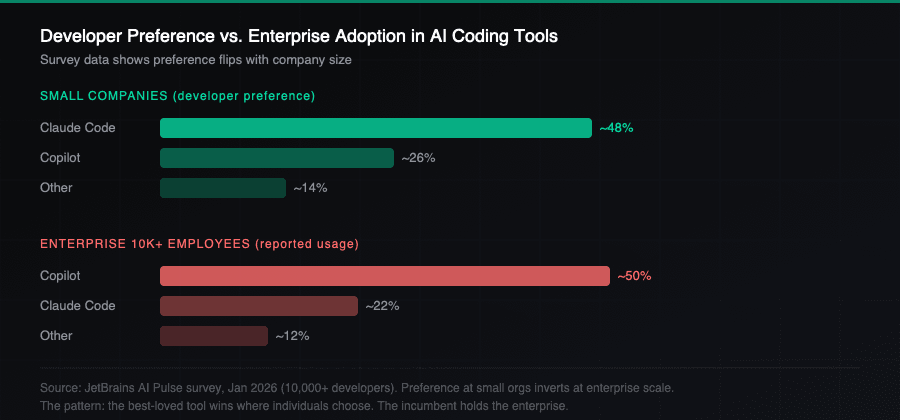
The cause is structural, and Microsoft knows it. They own GitHub, the development environments (VS Code), the enterprise agreements, and the cloud infrastructure most companies already run on. Adopting Copilot across thousands of engineers is a configuration change, not a procurement fight. Adopting Claude Code means buying, approving, securing, and integrating a separate tool. The good-enough tool that is already in the building just gets switched on.
This is the same pattern that let Microsoft bundle Teams into Office and overtake Slack and Zoom. Distribution beats quality when the quality gap is small and the distribution advantage is large. And right now, the quality gap between frontier coding agents is small. Claude, GPT, and Gemini trade the lead every few weeks. A model that is best in May gets matched in June.
Markman Capital, writing about the Build conference last week, put it plainly: "Everyone measured the model. The distribution around it is what decided the winner."
What this means for your team
Three takeaways, depending on your situation.
If you are under 500 employees: Use the tool your developers like best. At this size, procurement friction is low, and the productivity difference between the top agents is real enough to matter. Claude Code, Codex CLI, Cursor, whatever your team reaches for. The cost will sting less than forcing a worse workflow.
If you are 500 to 10,000 employees: Run a pilot with two tools simultaneously for 90 days. Track actual productivity (pull request throughput, bug fix time, developer satisfaction), not just cost. The per-engineer cost of a good coding agent is $50 to $200 per month. The per-engineer cost of a bad one is the salary you pay someone to fight with their tools.
If you are over 10,000 employees: The distribution advantage is real, and Copilot will probably win by default because it is already in your stack. But ask your best engineers which tool they actually want to use. Microsoft's own engineers chose Claude Code when given the option. That preference did not change because the license got pulled. The engineers who preferred Claude Code will use Copilot CLI because they have to, not because they want to. That friction has a cost.
Microsoft is not breaking up with Anthropic
One important nuance. This is not a clean break. Claude models remain available through Microsoft Foundry, through Copilot itself, and through Microsoft 365. The cancellation is specifically for the standalone Claude Code CLI tool, and only within the Experiences + Devices division. Microsoft is keeping the model partnership. It is dropping the competing tool.
That distinction tells you something about where the defensibility actually sits. Microsoft does not need to beat Claude as a model. It needs to beat Claude Code as a product experience wrapped inside its own distribution. If Copilot CLI gets good enough, and it is already in every engineer's terminal by default, the model behind it becomes a swap. Anthropic today, OpenAI tomorrow, their own MAI model next quarter.
The real cost question
The part of this story that should concern every CTO is not the Microsoft vs. Anthropic drama. It is the budget pattern.
Token-based billing for agentic coding tools is a new expense category, and the early data suggests it scales faster than most organizations expect. Microsoft, one of the richest companies on earth, pulled a popular tool from its own engineers because the cost ran ahead of the budget. Uber hit the same wall. These are not small companies scrambling. This is the cost structure of AI coding agents at scale, and nobody has figured out how to predict it yet.
When you evaluate a coding agent, ask the vendor for per-engineer cost data at your scale. If they cannot give you a straight answer, budget for 2x what they quote.
Sources
- Tom Warren, "Microsoft starts canceling Claude Code licenses," The Verge, May 14, 2026
- Forbes, "Microsoft Ends Claude Code Licenses As It Shifts Developers To Copilot," June 1, 2026
- Moneycontrol, "Microsoft pulls Claude Code licenses, shifts engineers to GitHub Copilot CLI amid rising AI costs," June 3, 2026
- Markman Capital Insight, "Microsoft Moves Away From Claude Code With In-House Coding Model," June 1, 2026
- JetBrains, "Which AI Coding Tools Do Developers Actually Use at Work?" January 2026
- James Collins, "The State of MCP: Everything That Changed in H1 2026," DEV Community, June 4, 2026