AI Agents Crossed the Action Line Across Three Industries in 48 Hours
Adonis inside Epic, brightplace on MCP, and Hanson Bridgett on Claude all shipped AI agents that execute workflows, not just answer questions, in a 48-hour window.
By SpringVanta
On June 17, Adonis went live inside Epic Connection Hub, letting health systems deploy AI agents that don't just flag denied claims, they resolve them. On June 16, brightplace shipped Connect, a Model Context Protocol layer that lets any AI agent run the full apartment search from discovery to tour booking without a human in the loop. On June 17, Am Law 200 firm Hanson Bridgett announced it had deployed Claude firmwide for 200-plus attorneys, with legal operations workflows like budgeting and pricing already showing results.
All three landed in the same 48-hour window. And all three moved past the "AI that answers questions" stage into something more concrete: agents that execute the workflow end to end.
Healthcare: agents that resolve claims inside the EHR
Adonis has been building revenue cycle orchestration since 2022. The company raised a $40M Series C in March, bringing total funding past $95M. But the June 17 announcement is about distribution, not capital. By landing in Epic Connection Hub, Adonis becomes deployable inside the EHR that most large health systems already run. No separate integration project, no parallel workflow.
Revenue cycle teams spend their days in reactive workqueues: aged accounts receivable, denials, reimbursement variance. Adonis monitors those signals continuously, prioritizes them, and then deploys AI agents to take action. The agent researches the denial, prepares the appeal, and files it. Nobody on the RCM team has to draft the appeal or route it.
ApolloMD reported a 67% reduction in denial rates and a 90% success rate in autonomous issue resolution. Fox Valley Orthopedics recouped nearly $200,000 in denials through Adonis workflows. Allied Digestive Health saw 4.5x return on investment in year one. ApolloMD saves over 1,000 full-time-equivalent hours per month.
Adonis co-founder Aman Magoon frames the shift plainly: the platform doesn't replace Epic, it makes it smarter. The system of record stays. The intelligence layer sits on top.
Also on June 17, Assort Health shipped Continuous Patient Conversations, which adds Patient Journey Memory across phone, chat, text, and intake forms. The product builds on 180M-plus patient interactions and 62,000 care protocols. Every interaction a patient has on any channel feeds a longitudinal profile, so the next interaction picks up where the last one left off. Insurance verification happens before the patient arrives. Open referrals trigger automatic outreach. When a patient calls to schedule, the agent checks whether they have outstanding intake forms or pending referral follow-ups and closes those out in the same call.
Assort's dataset has grown from 150M to 180M interactions in roughly six weeks. The company raised $102M total.
Real estate: MCP makes apartment search agentic
brightplace launched Connect on June 16, and it's the first real estate product I've seen that takes the agent-as-user pattern seriously. Instead of building a better search UI for humans, brightplace built infrastructure for AI agents.
Here's how it works. A renter asks ChatGPT, Claude, or Perplexity for help finding an apartment. The agent connects to brightplace via MCP, describes what the renter wants in natural language, evaluates real-time supply, checks unit-level fit, and requests a tour, all through one connection. The renter never navigates a listing site. The tour gets booked.
Brian Lichtenberger, brightplace's founder and CEO, frames the bet: "When that agent shows up, it needs more than a feed of listings. It needs judgment, context, and the ability to act. brightplace Connect gives it all three."
The Rental Advisor handles discovery, recommendation, listing detail (including unit-level financial intelligence), tour availability, and tour requests. Operators that list with brightplace become reachable in agentic search automatically. The product can also be embedded on an operator's own site.
brightplace launched publicly in April 2026 and was selected for the RET Ventures PropTech AI Accelerator. The company built IntentOS, which combines market data, financial intelligence, and conversational AI. Every response runs through Fair Housing guardrails.
This is infrastructure, not a consumer app. The bet is that renters will increasingly use AI agents to handle transactions, and operators who aren't reachable by those agents will lose deals they don't even know about.
Legal: horizontal platform vs. vertical tools
Hanson Bridgett, a 200-plus attorney Am Law 200 firm based in San Francisco, deployed Claude firmwide earlier this month. What makes this interesting isn't the technology. Every Am Law firm is experimenting with AI. What caught my attention is what COO and CFO Laura Long told Law.com about how the firm is choosing between horizontal and vertical tools.
Legal operations workflows are where the firm has seen the most immediate value. Long's team uses Claude for budgeting and pricing, lateral recruitment, finance functions, and marketing. These are the operational tasks that firms typically handle with a patchwork of spreadsheets, specialized tools, and manual processes.
Long said the firm is still evaluating legal-specific tools like Harvey and Legora, but Claude's legal plugins and integration ecosystem are making the firm reconsider whether it needs them: "With the new features and the connections that Claude is able to provide, it's making us think a little bit more seriously about, all right, which tools do we want to use and for which purposes?"
That's a platform consolidation question. If Claude's legal plugins and integrations handle budgeting, pricing, intake, and document review well enough, the marginal value of a legal-specific platform shrinks. It's different from asking which tool writes the best contract clause.
The firm also spent more time on governance than on evaluation. Long said they didn't require a formal evaluation process for Claude because leadership already had experience with it from personal use, but they devoted substantial energy to security parameters, access controls, and acceptable use policies. The firm maintains Copilot and ChatGPT licenses alongside Claude, hedging against single-vendor dependence.
What ties these together
Each of these three stories represents a different path to the same outcome: AI that acts inside the workflow.
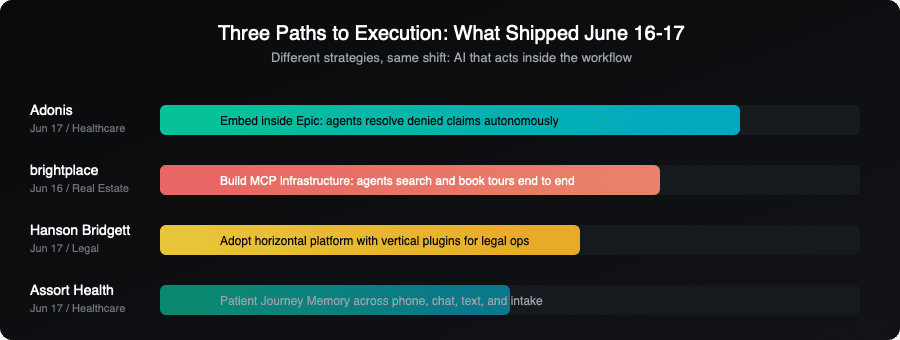
Adonis chose to embed inside the incumbent system (Epic). brightplace chose to build new infrastructure for a new kind of user (the AI agent). Hanson Bridgett chose to adopt a horizontal platform with vertical plugins (Claude with legal practice plugins).
If you operate in any of these verticals, the evaluation question is shifting. It's no longer "does this AI tool answer my questions?" It's "can this AI agent execute the workflow end to end, inside the system I already use, with the context it needs to handle exceptions correctly?"
For healthcare operators: can your AI resolve a denied claim without a human drafting the appeal? Adonis says yes, and now it runs inside your EHR.
For real estate operators: can an AI agent book a tour for a prospect who never visited your website? brightplace says yes, if you're reachable via MCP.
For legal operators: can a single platform handle your budgeting, your intake, and your document review, or do you need three different tools? Hanson Bridgett is still figuring that out, but they're asking the right question.
The verticals are different. The shift is the same. Answering was last year's problem.
Sources:
- Adonis Brings AI-Powered Revenue Intelligence to Epic Connection Hub — PR Newswire, June 17, 2026
- How Hanson Bridgett Is Using Claude Firmwide — Law.com Legaltech News, June 17, 2026
- brightplace Launches brightplace Connect — The AI Journal / PR Newswire, June 16, 2026
- Introducing Continuous Patient Conversations — Assort Health, June 17, 2026
- Adonis Scores $40M for AI Platform Aiming to Boost Hospital Revenue — MedCity News, March 26, 2026