Vertical AI Intake Gets Funded, Connected, and Shipped
DocuSign AI agents, Claude for Legal, and Coral's $12.5M round show vertical AI intake in legal and healthcare moving from pilots to deployed products.
By SpringVanta
Three moves in the last four weeks signal that vertical AI intake has moved from demos to deployed infrastructure.
DocuSign shipped AI agents for legal contract intake on May 11. Anthropic launched Claude for Legal the next day. And Coral, a New York startup automating healthcare back-office workflows, closed a $12.5 million seed round led by Lightspeed and Z47 in late April.
None of these are chatbot bolt-ons. Each one targets a specific workflow in a specific industry, with connections into the systems that already run the business.
DocuSign builds an agent layer for legal contracts
DocuSign's new release is not about e-signatures. The company introduced an AI assistant and a set of software agents built on its Iris engine, designed to handle contract intake, drafting, negotiation, and execution inside corporate legal departments. The agents draw on previous negotiations, accepted terms, and internal policies to suggest next steps.
DocuSign also launched Agent Studio, a workspace for building custom agents for agreement automation. And it wired in integrations with Harvey, Legora, and Thomson Reuters CoCounsel, plus MCP connections to Anthropic Claude, OpenAI ChatGPT, Microsoft Copilot, and Slack.
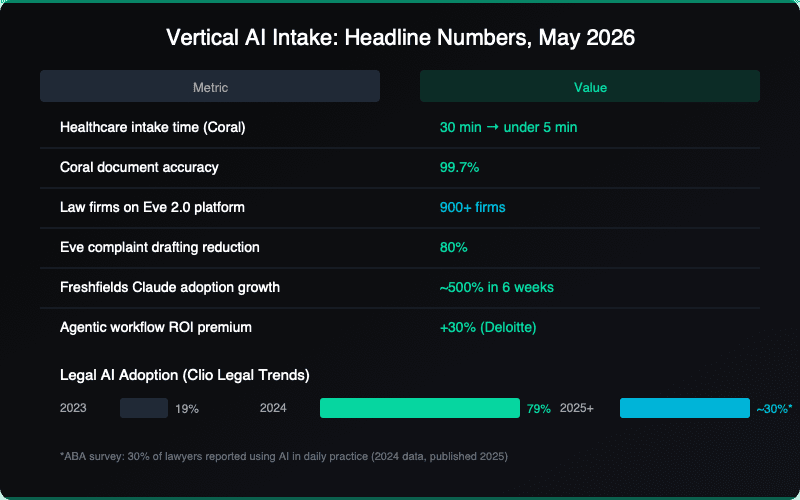
The pitch is straightforward: legal teams work across email, PDFs, and separate software products today. DocuSign wants to collapse that into a single agreement workflow where AI handles the repetitive parts. Deloitte research cited by DocuSign shows that organizations using agentic workflows with an end-to-end agreement platform see roughly 30% higher ROI than those that don't.
CEO Allan Thygesen framed the shift as moving from "electronic signing to a broader agreement management platform that acts on contract data as well as storing it."
Anthropic goes all-in on legal
The day after DocuSign's launch, Anthropic formally announced Claude for Legal. The offering includes twelve practice-area plugins (commercial, employment, privacy, corporate, AI governance, and others), new MCP connectors to DocuSign, Ironclad, iManage, NetDocuments, LexisNexis, and Thomson Reuters, and an open-source ecosystem with contributions from Harvey and Legora.
Mark Pike, Anthropic's Associate General Counsel and product lead for the legal vertical, told Artificial Lawyer that legal became the number-one power-user job function in Claude Cowork after the February plugin launch, with over three times the usage of any other function. Over 20,000 people registered for Anthropic's "How Legal Teams Put Claude to Work" webinar in April.
Freshfields deployed Claude to thousands of lawyers across 33 offices. Usage grew roughly 500% in the first six weeks.
Harvey CEO Winston Weinberg called the launch "validation" and noted that he and co-founder Gabriel Pereyra had expected to compete with model companies eventually. Thomson Reuters CTO Joel Hron framed it as a "convergence of roles" rather than displacement.
Coral automates the healthcare intake nobody wanted to touch
While legal gets the spotlight, healthcare's administrative back office is where some of the most painful intake bottlenecks live.
Coral, founded in 2024 by two IIIT Hyderabad graduates, integrates directly into existing EHR systems, fax lines, and payer portals. It handles patient intake, prior authorizations, insurance verification, and document processing. The founders' insight: don't ask providers to rebuild their systems. Connect to what's already there and automate the friction.
The numbers are specific. Coral's models hit 99.7% accuracy on healthcare back-office document types like handwritten fax forms, scanned insurance cards, and prior authorization templates. General-purpose robotic process automation tools operate at roughly 52% accuracy on the same documents.
A patient intake process that previously required 30 minutes of staff coordination now completes in under five minutes. Coral processes 500,000 monthly workflows and has grown revenue 8x in less than a year. A meaningful share of customers are paying full contract value upfront.
Coral started in durable medical equipment and expanded to infusion centers and specialty pharmacies. Its latest product additions include AI-powered voice and text workflows for payer follow-up communications.
The Lawmatics and Eve signals
Two more data points round out the picture.
Lawmatics, a legal CRM platform, announced an AI Suite in March that brings agentic automation to legal lead intake. The tools automate lead qualification, follow-up, and appointment scheduling inside the firm's existing CRM.
And Eve, a plaintiff-side AI workforce platform, reached general availability with Eve 2.0 after a year of production deployments with over 900 plaintiff law firms. Mike Morse Law Firm reported a 2-3x attorney capacity increase. Smith Clinesmith LLP cut complaint drafting time by 80%. The platform now includes AI Agents that advance casework automatically and an AI Auditor that reviews cases for missed value every night.
What this means for intake-focused businesses
The pattern across these moves is consistent: vertical-specific AI that connects to existing systems, handles the structured parts of intake and workflow, and leaves judgment calls to humans.
For law firms, that means AI handling conflict checks, matter classification, fee-structure triage, and routing, while attorneys stay focused on case strategy. Clio's 2024 data shows 79% of legal professionals adopted AI in 2024, up from 19% in 2023. The ABA's 2024 survey (published 2025) found about 30% of responding lawyers using AI in daily practice. The gap between adoption and revenue growth, which SpringVanta covered previously, suggests that firms buying AI tools and firms deploying them well are two different groups.
For healthcare practices, the opportunity is narrower but more urgent. Administrative overhead runs roughly $450 billion annually in US healthcare. Prior authorization delays don't just slow paperwork. They delay treatment. Coral's approach of integrating with existing EHR and fax infrastructure, rather than replacing it, matches how healthcare actually buys technology.
The DocuSign and Anthropic launches also signal something about market structure. When the largest e-signature company and a $900 billion AI lab both build legal-specific agent products in the same week, vertical AI intake is no longer a niche. It's a category.
Sources:
- DocuSign launches AI tools for in-house legal teams, IT Brief, May 11, 2026
- Claude For Legal Launches, May Reshape the Legal Tech World, Artificial Lawyer, May 12, 2026
- Coral Raises $12.5M to Automate Healthcare AI, The AI World, April 21, 2026
- Eve Expands Plaintiff AI Workforce Platform to GA, PR Newswire, March 10, 2026
- Lawmatics Announces AI Suite for Law Firms, MarketWatch, March 24, 2026
- Legal Automation in 2026 Explained, Lexitas, 2026