400,000 Calls and a Signed Lease: Vertical AI Found the Money in the Middle
Four June 15 launches across healthcare, legal, and real estate all target the same gap: the repetitive operational work between first contact and resolution where revenue leaks.
By SpringVanta
On June 15, four companies in three industries shipped AI products that have nothing to do with lead capture, clinical diagnosis, or legal analysis. They target the operational middle: billing calls, lease paperwork, invoice processing, calendar management. The repetitive work that sits between first contact and resolution, where most staff time disappears and most revenue leaks.
Cedar's Kora handled 400,000 patient billing calls in its first year. Entrata launched agentic workflows that move renters from inquiry to signed lease. Yardi deployed AI agents across every multifamily role from inspections to accounting. Dialogica emerged from stealth with a voice-first legal platform that attacks calendaring and timekeeping instead of document drafting.
The pattern across all four: vertical AI moved past the flashy endpoints (intake, diagnosis, drafting) and into the plumbing.
Cedar's Kora: a year of evidence
One year ago, Cedar launched Kora, an AI voice agent for patient billing calls. The original goal was automating 30% of inbound calls. Twelve months later, Kora has handled nearly 400,000 calls across ten provider organizations, including health systems running Epic and Cerner.
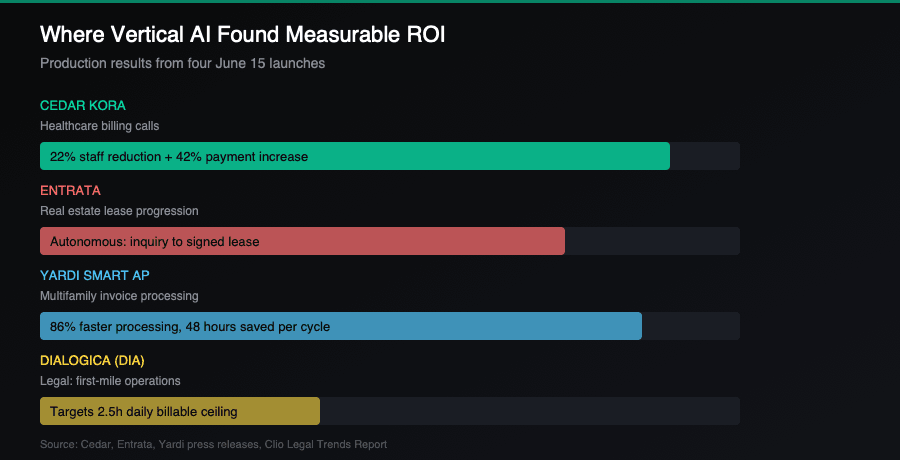
At Gastro Health, a gastroenterology practice with 120 locations across seven states, Kora went live in September 2025. Since then it has processed 60,000 calls. Live agent handle time dropped 24%. Call center staffing dropped 22%. More than 80% of patients who filled out post-call surveys rated the experience highly, which Cedar notes is above what live agent teams were achieving.
At ApolloMD, a national emergency medicine group and Cedar's original Kora partner, the broader patient financial platform contributed to a 42% increase in patient payments alongside measurable reductions in live agent workload.
Cedar CEO Florian Otto told Fierce Healthcare that Kora was built "not to deflect calls, but to handle the ones that genuinely require explanation and resolution." The company now plans to expand Kora into outbound patient engagement and agentic workflow automation across the revenue cycle.
What separates this from the other launches this week is the timeline. Most vertical AI announcements come with pilot numbers or beta results. Cedar has twelve months of production data across ten health systems. The 400,000-call track record is the kind of evidence that procurement teams actually want to see before signing a contract.
Entrata: closing the gap between tour and signature
Entrata, a property management operating system used across multifamily housing, announced Autonomous Lease Progression inside its OXP Studio. The product targets the stretch between initial inquiry and fully executed lease, which is where most leasing automation stops working.
The AI agents re-engage stalled prospects, flag missing or incorrect documentation, communicate screening updates, follow up on pending lease signatures, and route unresolved exceptions to on-site teams. Catherine Wong, COO and CPO at Entrata, said the goal is "building systems that can understand what's happening operationally and help move work forward."
Most standalone leasing AI tools schedule a tour and hand off. Entrata's agents keep working through application, screening, and signature. That gap between tour booking and signed lease is where prospects go cold and deals die. Entrata also launched OXP Communications, a shared inbox that pulls SMS, email, and agent-driven conversations into one workspace so leasing and operations teams stop switching between systems.
Yardi: agents across every role, with numbers to prove it
The same day, Yardi announced Virtuoso Enterprise for multifamily, covering leasing, resident services, maintenance, and accounting. The platform includes Chat IQ for the renter journey (lead nurturing, tour scheduling, payment reminders, renewals), AI inspection agents that analyze video walkthroughs to identify needed repairs, and Smart AP for invoice processing.
The Smart AP number is the strongest: KETTLER, a multifamily operator, saw an 86% decrease in invoice processing time and eliminated 48 hours of human processing per cycle using the tool.
Richard Malpica, VP of multifamily at Yardi, said their agents have "transitioned from answering to doing." The product scope is wider than anything else in multifamily this year. Yardi is embedding AI into maintenance inspections and accounts payable, not just the leasing funnel.
Dialogica: the first mile nobody wanted
Dialogica, or "Dia," came out of stealth with a different thesis. Most legal AI tools focus on the "last mile": document drafting, contract review, legal research. Dia targets the "first mile": calendaring, timekeeping, redlining, precedent searching, tracking clients and matters.
The company is backed by Tom Glocer, the former CEO of Thomson Reuters, along with Ground Up Ventures and partners at AmLaw 50 firms. Its president, Scott Joachim, was Co-Chair of Global Private Equity at Paul Hastings. The backing matters because the problem Dia targets is unglamorous. Nobody gets excited about AI that does your timesheets.
But the average attorney spends 2.5 hours per day on billable work, according to the Clio Legal Trends Report. The rest goes to administration, business development, and operational overhead. Dia is voice-first, so lawyers talk to it rather than learning a new interface. Data stays inside the firm, which addresses the confidentiality concern that has slowed legal AI adoption more than any technical limitation.
What the convergence tells you
All four products sit in the gap between the work that generates revenue and the work that supports it. Billing calls do not generate revenue, but unresolved billing questions delay payments. Lease paperwork does not generate revenue, but stalled applications kill deals. Invoice processing does not generate revenue, but missed charges and late fees compound quietly. Timekeeping does not generate revenue, but unbilled hours are gone permanently.
The vendors building for this layer have an advantage that intake-focused products do not: the ROI is measurable. You can track staffing reductions, payment velocity, processing time, and recovered charges. From this week's numbers alone: 22% fewer call center staff at Gastro Health, 42% higher patient payments at ApolloMD, 86% faster invoice processing at KETTLER, 48 hours saved per AP cycle.
For operators evaluating vertical AI, the intake layer is largely solved. The question worth asking now is whether your vendor can handle the operational middle: the billing follow-ups, the lease progression, the document exceptions, the time tracking. That is where staff time goes and where money leaks out of the business.