87% of Purchase Searches Get an AI Overview. Buyers Don't Click Like They Used To.
Peec AI found AI Overviews in 87% of commercial queries. ClickStream data shows AI Mode and AIO create opposite user behaviors. Here's what changes for your visibility.
By SpringVanta
If you've been tracking AI Overview coverage rates, you've probably seen numbers in the 20-30% range. Ahrefs analyzed 146 million results and found 20.5%. Authoritas and SE Ranking landed near 30%. Those numbers are correct for the full breadth of Google search.
But they're the wrong number if you sell something.
Peec AI, an AI search visibility platform, studied 500,000 prompts focused on commercial and buying-intent queries. Product comparisons. "Best X for Y" searches. Decision-stage stuff. AI Overviews appeared in 87% of them. For decision-stage prompts specifically, the rate hit 88.5%.
Longer queries triggered AI Overviews more often: 89% for 11-to-15-word prompts, compared to 64.6% for two-word queries. Regionally, AI Overviews appeared in 90.3% of searches outside the EU, versus 76% inside it. (France is at zero because Google hasn't launched AI Overviews there yet.)
The 87% figure is not a contradiction of the 20-30% studies. It's a different slice. Strip out navigational searches and short-tail queries that rarely trigger AI Overviews, and the average climbs fast. What Peec measured is the query type that matters most if you're trying to reach people with wallets out.
Most visibility work targets informational queries because that's where the volume is. The ClickStream and Peec data both suggest the purchase-intent queries, the ones with lower volume but higher conversion value, are the queries running through AI intermediaries at near-universal rates. If your optimization program only targets informational search, you're working on the queries that AI treats as optional and ignoring the ones where it shows up almost every time.
Two surfaces, opposite behaviors
A separate study from ClickStream Solutions and Surfer SEO tracked 846,000 U.S. Google sessions in February and March 2026. Eric Van Buskirk analyzed the data. Kevin Indig covered it for Search Engine Land.
The finding that stuck with me: users behave in opposite ways depending on which AI surface they're on.
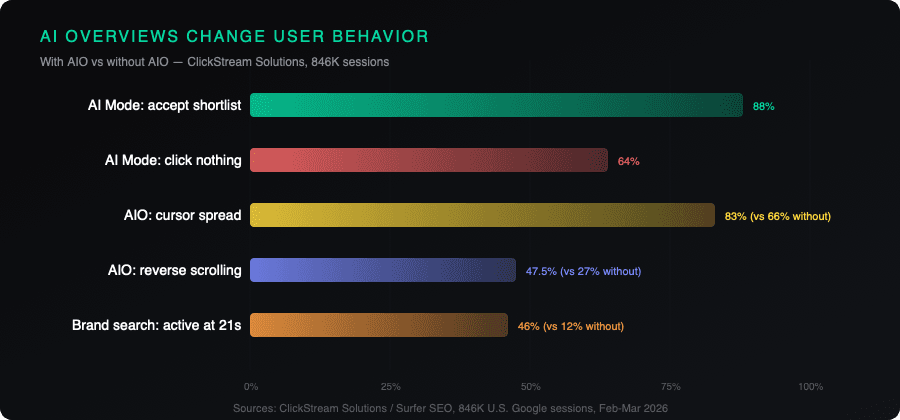
In AI Mode, 88% of users accepted the AI's shortlist. 74% picked the first item. 64% clicked nothing at all. Indig called it "autoplay." The user reads the answer, picks from inside it, and moves on. It's a closed loop.
AI Overviews create something closer to Netflix browsing. Cursor tracking showed users' cursors spread across 83% of the viewport with an AI Overview present, compared to 66% without one. Users kept their cursors still 44% of the time (they're reading, not disengaging), versus 29% without an AI Overview. Nearly half of all scrolling, 47.5%, went backward. Without an AI Overview, reverse scrolling accounted for 27%.
The browsing pattern: hover, scroll past, something pulls you back, scroll up to re-read. Your listing in an AI Overview SERP isn't getting one impression anymore. It's getting two or three, and the second one is when the comparison happens.
These are different optimization problems. AI Mode is about getting into the model's shortlist. AI Overviews is about being compelling when someone is actively comparing options on the SERP.
Search intent stopped predicting time-on-page
For two decades, search intent has been the core segmentation framework in SEO. Informational queries get one treatment, transactional another, navigational another. The ClickStream data shows that when an AI Overview is on the page, those distinctions collapse on the time-on-page axis.
At 21 seconds into a session without an AI Overview, only 12% of navigational searchers were still on the page, and 32% of local searchers were. With an AI Overview present, all five intent types (informational, local, navigational, transactional, video) clustered within 6 points of each other, between 41.9% and 48.5% still active. Intent no longer predicts how long someone stays.
Scroll depth still varies by query type under AI Overviews. But time-on-page is now roughly the same across all intent categories when the AI summary is on the SERP.
Brand searches aren't a shortcut anymore
Cursor scatter for navigational queries jumped 40% when an AI Overview was on the page. Without one, navigational searchers scored 19.7 on the scatter measure, lowest of any intent type. Only 12% were still active at 21 seconds. With an AI Overview: scatter hit 27.5, and 46% were still on the page at 21 seconds.
Users who typed a brand name into Google, knowing exactly where they wanted to go, started sweeping the page first. The brand-name shortcut that worked for 20 years is now a two-step process: see the brand, check the AI Overview, then decide whether to click through. Brand recall alone doesn't close the loop anymore.
Your email program might feed your AI visibility
An iPullRank report on Google's Personal Intelligence feature found that Gmail content is the strongest signal for brand visibility in AI Mode. When Personal Intelligence is active, brands a user interacts with via email appear more often in AI Mode recommendations.
This is a small-sample finding. iPullRank measured outputs, not Google's internal systems, so treat the numbers as directional. But the mechanism makes sense: if Google knows you open emails from a brand, it can reasonably infer you trust that brand, and AI Mode surfaces trust signals. Your email team and your search team probably don't talk. They might need to start.
Separately, Google expanded Preferred Sources into AI Overviews and AI Mode. More than 345,000 sources have been selected by users so far, up from 90,000 at December's global rollout. Google says people click through to Preferred Sources at twice the rate of other links. Audience loyalty now directly shapes AI search visibility. If your readers add you as a Preferred Source, your links get a label and a CTR boost inside AI answers.
What changes this quarter
AI Overviews on commercial queries: your listing gets 2-3 impressions per session. The second one is when comparison happens. Title tags and meta descriptions carry more weight than six months ago because users re-read them during reverse scrolling. Write for the person circling back, not the person scanning forward.
AI Mode is a different job. 88% of users accept the shortlist as-is. Position one captures 74% of selections. This is a model-layer problem: structured data, corroboration across independent sources, and semantic consistency matter more than SERP positioning.
And if your email program and your search visibility program are separate, you're leaving an AI Mode signal on the table. The iPullRank data is early, but the direction is worth testing.
Sources
- Matt G. Southern, "Google AI Overview Data Looks Different For Commercial Queries," Search Engine Journal, May 29, 2026
- Kevin Indig / Eric Van Buskirk (ClickStream Solutions), "Users behave differently in AI Overviews vs. AI Mode," Search Engine Land, May 27, 2026
- Matt G. Southern, "Preferred Sources Expand, Gmail Brand Lift, Pichai On AI Overviews," Search Engine Journal, May 29, 2026
- Peec AI: 500,000 prompt analysis, April 2026
- ClickStream Solutions / Surfer SEO: 846,000 U.S. Google search sessions, Feb-March 2026
- iPullRank: Personal Intelligence and AI Mode brand visibility