Three verticals, one week: AI intake goes omnichannel
Weave, HouseWhisper, and LexAxiom each shipped multichannel AI intake in the same 48 hours. Here is what the convergence means.
By Springvanta
Between May 27 and 28, three companies in three different industries announced the same thing: AI intake that works across channels, not just on a single form or phone line.
Weave built an omnichannel AI receptionist for healthcare practices, powered by Google Gemini. HouseWhisper shipped Lead Engine and Rules Engine to automate real estate lead nurturing from dormant CRM contacts. LexAxiom launched LexSuite, a full agentic revenue engine for solo and small law firms.
None of these companies coordinated. They are solving the same problem from different angles, and they all arrived at multichannel intake in the same week.
Weave: the AI receptionist that keeps context across voice and text
Weave, the healthcare patient communications platform (NYSE: WEAV), announced an AI receptionist built on Google Cloud's Gemini Enterprise Agent Platform on May 28. It handles inbound calls and texts, preserves conversation context when a patient switches from phone to SMS, and routes to a human staff member when the situation calls for it.
The key detail: context persistence. A patient calls about an appointment, gets put on hold, follows up by text, and the AI remembers the earlier call. Weave's CTO Abhi Sharma said the system "preserves context across every touchpoint" and "transitions patients from AI to staff when human support is needed most."
Google Cloud's Chris Sakalosky framed it as automating "high-frequency, manual tasks in the front office." Weave serves over 40,000 practice locations. The AI is embedded into existing workflows rather than running as a separate tool.
Also this week, K Health and Penn Medicine announced an AI collaboration for clinical intake that pulls patient history from electronic health records before the visit. Two separate healthcare AI intake plays in 48 hours.
HouseWhisper: from answering leads to running the whole lifecycle
HouseWhisper started in 2025 as an AI assistant that helped real estate agents respond to inbound leads faster. On May 27, it expanded into something more ambitious: Lead Engine and Rules Engine.
Lead Engine pulls from a team's existing CRM and initiates conversations with contacts who were never followed up on. It tailors messages to each person's profile and interaction history. When a lead hits a threshold of intent, the system hands them to a human agent.
Rules Engine sits underneath. Team leads set routing logic by ZIP code, price range, language, and agent availability. The idea is to make sure that when Lead Engine warms a contact up, they do not sit in a queue.
CEO Luis Poggi said the system "remembers details and resurfaces them at the right time in the conversation." The pricing model is worth noting: teams pay a monthly platform fee, then a referral fee only when a Lead Engine-nurtured lead actually closes.
HouseWhisper has 250+ teams and 7,000 agents on the platform. It has raised nearly $10 million.
LexAxiom: agentic revenue engine for law firms
LexAxiom launched LexSuite on May 27. It is aimed at the 440,000 solo, small, and mid-size law firms that cannot afford to build custom AI systems or hire revenue operations teams.
LexSuite uses vertical agents to handle lead follow-up, intake orchestration, work routing, funnel monitoring, and team coaching. The difference from a generic CRM with AI bolted on: LexAxiom's Privilege-Native Architecture, which classifies firm data at ingest and enforces attorney-client privilege at the protocol layer.
CEO Alexis Austin Litle (a practicing attorney) was blunt about the stakes: "When confidential information leaks through a connector or a hallucinated citation lands in a brief, the attorney is sanctioned and referred to the bar. The vendor walks away." CTO Deepankar Das noted that LLMs "have repeatedly failed at self-policing" and that the verification layer sits outside the model.
The architecture paper series on SSRN addresses threshold privilege questions before multiple federal courts. This is not a generic AI tool with legal templates. It is built for the specific regulatory reality of law firms.
Why the convergence matters
These three products share a pattern that was not standard even six months ago:
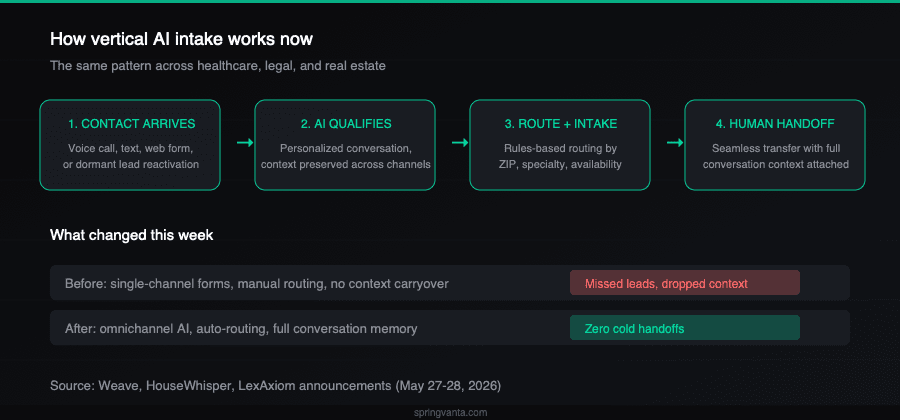
- Multichannel by default. None of these tools silo voice, text, and web into separate queues. Context follows the conversation.
- Vertical-specific guardrails. Weave has HIPAA. LexAxiom has privilege enforcement. HouseWhisper has performance-based pricing tied to actual closings. Generic horizontal tools lack this.
- Full lifecycle, not just first contact. All three moved beyond answering the first inbound message. They nurture dormant leads, route qualified prospects, and hand off to humans with context intact.
Six months ago, most AI intake tools were single-channel form replacements. This week, three verticals independently shipped the same upgrade: omnichannel intake with memory.
For businesses evaluating AI intake, the signal is clear. The floor has moved. Single-channel chatbots and static intake forms are no longer the competitive option. The question is which vertical platform handles your industry's compliance requirements and fits your existing workflows.
Sources
- Weave AI Receptionist announcement (May 28, 2026)
- K Health + Penn Medicine collaboration (May 27, 2026)
- HouseWhisper Lead Engine and Rules Engine via Inman (May 27, 2026)
- LexAxiom LexSuite announcement via VentureBeat (May 27, 2026)
- HouseWhisper press release (May 27, 2026)
- Cloze-SkySlope integration expansion via Real Estate News (May 27, 2026)