Accountable for AI You Don't Control: Three Reports Say the Same Thing
Three reports from June 8 converge on one problem: enterprise AI governance was built for humans, but agents don't wait for approval. IBM, TechTarget, and CCI quantify the accountability gap, security gap, and compliance multiplier.
By Springvanta
Three reports dropped on June 8, 2026, from three different angles — and they all describe the same broken system.
IBM surveyed 2,000 C-level technology executives across 33 countries and found that two-thirds of CIOs and CTOs are being held accountable for AI systems they do not fully control. TechTarget reported that 80% of Fortune 500 companies are running active AI agents while fewer than half have formal security controls. And Corporate Compliance Insights laid out the compliance math: a single misconfigured agent can produce tens of thousands of regulatory violations in one session, because every major privacy framework was written for humans who access records one at a time.
Read those together and you get the full picture. Accountability runs ahead of control. Control runs ahead of governance. Governance was designed for a slower species.
The IBM numbers
The IBM Institute for Business Value study, conducted with Oxford Economics in Q1 2026, puts hard numbers on a problem most technology leaders already feel in their gut.
- 70% of respondents said teams across the business are deploying technology faster than IT can track it
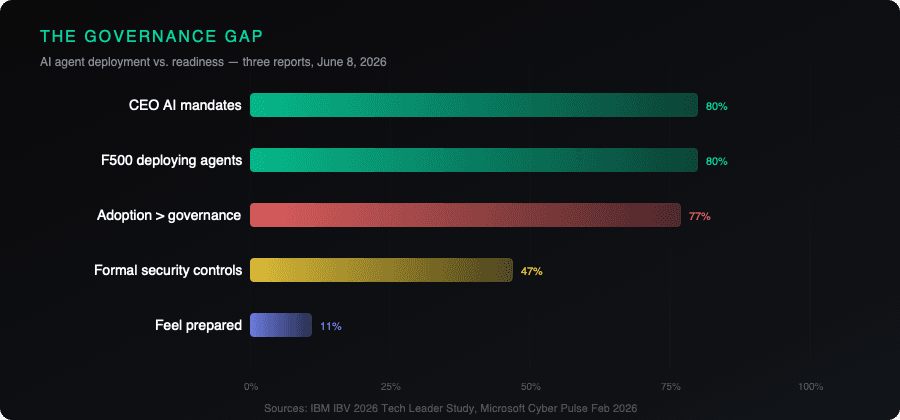
- 80% are operating under CEO-driven AI transformation mandates
- Only 11% believe they are fully prepared for the scale of AI agent deployment expected in the next year
- 77% say AI adoption is already outpacing their governance capabilities
- Organizations experienced an average of 54 AI agent incidents in the past year that required human correction
Of those incidents, 17% were high severity. Among the high-severity ones, 37% resulted in data exposure or security breaches and 33% caused cascading system failures.
Matt Lyteson, IBM's CIO, described the tension plainly: technology leaders are "scaling AI systems that operate continuously and autonomously, often within governance models and architectures designed for a far slower, more predictable environment."
Here is the part that should change how you think about this. Organizations that embed control directly into their AI systems — rather than relying on manual governance or human approval of every output — deploy 16 times more AI agents, deliver 18% higher operating margins, and spend 4 times less of their AI budget. The governance-first crowd is not slower. They are faster, cheaper, and safer.
Shadow agents are the new shadow IT
The TechTarget analysis, by YOUnifiedAI's Eugina Jordan, adds a dimension the IBM study mostly sidesteps: the agents your employees are spinning up without telling anyone.
Citing Microsoft's February 2026 Cyber Pulse report, Jordan noted that 29% of employees are using unsanctioned AI agents — autonomous scripts that bypass formal identity and access controls. When these agents start planning multi-step workflows across your SaaS stack, your network perimeter stops mattering. The real boundary is what Jordan calls the "reasoning layer": the point where a model turns natural language into action.
Her argument for fixing this is architectural, not procedural:
- Separate reasoning from execution. The LLM should only propose an action. A separate, deterministic service validates permissions before anything gets deleted or sent.
- Just-in-time authorization. Use protocols like MCP to issue temporary, scoped credentials that expire the moment a task completes.
- Centralized agent registries. Every autonomous agent should be registered, version-controlled, and monitored for behavioral anomalies. If your analytics agent suddenly queries HR payroll, that should trigger an alert, not just a log entry.
This is not theoretical. Microsoft's Cyber Pulse report confirmed that 80% of Fortune 500 companies already have active agents in production. Fewer than half have the controls to manage them.
The compliance multiplier
The Corporate Compliance Insights piece, written by TrustLogix co-founder Srikanth Sallaka, reframes the problem in financial terms that should make any compliance officer reach for antacids.
Privacy frameworks like GDPR, HIPAA, CCPA, and GLBA impose per-violation or per-record fines. Those fines were calibrated around the assumption that a human operator accesses records one at a time, generates detectable audit trails, and moves slowly enough that incidents get caught before they scale. An AI agent querying databases at machine speed breaks every one of those assumptions.
Sallaka calls this "the multiplier problem." A human might access 5 to 20 records per minute and generate partial audit trails. An agent can query thousands per minute and generate none. Where a human incident might produce tens of regulatory violations, an agentic incident can produce tens of thousands in a single session.
The financial exposure compounds fast. IBM's 2025 Cost of a Data Breach report puts the global average breach cost at $4.44 million, based on human-driven incidents with an average time to identification of 181 days. Agentic incidents compress the timeline and expand the record count at the same time.
Then there is the regulatory attitude shift. Regulators are starting to treat the deployment of an under-governed AI agent as intentional conduct. Under CCPA, that moves incidents from the $2,500 unintentional tier to the $7,500 intentional tier — tripling the per-violation cost. Under HIPAA's updated 2026 penalty schedule, willful neglect starts at $50,000 per violation with a $2.19 million annual cap applied to every record the agent touched.
Sallaka identifies four risk vectors that existing frameworks were not built to handle: over-permissioned tool access (agents use the broadest access available because nothing creates friction), context window data bleed (persistent memory retains PII across sessions), reasoning-driven de-anonymization (agents correlate quasi-identifiers across separate databases), and agent-to-agent PII propagation (multi-agent pipelines create dozens of disclosure events per workflow).
The IBM data supports this: 97% of organizations that experienced an AI-related security incident lacked proper access controls on the AI systems involved.
What the convergence tells us
Read independently, each report describes a piece of the problem. Read together, they describe a structural failure.
The IBM study quantifies the accountability gap: executives own risk for systems they cannot see. The TechTarget analysis maps the attack surface: agents operating outside formal governance, with reasoning-layer vulnerabilities that perimeter security was never built to address. The Corporate Compliance Insights piece calculates the financial exposure: per-record fine structures designed for human-speed actors, applied to agents that operate at machine speed without audit trails.
All three converge on the same diagnosis. Enterprise AI governance was built for humans. Agents do not wait for approval, do not generate readable logs, and do not stop at one record. The governance model needs to catch up to the deployment model, or the fines will do the catching up instead.
What to do in the next 90 days
Both the IBM study and the TechTarget analysis offer roughly the same 90-day roadmap. Collapsed into practical steps:
Days 1-30: Find what is running. Audit every AI agent in your environment, sanctioned and unsanctioned. Tier them by data risk, focusing on anything that touches PII, financial data, or regulated systems. If you cannot inventory it, you cannot govern it.
Days 31-60: Separate reasoning from execution. Pilot the architectural pattern where the LLM only proposes actions and a deterministic service validates permissions before execution. This is the single most impactful structural change you can make right now.
Days 61-90: Consolidate and monitor. Establish a centralized agent registry. Implement behavioral monitoring that flags anomalies — an analytics agent querying HR data, a customer-support agent accessing billing records. Move from static API keys to just-in-time, task-scoped credentials.
The IBM data says this is not a cost center. Organizations with embedded controls deploy 16 times more agents at 4 times lower cost. Governance done right is an accelerator, not a brake.
Sources:
- IBM Institute for Business Value, "2026 Tech Leader Study" (June 8, 2026) — newsroom.ibm.com
- CIO.com coverage of IBM study (June 8, 2026) — cio.com
- CIO Dive coverage (June 8, 2026) — ciodive.com
- Eugina Jordan, "AI agents are running wild: Secure the reasoning layer now," TechTarget SearchCIO (June 8, 2026) — techtarget.com
- Srikanth Sallaka, "Data Privacy Rules Built for Human Behavior Have an AI Agent Problem," Corporate Compliance Insights (June 8, 2026) — corporatecomplianceinsights.com