AI That Runs the Office, Not Just Helps With It
Elation bought Aster. Lassie raised $35M for back-office AI. Kilpatrick built a legal MCP stack. Same week, same signal: vertical AI moving from copilot to operator.
By Springvanta
Something shifted this week. Three companies in three different industries made the same bet within a 96-hour window: that vertical AI should stop assisting people and start doing the work itself.
On Monday, Elation Health acquired Aster, a women's health EHR startup that built a voice agent called Atlas. On Tuesday, Lassie announced a $35M Series A led by Andreessen Horowitz to run back-office operations for medical and dental practices. On Thursday, law firm Kilpatrick launched Kilpatrick Labs, an in-house AI program built on a custom MCP platform connecting 17 enterprise systems.
These are not copilots. They make calls, reconcile payments, route legal work, and verify insurance without anyone watching.
Healthcare: Elation Health buys a voice agent team
Elation Health provides EHR software for primary care physicians. On June 2, it acquired Aster, a three-year-old startup focused on women's health. The acquisition target was not Aster's customer base. It was the team and technology behind Atlas, a voice AI agent that automates front-office coordination: appointment scheduling, insurance verification, lab result management, care navigation.
Kyna Fong, Elation's co-founder and CEO, told Fierce Healthcare the acquisition accelerates development of what she calls "the first agentic operating system for primary care." The framing is deliberate. Elation already embedded Anthropic's Claude into its EHR in January for chart summaries. In March, it rolled out agentic billing workflows. Adding Aster's voice agent technology gives it an automated front office to pair with the automated back office.
Clinicians using Elation's existing AI features report saving six to 10 hours per week, according to Fong. The Aster acquisition pushes that number higher by removing the phone-and-scheduling layer that consumes staff time in independent practices.
Aster was co-founded by sisters Fifi Kara (a Y Combinator alum and former Meta Health design lead) and Dr. Lailah Kara-Newton, who practiced obstetrics and gynecology for over seven years. They started the company after Dr. Kara-Newton experienced undiagnosed preeclampsia during her own pregnancy. The entire Aster team, including CTO Nacho Vazquez, joins Elation.
Medical practices: Lassie's $35M for back-office automation
The day after Elation's acquisition, Lassie announced a $35M Series A led by a16z, bringing its total funding to $47M. The company builds autonomous agents that handle back-office administration for small medical and dental practices.
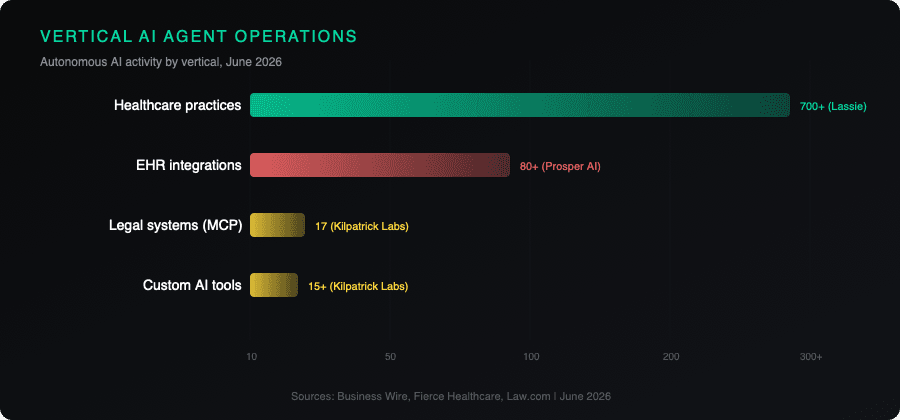
The numbers are concrete. Lassie operates in more than 700 practices across 49 states. Its agents provide over 250,000 hours of labor per year. A typical practice loses more than 100 hours a month to administrative work and spends roughly $200,000 annually on admin staff, according to the company.
What Lassie's agent actually does is specific: it logs into a practice's insurance portals, pulls reimbursement data, reconciles payments against patient records, updates the practice management system, and verifies that funds landed in the bank account. Dr. Eric Kwon, founder of Grace Dental, said the platform saves his practice over 100 hours a month and cut payment processing from four to five weeks down to under a week.
Lassie was founded by Steijn Pelle (an early product manager at Robinhood and Coinbase) and Frédéric Renken (the first product hire at Superhuman). a16z general partner Alex Rampell, who co-founded Affirm, is joining the board. Dr. Ed Zuckerberg and former Robinhood CFO Jason Warnick joined as advisors.
The company says it will expand beyond healthcare to other small business verticals. It started with medical and dental because the administrative pain is both severe and structured enough for an agent to handle reliably.
Legal: Kilpatrick builds its own MCP infrastructure
On June 5, Kilpatrick Townsend & Stockton launched Kilpatrick Labs, an internal AI research and development program. What makes this notable is not the lab itself (law firms launching innovation programs is routine at this point). It is the architecture.
Kilpatrick Labs runs on an in-house Model Context Protocol (MCP) platform that connects 17 of the firm's enterprise systems as standardized, AI-callable tools. The lab is currently developing more than 15 custom AI tools powered by Anthropic's Claude, covering patent and trademark prosecution, litigation monitoring, billing automation, and client-facing applications.
Charles Gray, partner and leader of Kilpatrick Labs, told Law.com the firm previously used an internal wrapper around ChatGPT called Kwery back in 2023. The shift to a custom MCP platform reflects a growing recognition that off-the-shelf AI tools cannot address the specialized needs of a practice without also exposing client data to third-party systems.
The firm runs everything on-premises. Gray said building internally "was the only way to do that without losing control over our clients' data or our attorneys' judgment."
The MCP approach is gaining traction in legal. Artificial Lawyer noted on June 2 that Harvey, Legora, iManage, and NetDocuments are all moving toward MCP support. Kilpatrick is unusual because it is a law firm building its own MCP layer rather than waiting for vendors to provide one.
What ties these together
These are three different industries with three different deployment models. Elation is a platform company acquiring voice AI technology. Lassie is a startup selling autonomous agents as a service. Kilpatrick is a law firm building its own AI infrastructure.
What they share is a common premise: vertical AI works when it operates inside industry-specific workflows, not when it sits on top of them as a generic assistant. Aster's Atlas voice agent works because it knows what questions to ask during patient intake. Lassie's back-office agent works because it understands how insurance reimbursement portals are structured. Kilpatrick's MCP platform works because it maps the firm's own 17 systems into a single AI-callable interface.
The funding and acquisition activity in a single week is a signal, not a trend line. a16z putting $35M into a company that runs dental practice back offices is a specific wager on vertical AI operations. Elation buying a voice agent startup instead of building one says the acquisition market for vertical AI technology is active enough to justify buying rather than building. Kilpatrick building its own MCP stack says that at least some firms are willing to invest in internal AI infrastructure when vendor timelines do not match their needs.
For anyone evaluating AI intake, voice agents, or workflow automation, the practical takeaway is narrow: the market is moving from tools that suggest actions to systems that take them. The question is not whether an AI agent can handle your intake calls or reconcile your payments. It is whether your vendor built for your specific workflows or bolted a chat interface on top of a generic model.
Sources: Fierce Healthcare | Business Wire (Lassie) | Law.com (Kilpatrick) | Artificial Lawyer (MCP in legal)