The Agentic AI Pilot Trap: Forrester Diagnoses It, Three Startups Fix It
Forrester says 75% of enterprises are stuck in agentic AI pilots. On the same day, lakeFS, Relai, and Jedify launched products targeting the three gaps: data isolation, reliability, and business context.
By Springvanta
Three things happened on June 10 that, taken together, explain where agentic AI actually stands in mid-2026.
First, Forrester published "The State of Agentic AI, 2026," finding that three-quarters of enterprise leaders say they're adopting agentic AI but only a small minority have moved beyond pilots. Second, lakeFS launched a product that gives every agent its own isolated data sandbox. Third, Relai raised $6.9 million to stop agent fixes from silently breaking other things. And Jedify raised $24 million to give agents the business context they've been missing.
Read separately, these are four announcements. Read together, they tell a coherent story about why agents stay in pilots and what it takes to get them out.
What Forrester found
The headline number: 75% adoption, minimal production. The technology itself works. "Long-horizon agents" can now run for days or months. Vendors demo this regularly. The gap isn't in the models.
Brian Hopkins, VP and principal analyst at Forrester, said: "The gap we see isn't about models or ambition; it's about orchestration, control, and trust."
The report identifies three specific problems:
- Agent sprawl: More than half of enterprises with formal governance policies still experience it. Writing rules down doesn't enforce them.
- Missing infrastructure: No central registries, no control planes, no automated guardrails for tracking what agents do in real time.
- Operational fragility: Long-horizon agents work in demos but break when they touch production systems at scale.
The Register summarized it this way: "Until companies tie agent autonomy to measurable changes in how work gets done, agentic AI will remain stuck in proof-of-concept purgatory."
Nearly half of security decision-makers cite agentic AI as a concern. The report argues that identity-driven oversight, runtime enforcement, and continuous governance will determine whether organizations can manage the risk or just accumulate it.
Three startups, three gaps
On the same day SecurityBrief covered the Forrester findings, three companies launched products that map directly onto the report's diagnosis.
lakeFS: Data isolation
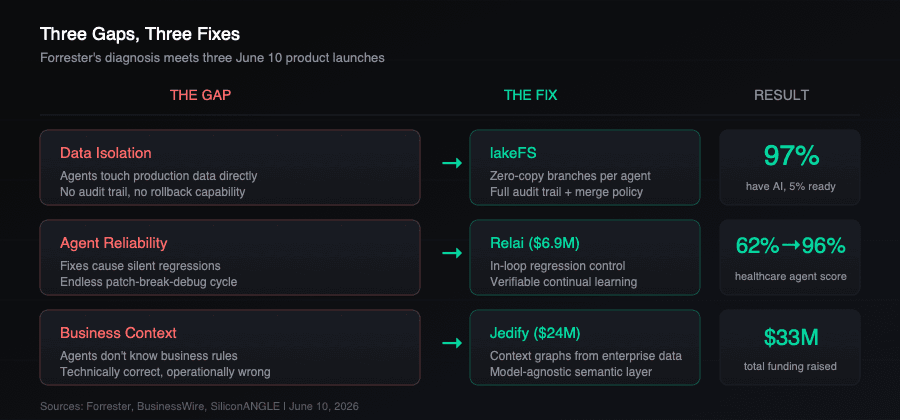
lakeFS for Agentic AI gives every agent run its own zero-copy branch of production data. Changes get validated and merged under policy. Every action produces an audit trail. The platform is already in production at Arm, Bosch, Lockheed Martin, NASA, and Volvo.
The launch included a Dun & Bradstreet stat worth pausing on: 97% of organizations report active AI initiatives, but only 5% say their data is ready to support them.
Einat Orr, CEO and co-founder of lakeFS: "Any agent that reads or writes to production data without isolation or a reproducible trail is a liability, no matter how good the model is."
A Gartner analyst, Michael Simone, added: "As autonomous AI agents become data producers and consumers, traditional manual stewardship cannot scale, making governance automation essential."
This addresses the infrastructure gap Forrester flagged. Agents running against live production data without isolation is exactly the operational fragility the report warns about.
Relai: Agent reliability
Relai emerged from stealth with $6.9M and a platform for what it calls "verifiable continual learning." Founded by Soheil Feizi, a computer science professor at the University of Maryland and Presidential Early Career Award recipient, the company targets the cycle that keeps agents unreliable: a failure occurs, the team patches it, and the fix silently breaks something else.
Relai keeps regression control inside the optimization pipeline. Each proposed improvement gets validated against prior environments while it's being developed, not after it ships. Feizi calls this "online, in-loop regression control."
Early results: a financial services agent went from 39% to 80% validation score. A healthcare agent from 62% to 96%.
Feizi: "For the past two years, the question was whether AI agents could use tools and pass benchmarks. They can. The real frontier now is whether agents can learn continuously from real experience without breaking what already worked."
Kevin Wang from .406 Ventures: "The hardest part is keeping it reliable as teams continuously improve it."
This targets the sprawl problem. Agents that can't learn without breaking require constant human babysitting, which defeats the point.
Jedify: Business context
Jedify raised $24M in a Series A led by Norwest, with a strategic investment from Snowflake Ventures, to build what it calls context graphs. The platform links operational data (warehouses, CRM, financial systems) with unstructured material (documents, playbooks, Slack threads, meeting recordings) into a semantic model that understands business definitions, record relationships, and access permissions.
The problem: LLMs can produce fluent answers but can't determine which definition of revenue applies, which customer record is current, or which operational assumptions matter. Without that context, agents hallucinate or burn tokens on irrelevance.
CEO Assaf Henkin: "Enterprise data is fragmented across systems, definitions, permissions and workflows. Jedify turns that fragmented knowledge into a live context graph that agents can use to produce accurate, cost-efficient, business-ready answers."
Jedify positions itself as model-agnostic, sitting apart from the model providers. The argument: enterprises handing their data to the same vendors selling them tokens face misaligned incentives, and an independent context layer avoids vendor lock-in that clashes with governance requirements.
This is the context discipline gap. Agents that can call tools but don't understand business rules produce technically correct but operationally wrong outputs.
What the convergence tells us
None of these launches are governance frameworks. They're infrastructure. Forrester's Hopkins specifically warned that companies treating agentic AI as "a feature experiment will stay stuck in pilots." These three companies are building the operational structures that make safe production deployment possible.
The pattern:
- Data isolation (lakeFS): Agents need sandboxed environments, not direct production access.
- Reliability verification (Relai): Agents need to learn from failures without introducing regressions.
- Business context (Jedify): Agents need to understand your rules, not just process your inputs.
If your organization is running AI agents and any of these three areas is unclear, you're running a pilot. Which, per Forrester, is where 75% of enterprises still are.
Sources:
- SecurityBrief NZ: Forrester finds agentic AI stuck in enterprise pilots (June 10, 2026)
- The Register: Agentic AI hype races ahead as enterprises remain stuck in pilot mode (June 5, 2026)
- BusinessWire: lakeFS for Agentic AI (June 10, 2026)
- SiliconANGLE: Relai raises $6.9M (June 10, 2026)
- SiliconANGLE: Jedify raises $24M (June 10, 2026)