Vertical AI Stops Reading and Starts Writing Back
Five agentic AI launches in eight days across law, real estate, and healthcare all share one trait: they write back to the system of record instead of just reading from it.
By Springvanta
Something shifted in vertical AI this past week, and it happened across three industries at once.
Between June 2 and June 9, at least five companies shipped new AI products that share one trait: they stopped being read-only. Filevine's LOIS console writes tasks back into a law firm's case system. Legora's new Agent dispatches sub-agents across an M&A data room and delivers a finished due diligence report. MetroList and Lundy launched nora, an AI assistant that manages real estate agents' calendars, compliance questions, and market searches through natural language. DocumentDrafter introduced Agentic Templating, where a lawyer approves a template once and every downstream contract inherits that judgment. LexAxiom shipped LexSuite, a revenue engine that chases leads and runs intake for small law firms.
That is a lot of product launches in eight days. The thing they have in common is not "AI" in the vague sense. It is that all of them act on the system of record instead of just reading from it.
The read-to-write shift
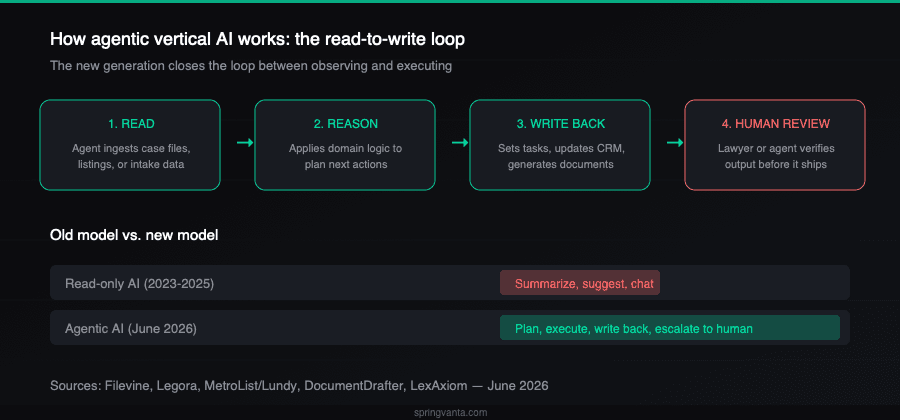
For the past two years, vertical AI tools have mostly been assistants that sit next to your existing software. They summarize, they search, they draft emails. Useful, but fundamentally passive. You ask, they answer. The data flows one way: out of your CRM or case management system, into a chat window.
What shipped this week is different. These tools write back. Filevine's LOIS console is the clearest example. Built on top of Filevine's existing case management platform, LOIS can set tasks, move deadlines, update calendars, generate documents, and run reports inside the firm's system of record. Ryan Anderson, Filevine's CEO, put it plainly: "For ten years, we have watched lawyers get better tools, but tools do not run firms and tools do not win cases. We built the AI that does both."
Kyle Hall, a senior attorney at Kopka Law Group, described taking a 5,000-page claim file and getting it sorted down to a couple hundred pages of tailored summaries. Not a summary he reads in a chat window, but summaries filed back into the case, ready for the next step. "It lets me get into cases earlier instead of waiting two or three days for a human summary," he said.
Legora's Agent takes the same logic further. The company made its Agent generally available on June 4. In one demo scenario, it accesses a virtual data room, builds a multi-phase plan for an M&A deal covering eight practice areas, and dispatches sub-agents to work in parallel. Forty minutes later, the draft due diligence report is done, structured to the firm's house style, with risks flagged red, amber, or green. The company's summary: "Work that used to be 'two associates and a week' is now 'one instruction and a coffee break.'"
Whether that is literally true for every deal is beside the point. The agent plans, executes, and writes results back. The lawyer reviews.
Real estate gets the same treatment
The pattern is not limited to law. On June 9, MetroList, northern California's largest multiple listing service, launched nora, an AI assistant built with Lundy, Inc. Nora manages emails, calendars, MLS compliance questions, and property searches through natural language. It is MLS-connected, meaning it has access to live listing data and can act on it.
Dave Howe, MetroList's president and CEO, described it as a way for agents to "save time, reduce administrative work and stay focused on the needs of their clients." The platform uses a Stripe-powered microtransaction wallet, which is an interesting pricing model: agents pay for what they use rather than a flat SaaS subscription. MetroList gives subscribers trial credits to start.
This is not a chatbot that tells you what a property is worth. It is an agent that handles the actual workflow: scheduling, compliance lookups, document management. The AI writes back to the calendar, the task list, the compliance system.
Legal drafting gets agentic
DocumentDrafter's Agentic Templating, announced June 5, tackles a different piece of the same problem. Instead of having AI draft contracts from scratch (which is where most legal AI has focused), Agentic Templating works from a precedent or template that a lawyer has already reviewed and approved. The lawyer's judgment gets baked into the structure once. Every contract generated from that template inherits the same standards.
Michael Bjerg Hansen, DocumentDrafter's CEO, described it as "AI working upstream, inside a structure the firm controls, where the firm's judgment is made once, and everything downstream inherits it."
This is a practical approach that avoids the hallucination problem that plagues generative legal AI. The AI is not inventing clauses. It is executing a structured process defined by the lawyer, filling in variables and applying logic that the lawyer already approved. The output is deterministic, not probabilistic.
LexAxiom's LexSuite, launched May 27, goes after the same theme from the revenue side. It is an agentic revenue engine for solo and small law firms that follows up with leads, orchestrates intake, routes work, monitors funnel performance, and coaches the team. LexAxiom's CEO, Alexis Austin Litle, emphasized the privilege architecture: "Privilege cannot be retrofitted. It must be the foundational primitive for all credible legal solutions."
Why this week matters
The convergence is the story. It is not that any single one of these launches is revolutionary on its own. It is that they all landed in the same eight-day window, across three verticals, and they all do the same thing: close the loop between reading and writing.
If you are evaluating AI intake or automation for your firm or agency, the bar just moved. The first generation of vertical AI observed and suggested. This generation executes. The evaluation question is no longer "Can this tool summarize my intake data?" It is "Can this tool run my intake workflow end to end, write results back to my CRM, and hand off to a human when judgment is needed?"
The vendors shipping this week are betting yes. The firms and agencies adopting them will find out how much of that is real and how much is still aspirational. Either way, vertical AI is done being a layer on top of your software. It is trying to become the software.
Sources: Filevine, Legora, HousingWire / MetroList, Artificial Lawyer, LexAxiom / VentureBeat