AI Adoption Hits 97% in Real Estate — But Impact Still Trails Behind
Three 2026 surveys reveal vertical AI adoption is surging across real estate, healthcare, and enterprise ERP — but execution lags far behind ambition, with only 17% of...
By Springvanta
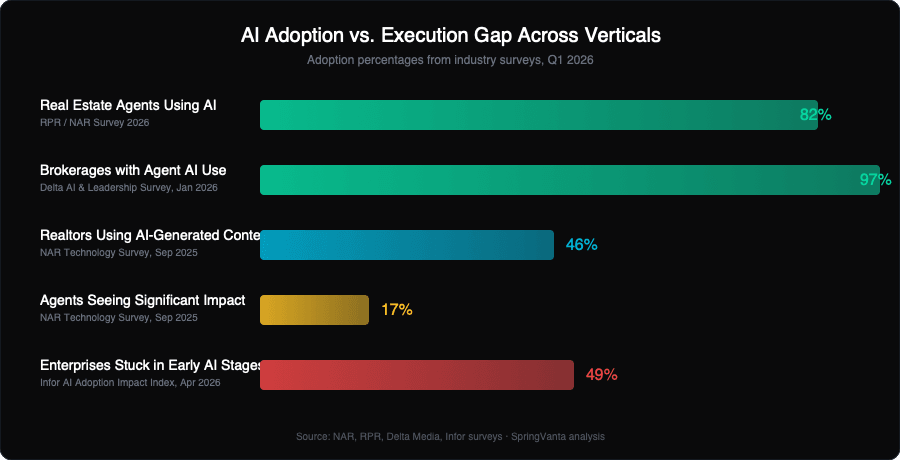
Three new surveys published in the first half of 2026 paint a striking picture of vertical AI adoption: the tools are spreading fast, but the outcomes are lagging. In real estate, 97% of brokerage leaders say their agents use AI, yet only 17% report a significant positive business impact. In enterprise ERP, Infor's new research finds 80% of leaders believe they can manage AI implementation, but 49% remain stuck in early-stage pilots. The pattern repeats across healthcare, legal, and professional services: adoption is outpacing execution, and the bottleneck is no longer awareness. It is workflow integration, data readiness, and vertical specificity.
Real Estate: Ubiquitous AI, Questionable Impact
The 2026 Delta Real Estate AI & Leadership Survey, released in January, found that 97% of brokerage leaders say their agents are using AI , up from 80% in 2024. A separate RPR survey put overall agent AI adoption at 82%, with 68% using AI tools daily or several times a week.
But NAR's own 2025 Technology Survey reveals the disconnect: while 46% of Realtors use AI-generated content (mostly ChatGPT for listing descriptions), only 17% say AI has had a significantly positive impact on their business. A full 46% report no noticeable change.
The gap is telling. Most agents are using AI as a content generator , writing listing descriptions, social media posts, and email campaigns. Few have integrated AI into the workflows that actually drive revenue: lead qualification, intake conversations, appointment scheduling, and follow-up sequences. Content creation is easy. Workflow automation is where the real value lives, and where most agents have not yet arrived.
Platforms are responding. MoxiWorks launched RISE, an AI-native marketing platform that predicts buying and selling intent within 30-, 60-, and 90-day windows. Luxury Presence raised $37 million to build an AI-powered CRM relationship engine. Zillow Pro now connects consumer behavior data with CRM workflows. The infrastructure for AI-driven lead automation is maturing. The question is whether agents will move beyond content generation and into the intake and qualification workflows where AI can actually close deals.
Enterprise ERP: Infor's Vertical Agent Bet
In April 2026, Infor released its Enterprise AI Adoption Impact Index, surveying 1,000 business decision-makers across the US, UK, Germany, and France. The headline finding: 80% of leaders believe they can manage AI implementation, but 49% are still in early AI stages , running pilots only, paused, or yet to start.
The barriers identified are structural, not aspirational:
- Data security, sovereignty, and compliance: 36%
- Discomfort with autonomous agents executing critical processes: 31%
- Doubts about organizational data maturity: 27%
- Lack of internal AI talent: 25%
- Unclear business benefits or ROI: 23%
Infor's response is to ship 100+ industry-specific AI agents across eight verticals , from dairy producers to EV manufacturers to healthcare providers , connected through an Agentic Orchestrator that coordinates multi-agent workflows with native MCP connectivity. CEO Kevin Samuelson's framing is direct: "A purchasing agent at a healthcare provider and one at a discrete manufacturer aren't the same agent. They shouldn't be."
The early results are promising. Xpress Boats reported a 98% improvement in process issue diagnosis speed, a 95% reduction in returns processing time, and a 50% reduction in expedited shipping costs. Coram International achieved 15% faster picking and 25% less travel distance in warehouse operations. These are not AI demos. They are production outcomes from vertical-specific agents embedded in real workflows.
Healthcare: Voice AI Moves Into Patient Intake
Healthcare is where vertical AI intake automation is moving fastest. The front-desk bottleneck , scheduling, insurance verification, prescription refills, new patient intake , is the exact problem voice AI agents are built to solve.
The market is crowded and maturing. Bland.ai offers HIPAA-compliant voice agents with self-hosted architecture that keeps PHI on the provider's infrastructure. Retell AI targets developer-built HIPAA patient intake agents. Syllable (ActiumHealth) focuses on enterprise health system intake. Infinitus handles payer-provider administrative workflows. The platforms are shipping production features, not prototypes.
What makes healthcare intake different from generic chatbot deployment is the compliance bar. HIPAA requires signed Business Associate Agreements, end-to-end encryption, structured audit trails, and verifiable third-party certifications. Voice AI agents carry a higher compliance burden than text-based tools because PHI is processed in real-time audio streams. Platforms that clear this bar are the ones gaining traction with actual healthcare providers.
The 10+ voice AI platforms now competing for healthcare intake all claim HIPAA compliance. The differentiator is increasingly EHR integration depth , whether the agent can write appointments back to the scheduling system in real-time, or whether staff still need to reconcile records manually.
What This Means for Intake Automation
Across all three verticals, the pattern is the same:
-
Adoption is no longer the bottleneck. Agents, brokers, practice managers, and enterprise leaders have moved past "should we use AI?" to "how do we make AI work in our specific workflows?"
-
Generic AI produces generic results. Infor's finding that 95% of businesses are not generating value from generic AI investments (per MIT research cited in Computer Weekly) aligns with NAR's data showing 46% of agents see no noticeable AI impact. The tools work. The integration does not.
-
Vertical-specific workflows are the unlock. A purchasing agent that understands healthcare supply chains is different from one that understands discrete manufacturing. A patient intake voice agent that integrates with Epic is different from a chatbot that collects form data. A real estate lead qualification agent that knows MLS data and local market conditions is different from a generic CRM chatbot.
For organizations evaluating AI intake automation, the research points to a clear framework: start with the workflow, not the tool. Map the intake process end-to-end. Identify where data moves between systems, where handoffs create delays, and where compliance requirements constrain automation choices. Then evaluate vendors on their ability to handle that specific workflow , not on their AI capabilities in the abstract.
The enterprises and practices that will see the 17% become 50% or more are the ones building vertical-specific AI into the intake and qualification workflows where revenue actually gets generated. Content generation is table stakes. Workflow automation is the game.
,-
Sources:
- Delta Real Estate AI & Leadership Survey, January 2026
- NAR 2025 Technology Survey
- RPR AI Adoption Report, February 2026 (HousingWire coverage)
- Infor Enterprise AI Adoption Impact Index, April 2026
- Infor April 2026 Release Notes
- Placester: 13 Impactful Real Estate Marketing AI News in 2026
- How Brokers Can Help Agents Stay Competitive, NAR, May 2026