Google I/O 2026: Antigravity, MCP Everywhere, and Agent-First Dev
Google I/O 2026 shipped Gemini 3.5 Flash, Antigravity 2.0 IDE, MCP on mobile devices, and Gemini Spark. Here is what businesses building with AI agents need to know.
By Springvanta
Google used its annual I/O developer conference on May 19 to announce something bigger than a model update. The company is restructuring its entire AI developer stack around autonomous agents, from the IDE down to mobile devices.
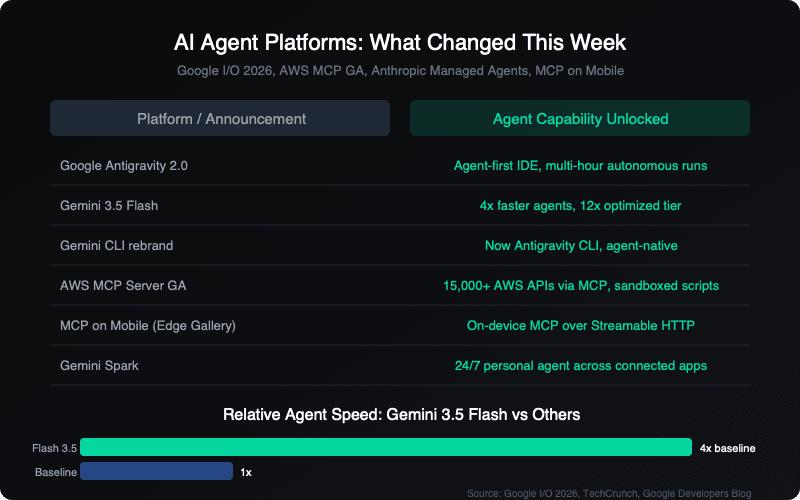
Gemini 3.5 Flash is the technical centerpiece. Google DeepMind chief technologist Koray Kavukcuoglu told reporters it outperforms the company's previous frontier model, 3.1 Pro, on "nearly all the benchmarks" including coding, agentic tasks, and multimodal reasoning. It runs four times faster than other frontier models, with an optimized tier that hits 12x speed at the same quality.
That speed matters because Flash was co-developed with Antigravity, Google's agent-first development platform. On stage, Google engineer Varun Mohan demonstrated multiple agents spawning off to work on separate components, then reassembling their output into a complete operating system. Antigravity 2.0 launched the same day as a standalone desktop application.
What Is Antigravity 2.0 and Why Does It Matter?
Antigravity is Google's answer to Cursor, Claude Code, and Windsurf. It is a standalone IDE where AI agents have a "native environment where they can live, work, and execute," as Kavukcuoglu described it. Unlike a chat window bolted onto a code editor, Antigravity treats the agent as the primary operator. Developers describe outcomes. Agents plan, write, test, and iterate.
The key difference from earlier AI coding tools: agents can run autonomously for multiple hours. Google's senior director of product Tulsee Doshi confirmed the model will pause and ask for human input at decision points that require judgment, but the default mode is hands-off.
Google also announced that the Gemini CLI is being rebranded as the Antigravity CLI, consolidating its command-line agent tooling under one name.
How Does Gemini 3.5 Pro Fit In?
Flash is fast. Pro is the orchestrator. When Google ships 3.5 Pro (currently internal, wider release expected in June), the two models work in tandem. Doshi explained: "3.5 Pro becomes your orchestrator, your planner, and then it actually can use Flash to be the various sub-agents."
This mirrors patterns already emerging in enterprise deployments, where a reasoning-heavy model breaks work into tasks that faster, cheaper models execute. Google is building that architecture into the platform itself.
What About MCP on Mobile?
On the same day as the I/O keynote, Google's developer blog announced that the AI Edge Gallery app for Android now supports the Model Context Protocol over Streamable HTTP. This is an experimental feature that lets an on-device Gemma 4 model call external tools via MCP servers.
The reasoning and tool selection happen entirely on the phone. The MCP server handles execution, whether it runs on a home computer or a cloud endpoint. Use cases include connecting to Google Workspace MCP for calendar and email queries, Google Maps MCP for location data, and web fetch MCP for real-time information retrieval.
For teams building customer-facing AI agents, on-device MCP changes the deployment equation. A voice intake agent could run locally on a customer's phone, calling backend MCP servers for CRM lookups or appointment scheduling without routing everything through a cloud LLM.
How Does This Compare to Anthropic and AWS?
Google is not alone in this push. The same week:
- Anthropic shipped Claude Managed Agents with "dreams" (background reasoning), multi-agent orchestration, outcomes-based workflows, and webhooks. The redesigned Claude Code desktop app now supports parallel sessions and SSH on Mac.
- AWS made its MCP Server generally available. Agents can call any of 15,000+ AWS APIs through a single tool, run sandboxed Python scripts server-side, and discover curated "skills" for complex tasks. The server integrates with CloudTrail for audit logging and IAM for access control.
- Google Cloud has 50+ managed MCP servers covering Maps, BigQuery, Cloud Run, Kubernetes Engine, and Workspace services.
Three major cloud providers are now shipping MCP servers as first-party products. The protocol Anthropic open-sourced has become the default integration layer for AI agents accessing real-world services.
What Does This Mean for Businesses Building With AI?
The practical takeaway is about speed and cost. Gemini 3.5 Flash is available at half to one-third the price of comparable frontier models, according to Google. If you are running agents that execute multi-step workflows, coding pipelines, or data processing tasks, the price-to-performance ratio makes high-volume agent deployment more feasible.
Gemini Spark, Google's new 24/7 personal agent, is entering beta for trusted testers. It reasons across connected apps like Gmail and Calendar. For SMBs evaluating AI tools, Spark represents the consumer-facing version of the same agent architecture that Antigravity provides to developers.
The MCP standardization across Google, AWS, and Anthropic means your agent integrations are portable. A tool you build against Google's Maps MCP today follows the same protocol as one you build against AWS's CloudFormation MCP tomorrow.
Sources
- Google Gemini 3.5 Flash: Agents, Not Chatbots - TechCrunch, May 19, 2026
- Google AI Edge Gallery: MCP Integration, Notifications, Session Continuity - Google Developers Blog, May 19, 2026
- Google Debuts New AI Models, Personal AI Agents - CNBC, May 19, 2026
- AWS MCP Server Now Generally Available - AWS News Blog, May 6, 2026
- Anthropic Claude Updates: Managed Agents, Memory, Legal MCP - Releasebot, May 2026