The AI Agent Accountability Gap: 80% See Risky Behavior
Five independent reports confirm enterprises deploy AI agents far faster than they govern them. Microsoft and Google respond with governance tools in the same week.
By SpringVanta
Eighty percent of organizations have already encountered risky behavior from their AI agents. That is not a prediction , it is a finding from McKinsey's 2026 enterprise AI survey, and it landed the same week Microsoft and Google shipped dedicated governance tools for the same problem.
The data points stacking up in May 2026 tell a clear story: enterprises are deploying AI agents faster than they can govern them. For service businesses evaluating AI automation , intake forms, voice agents, lead qualification , this is not an abstract governance debate. It is a practical question of whether your AI systems will work for you or against you.
The numbers that define the gap
Five independent sources published findings in the past month that converge on the same conclusion:
- McKinsey (2026): 80% of organizations have encountered risky AI agent behavior , actions that were unintended, unauthorized, or outside acceptable guardrails. Only one-third report governance maturity.
- Dataiku (2026): 87% of CIOs say AI agents are already embedded in their enterprises, yet 75% lack real-time visibility into agent operations in production.
- Deloitte/MIT Technology Review (2026): 74% of companies plan to deploy agentic AI within two years, but only 21% report having a mature governance model for autonomous agents.
- ISACA (2025): 66% of industry leaders believe formal agent accountability frameworks will become mandatory within two years.
- Gartner (2025): Over 40% of agentic AI projects will be canceled by the end of 2027 due to escalating costs, unclear value, or inadequate risk controls.
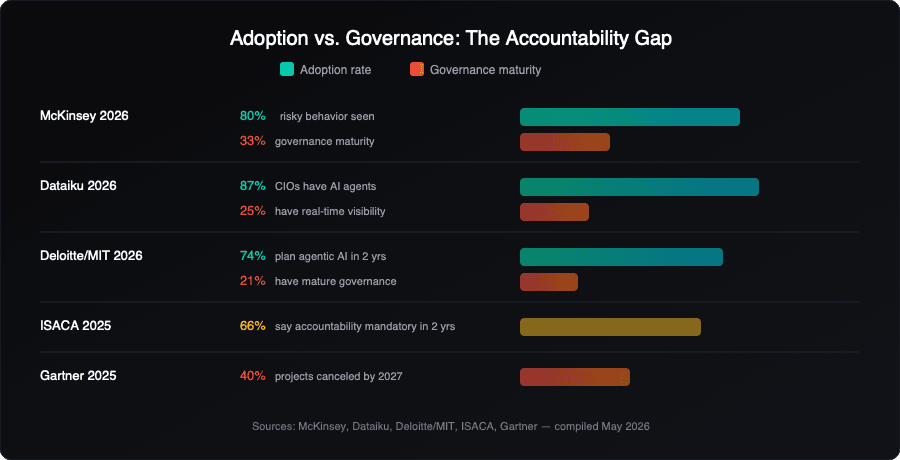
None of these sources are talking to each other. They surveyed different populations, used different methodologies, and published on different timelines. The convergence is what makes it significant.
The platform response: two control planes in one week
The same data tidal wave prompted the two largest enterprise software vendors to ship governance products within days of each other.
Microsoft Agent 365 reached general availability on May 1, 2026. Priced at $15 per user per month (or bundled into the new Microsoft 365 E7 suite at $99 per user per month), Agent 365 provides a centralized control plane for discovering, governing, and securing AI agents across Microsoft environments and third-party platforms. It integrates with Microsoft Entra for identity management, Microsoft Defender for threat protection, and Microsoft Purview for data governance. New capabilities include discovery of shadow AI agents on Windows devices , including unsanctioned tools like Claude Code , and a unified agent registry that treats AI agents as manageable enterprise resources alongside users, devices, and applications.
Google's AI Control Center for Workspace launched on May 4, 2026. It gives Workspace administrators a single dashboard to manage all generative AI activity across Gmail, Drive, Docs, Sheets, Slides, Meet, Calendar, Chat, and the Gemini app. Four modules cover monitoring and access control, per-product security policies, data loss prevention rules, and privacy guarantees. Google also opened its Workspace MCP server to public developer preview, letting third-party AI agents access Workspace data through a governed channel.
As Forrester principal analyst Biswajeet Mahapatra noted, the announcements position AI governance as "an operational discipline owned jointly by IT and security." Omdia chief analyst Lian Jye Su called governance "a core component of all AI-assisted enterprise applications."
What the platforms do not cover
Both tools are significant steps forward. But as the analysts themselves noted, the hardest governance problems sit outside any single vendor's console.
Shadow AI agents , built through low-code platforms, browser extensions, developer tools, or embedded SaaS features , can bypass centralized controls and operate with inherited permissions. Third-party integrations expand agent reach without equivalent visibility into downstream data propagation. And audit logs may show what an agent did, but not always why it chose to do it.
Pareekh Jain, CEO of Pareekh Consulting, put it plainly: "Audit logs may show what happened, but not always why an autonomous agent chose an action."
A landmark 2026 report from Accenture and the Wharton School of Business captured the structural problem: "Intelligence may be scalable, but accountability is not."
Why this matters for service businesses
If you are deploying AI agents for customer intake, lead qualification, voice reception, or form automation, the accountability gap has direct implications:
You cannot scale what you cannot see. If 75% of CIOs lack real-time visibility into production agents, the first step before adding any new AI tool is establishing a registry of what is already running. What agents exist? What data do they access? What actions can they take?
Governance is not a brake , it is an accelerator. The companies in the top 12% of agentic AI ROI are almost entirely the ones whose governance layer catches problems before they compound, according to Stanford's 2026 Enterprise AI Playbook. Clear governance means you can deploy agents faster because you have defined boundaries.
Regulation is weeks away, not years. The EU AI Act's main body takes effect in August 2026. Colorado's AI Act takes effect June 30, 2026. California, New York, Utah, and Texas have already enacted AI governance laws. If you operate in any of these jurisdictions, agent accountability is a compliance requirement, not a best practice.
The microservices analogy holds. A decade ago, enterprises solved the tension between microservice autonomy and operational control by building service meshes, mutual TLS, and centralized observability. AI agents need the same infrastructure. The question is not whether to give agents autonomy or accountability , it is whether you have the governance layer to deliver both.
What to do this week
- Inventory your agents. Every AI tool touching customer data, forms, voice systems, or CRM should be in a single registry with named owners.
- Check visibility. Can you answer , right now , what each agent did in the last 24 hours, under whose authority, and with what data?
- Evaluate platform controls. If you are a Microsoft or Google shop, Agent 365 and the AI Control Center are available now. Test them against your actual agent fleet.
- Plan for cross-platform governance. No single vendor covers every agent in your environment. Budget for governance tooling that works across SaaS, cloud, and local deployments.
The enterprises that will scale AI agents successfully in 2026 are not the ones with the most agents. They are the ones with the best answers to the question: when something goes wrong, who is responsible , and can you prove it?
Sources:
- Tigera, "The AI Agent Accountability Crisis" (May 14, 2026)
- Computerworld, "Microsoft, Google push AI agent governance into enterprise IT mainstream" (May 5, 2026)
- Microsoft Security Blog, "Microsoft Agent 365, now generally available" (May 1, 2026)
- Google Workspace Updates, "AI control center" (May 4, 2026)
- Deloitte/MIT Technology Review, "Building agent-first governance and security" (April 2026)
- McKinsey, "Trust in the Age of Agents" (2026)
- GadgetBond, "Google Workspace now has a central hub to control all AI and agent access" (May 5, 2026)