AI Overviews CTR Floor in Sight: What the 2026 Data Shows
Three studies confirm AI Overviews suppress CTR — but early 2026 data shows stabilization. What the numbers mean for your search strategy.
By Springvanta
The Numbers Are Starting to Stabilize
After 18 months of click-through rate freefall, the data is showing something unexpected: the decline from AI Overviews may be bottoming out.
Seer Interactive's v3 AIO CTR study , published April 24, 2026 , analyzed 53 brands across 5.47 million tracked queries and 2.43 billion organic impressions. Their Q4 2025 model projected continued decline into 2026. Instead, organic CTR on AIO-present queries climbed from 1.3% in December 2025 to 2.4% in February 2026 , an 85% rebound in two months.
This doesn't mean recovery. Pre-AIO CTRs were 3.2% and higher. But it does suggest the worst of the shock has passed, and a new baseline is forming.
Three independent studies now confirm the direction , even if their exact numbers aren't directly comparable:
- Pew Research tracked 900 US adults across 68,879 real Google searches: 8% click rate when an AI Overview appears versus 15% without , a 47% relative decline in click probability.
- Ahrefs analyzed 300,000 keywords comparing December 2023 (pre-AIO) to December 2025: 58% lower CTR on the top-ranking page when an AI Overview is present, up from 34.5% in their April 2025 analysis.
- Seer Interactive tracked the longest time series , from 1.76% organic CTR on AIO keywords in June 2024 to a floor of 0.61% in September 2025, with the early 2026 stabilization pushing back up to 2.4%.
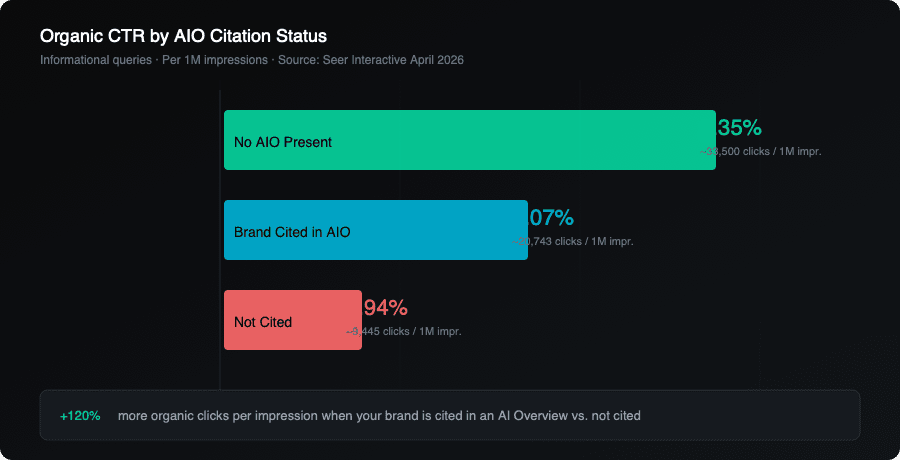
Average organic CTR by AIO citation status across informational queries. Source: Seer Interactive April 2026 update.
Citation Status Is the Lever That Matters
The Seer data reveals a dynamic that most coverage misses: AIO presence alone isn't the primary driver of CTR. Whether your brand is cited in the AI Overview is.
Being cited in an AI Overview delivers +120% more organic clicks per impression compared to being on the same SERP without a citation. For every 1 million impressions on informational queries:
- No AIO present: ~33,500 organic clicks
- Brand cited in AIO: ~20,743 organic clicks
- AIO present, brand not cited: ~9,445 organic clicks
The gap between cited and not-cited persisted in every single month of the dataset , throughout all of 2025, being cited delivered 2–5× the organic CTR of appearing on an AIO SERP without a citation.
There's a critical nuance here: CTR can drop even when clicks hold steady. In October 2025, Seer's data showed a 52% month-over-month CTR decline for cited brands. But clicks barely moved (398K to 400K). What actually happened was that impressions more than doubled , from 15.8M to 33.1M , because more queries earned citations. The denominator grew faster than the numerator. Always look at clicks and impressions separately before calling something a problem.
Query Intent Determines Exposure
Not all search programs face the same level of AI Overview risk. The Seer study classifies queries by intent and the gap is dramatic:
- Informational queries: AIO appears 36% of the time
- Commercial queries: AIO appears 8% of the time
- Transactional queries: AIO appears just 5% of the time
That 7× gap means brands with primarily transactional search programs have meaningful protection at current levels. But informational content , the how-tos, the comparisons, the what-is pages that many businesses built their organic strategy around , is operating squarely in AIO territory.
Specific query formats are almost guaranteed to trigger an AI Overview:
- Comparison queries ("X vs Y"): 95.4% AIO rate
- Question queries (what/why/how): 85.9% AIO rate
- Price/cost queries: 83.4% AIO rate
- "Near me" informational queries: 76.9% AIO rate
If your content strategy depends on comparison pages or Q&A formats, those pages are already competing against AI-generated answers.
Google's May 6 Response
On May 6, 2026, Google announced five updates to AI Overviews and AI Mode , inline links next to bullet points, hover previews on desktop, a "Subscribed" label for news subscriptions, article suggestions at the end of AI answers, and Community Perspectives with Reddit and forum quotes.
Google framed these purely as UX improvements. The words "click crisis" and "publisher pressure" don't appear in the official blog post.
But the context tells a different story. These updates arrived after months of escalating pressure: Penske Media's antitrust lawsuit, the European Publishers Council's EU Commission complaint, a Search Engine Land survey showing 33% of SEOs want to block Google once opt-out mechanisms exist, and Alphabet's own Q1 2026 earnings revealing that Google Network revenue (external AdSense) fell 4% to $6.97 billion while Search on Google's own SERPs grew 19%.
Google is managing a trade-off: keep the AI answer as the primary interface while letting enough clicks through to keep the content ecosystem alive.
What This Means for Your Strategy
The early 2026 stabilization changes the strategic calculation. Last year's default assumption : "AIO will keep crushing organic CTR, plan for decline" , no longer holds. That doesn't mean growth; it means the floor is visible, and where you stand on that floor depends heavily on your citation status.
For CMOs and marketing leaders:
-
Don't abandon AIO-heavy queries. A CTR drop isn't automatically a pullback signal. Your brand may be earning visibility inside the AI answer itself , check impressions and clicks separately in Google Search Console, filtered by Search Appearance → "AI Overviews" and "AI Mode."
-
Citation optimization is your highest-use SEO investment. The data is unambiguous: on an AIO-present SERP, being the cited source is the difference between ~20,700 clicks per million impressions and ~9,400. That means answer-first content structure, clean schema markup, strong entity signals, and demonstrable E-E-A-T across your digital footprint.
-
Double down on non-AIO query clusters. Queries without an AI Overview ended 2025 with higher CTRs than where they started (2.8% → 3.8%). These represent topics Google can't easily synthesize , they're opportunities for differentiation that won't get compressed by AI summaries.
-
Track paid search as your predictable baseline. Paid CTR held between 13–16% on AIO-present queries throughout 2025 with minimal variance. Use it as your forecasting anchor while organic continues to stabilize.
For practitioners:
- Audit your comparison and Q&A pages immediately. At 95% and 86% AIO trigger rates respectively, these formats need citation optimization, not just traditional ranking work.
- Build content that earns citations, not just answers. The goal isn't to answer the question , it's to be the source Google points to when it answers the question.
- Segment your Search Console data by AIO status. The gap between AI Mode impressions and clicks is your most direct traffic-loss indicator.
- Monitor the transactional frontier. AIO prevalence on transactional queries sits at just 5% today, but that number will move. When it does, the commercial impact per lost click will dwarf what we've seen in informational search.
The organizations that started pivoting toward citation-based SEO and multi-platform discoverability 6–12 months ago are the ones showing the earliest signs of recovery in Seer's data. The ones still waiting for the dust to settle are paying a higher price every month.
Sources:
- Seer Interactive, "AIO Impact on Google CTR: 2026 Update," April 24, 2026 : seerinteractive.com
- Ahrefs, "AI Overviews Reduce Clicks (Updated Study)," February 4, 2026 : ahrefs.com
- Pew Research Center, "Google users are less likely to click on links when an AI summary appears," July 2025 : pewresearch.org
- Google Blog, "5 new ways to explore the web with generative AI in Search," May 6, 2026 : blog.google
- SEO Kreativ, "AI Overviews Are Killing Clicks – Now Google Is Backtracking," May 10, 2026 : seo-kreativ.de