AI Agent Governance Enters the Framework Wars
AWS, NIST, CSA, and Forrester published competing AI agent security frameworks in 2026. Here's what the governance gap means for enterprises deploying agents.
By SpringVanta
AI agents are moving into production faster than the frameworks meant to govern them. In the first five months of 2026 alone, four major security and governance frameworks have landed , each addressing a different slice of the same problem: enterprises are deploying autonomous AI agents at scale while the controls to secure them remain incomplete.
Here's what changed this quarter and why it matters for any organization deploying , or about to deploy , agentic AI workflows.
The AWS AI Security Framework: Defense-in-Depth for Three Agent Types
On May 15, 2026, AWS published its AI Security Framework, organizing AI workloads into three categories based on risk and autonomy:
- AI that answers : Retrieval and generation systems with limited external connectivity
- AI that connects : Agents that interact with external APIs, databases, and services
- AI that acts : Fully autonomous agents that execute multi-step tasks across systems
Each category gets progressively stronger security controls across three layers: infrastructure security, identity and data security, and AI application security. The framework also introduces a three-phase deployment model : Foundational, Enhanced, and Advanced , that ties security investment to maturity.
For enterprises building agent-based intake forms, lead qualification workflows, or CRM automation, the "AI that acts" category applies directly. These agents need identity propagation controls, behavioral monitoring, and audit trails that most current deployments lack.
NIST's AI Agent Standards Initiative: The Government Response
The U.S. government's approach came into focus through two moves. First, NIST CAISI issued a Request for Information on January 8, 2026 , the first formal U.S. initiative specifically scoped to cybersecurity controls for autonomous AI agents. Then on February 17, NIST launched the AI Agent Standards Initiative, organized around three pillars:
- Industry-led standards facilitation through technical convenings
- Open-source interoperability protocols targeting MCP and Agent-to-Agent (A2A) profiles by Q4 2026
- Fundamental research on agent authentication and identity infrastructure
The critical detail: the first substantive NIST deliverables are not expected before late 2026. SP 800-53 control overlays designed for agent systems remain in development. Organizations deploying agents today operate in a standards vacuum.
CSA Research Note: The Numbers Behind the Governance Gap
The Cloud Security Alliance's April 2026 research note, "The AI Agent Governance Gap: What CISOs Need Now," aggregates survey data from multiple sources to paint a stark picture:
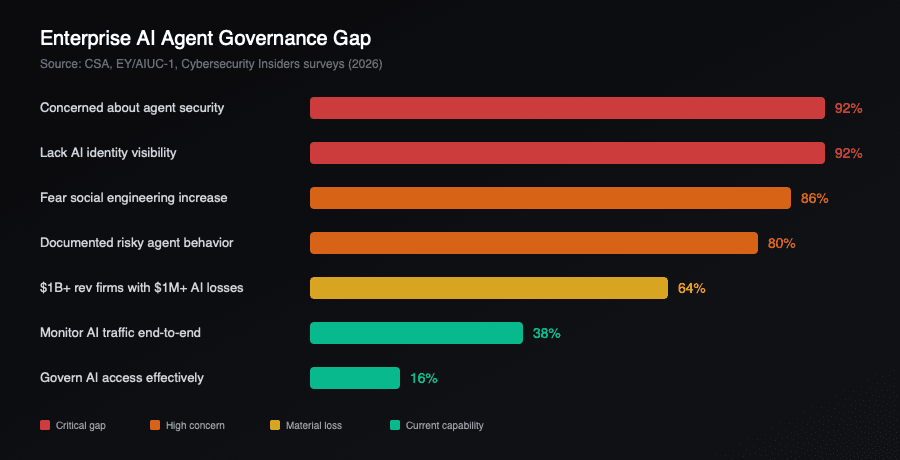
The gap between adoption speed and governance capability is not incremental , it's structural. Existing frameworks like NIST AI RMF 1.0, ISO/IEC 42001:2023, and the EU AI Act were designed for AI systems whose behavior could be characterized at deployment time. Autonomous agents that call APIs, spawn sub-agents, and adapt in real time violate those assumptions by design.
The identity problem is particularly acute. Among 235 large-enterprise CISOs surveyed, 92% lack full visibility into their AI agent identities, and 95% doubt they could detect or contain a compromised agent. Only 16% effectively govern AI access to core business systems like ERP, CRM, and financial platforms.
Data Readiness: The Foundation Nobody Built
A May 2026 Observer analysis highlighted a parallel problem: while organizations invest in AI governance structures, most neglect the data foundations those systems depend on. The Cloudera Data Readiness Index 2026 found that 96% of organizations report integrating AI into core business processes, yet nearly 80% admit their AI initiatives are constrained by limited data access across environments.
This matters for agent deployments specifically because agents don't just read data , they act on it. An intake agent that qualifies leads based on incomplete CRM records, a voice agent that pulls from inconsistent customer histories, or a workflow agent that operates across siloed databases: each compounds data quality problems into operational failures at machine speed.
Starbucks' widely reported AI inventory tool failure illustrates the point. The system was designed to automate stock counts and refills but received inaccurate data, resulting in inventory waste, product shortages, and reduced sales. The AI didn't fail , the data did.
What This Means for Organizations Deploying AI Agents
The convergence of these frameworks and data points creates a clear action agenda:
1. Build an agent inventory now. You cannot govern what you cannot see. Enumerate every AI agent deployment , including those provisioned by business units without IT involvement. Capture identity, delegated permissions, connected data sources, and human ownership.
2. Apply least-privilege to agent credentials. Only 16% of organizations effectively govern AI access to core systems. Even without agent-specific identity standards, existing PAM and IAM controls can be applied. Agents should receive time-bound, just-in-time credentials scoped to specific tasks.
3. Start monitoring agent-to-agent traffic. Only 17% of organizations continuously monitor agent-to-agent interactions. Extend SIEM and behavioral analytics to capture tool call sequences, API requests, and data access patterns.
4. Fix your data before you scale agents. Data readiness is the foundation. Clean, classify, and document the data your agents will touch before expanding deployments.
5. Use the OWASP Agentic Top 10 as your baseline threat model. Published in December 2025, it covers the primary attack surfaces unique to autonomous systems , goal hijacking, supply chain vulnerabilities, memory poisoning, and rogue agent behavior.
The Clock Is Running
The EU AI Act's enforcement deadline for high-risk AI systems arrives August 2, 2026. In the U.S., sector regulators : OCC, FFIEC, FDA, CISA, SEC , have existing authorities they can apply to AI agent deployments even without new legislation. Organizations that build governance infrastructure now will present agent registries, authorization policies, and audit trails to regulators. Those that don't will face compliance under pressure.
The frameworks are arriving. The agents are already here.
Sources: AWS Security Blog, NIST CAISI RFI (Jan 2026), NIST AI Agent Standards Initiative (Feb 2026), CSA Research Note (Apr 2026), Observer (May 2026), Cloudera Data Readiness Index 2026, Gartner (Aug 2025)