Google Overhauls AI Search Links as ChatGPT Builds an Ad Platform
Google shipped five new link features for AI Mode on May 6. The same week, OpenAI launched a self-serve Ads Manager for ChatGPT.
By Springvanta
On May 6, 2026, Google rolled out five changes to AI Mode and AI Overviews that make source links more prominent than they have ever been in a generative search result. Two days earlier, OpenAI had opened a self-serve Ads Manager for ChatGPT. And running alongside both, Google published new guidelines for building websites that AI agents can actually navigate.
Three moves in one week. None of them are incremental. Together they redraw the map for how businesses get found when the answer comes from an AI instead of a blue link.
What Google actually changed
Google's May 6 update touches every layer of the AI search result:
- Inline links. Source citations now appear directly next to the claim they support, instead of being grouped at the bottom of the AI response. A search about California bike touring puts a link to a Pacific Coast guide right beside the terrain bullet point.
- Hover previews. On desktop, mousing over an inline link shows the website name and page title before you click. Google's internal testing found people hesitated to follow links when they could not tell where they led.
- Community Perspectives. AI responses now surface quotes from Reddit threads, expert blogs, and public forums, with the creator's name or community attached. Google frames it as giving users access to real-world advice rather than a synthesized summary.
- Subscription labels. Links from news publications you already pay for get a "Subscribed" badge. Early testing showed users were significantly more likely to click labeled subscription links.
- Explore Further. A new end-of-answer section suggests deeper articles, case studies, and analyses on adjacent facets of your topic. It positions the AI response as a starting point, not a dead end.
The framing is publisher-friendly. The practical effect is more nuanced.
The 93% problem
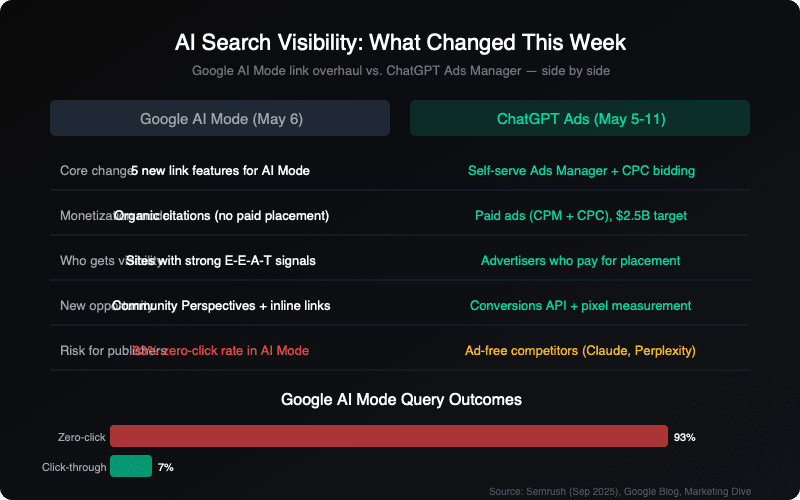
According to Semrush data from September 2025, 93% of searches conducted in Google AI Mode end without a single click to an external website. That figure predates these link changes, so it may improve. But the baseline is stark: for every 100 people who see your content cited in an AI Mode response, roughly 7 will actually visit your site.
Google's link overhaul is, in part, an acknowledgment of that pressure. eMarketer characterized the update as an attempt to "curb zero-click losses." Making links more visible and trustworthy is the right structural move. Whether it moves the 93% needle meaningfully is the open question that matters to every business with a content strategy.
What ChatGPT Ads Manager changes
While Google tries to make organic links more clickable, OpenAI is building a paid discovery layer on top of ChatGPT.
On May 11, OpenAI launched a beta self-serve Ads Manager for US businesses. Advertisers can now set budgets, upload creatives, launch campaigns, and track performance through a dedicated portal. The platform supports both CPM and cost-per-click bidding, with a new Conversions API and pixel-based measurement to track what happens after someone engages with an ad.
The ads pilot that began in February has already drawn brands like Target, Albertsons, and Williams-Sonoma. OpenAI is expanding it to the UK, Mexico, Japan, Brazil, and South Korea. Axios reports the company expects $2.5 billion in ad revenue this year, with a reported eye toward $100 billion by 2030.
For businesses, this creates a genuine second front in AI discoverability. Where Google's AI Mode rewards authoritative, well-structured content with organic citations, ChatGPT's ad platform offers a direct paid path to visibility inside AI-generated answers.
Agent-friendly websites
The third development received less coverage but matters just as much. Google published guidelines for optimizing websites for AI agents, a practice it calls Agentic Engine Optimization. The recommendations focus on making sites parseable by the vision models, HTML parsers, and accessibility-tree readers that AI agents use to navigate the web.
The core principles read like a mix of technical SEO and accessibility best practices: semantic HTML, stable layouts, explicit form labels, and avoiding deceptive overlays that confuse both agents and screen readers.
This signals a shift in what "search-friendly" means. It is no longer just about ranking well in a list of blue links. Your site needs to be interpretable by an autonomous agent acting on a user's behalf.
What to do this quarter
Three concrete moves for businesses that depend on search-driven leads:
-
Audit your AI citation profile. Search for your core topics in Google AI Mode, ChatGPT, and Perplexity. Note whether your content appears in the AI-synthesized answer, in the cited sources, or not at all. That gap is your first priority.
-
Structure content for inline linking. Google's inline citations pull from specific claims tied to specific sources. Write in self-contained, factual claims with clear attribution rather than long narrative paragraphs that are hard to decompose into cited bullets.
-
Prepare for agentic traffic. Review your site against Google's AEO guidelines. If your forms, navigation, and interactive elements rely on JavaScript-only rendering or visual-only cues, AI agents will struggle with them. Semantic HTML and accessible design are now SEO infrastructure.
The businesses that treat AI search visibility as a distinct channel, rather than an SEO afterthought, will be the ones whose content gets cited when the AI answer is the only answer the user sees.
Sources
- Google making links in AI Mode and AI Overviews a bit more direct — 9to5Google, May 6, 2026
- Google updates AI search to include quotes from Reddit and other sources : TechCrunch, May 6, 2026
- OpenAI solidifies ad platform ambitions with ChatGPT Ads Manager : Marketing Dive, May 11, 2026
- Google AI Mode and Zero-Click: 93% of Searches No Longer Generate Clicks : Semrush data analysis
- Google AI Mode May 2026 Update: 5 Link Changes & SEO Impact : PikaSEO
- Google's 5 AI search updates aim to curb zero-click losses , eMarketer, May 7, 2026