88% Had Agent Incidents This Year. Governance Just Became an Operations Problem.
Three reports this week converge on one conclusion: AI agent incidents are already widespread, and governance is now a deployment accelerator, not a compliance checkbox.
By SpringVanta
Three independent data points landed this week. Together they tell a story that matters for anyone running AI agents in production, or thinking about it.
Gravitee surveyed 919 executives and practitioners for their State of AI Agent Security 2026 report. 80.9% of organizations have moved past planning into active testing or production. Only 14.4% of those agents went live with full security and IT approval. And 88% of organizations experienced confirmed or suspected AI agent security incidents in the past year. In healthcare, that number is 92.7%.
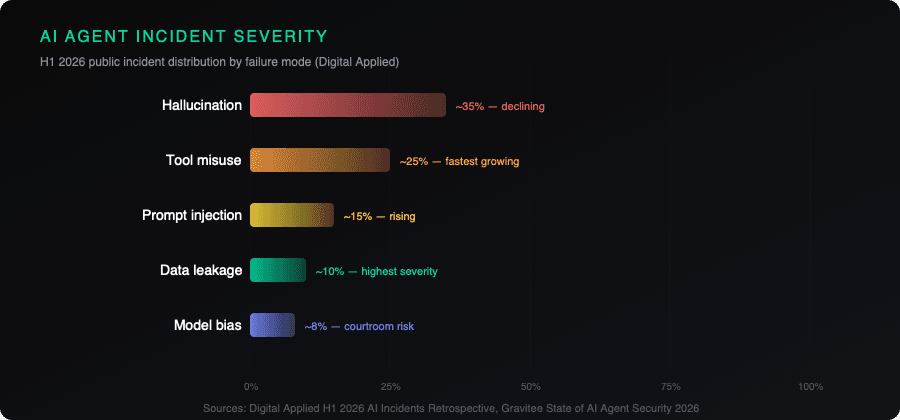
Separately, Digital Applied published their H1 2026 AI Incidents Retrospective, cataloguing over 50 public AI incidents between January and mid-May. They identified five failure modes that account for roughly 90% of incidents: hallucination, tool misuse, prompt injection, data leakage, and model bias. Tool misuse is the fastest-growing category, directly tied to the rise of production agentic workflows. Data leakage carries the highest severity multiplier. Roughly 18% of catalogued incidents reached the catastrophic tier: regulatory penalties, customer harm, or material financial loss.
And on the platform side, Computerworld reported that both Microsoft and Google shipped new agent governance controls in the same week. Microsoft Agent 365, generally available since May 1, is designed to discover, govern, and secure AI agents across Microsoft, third-party SaaS, cloud, and local environments. Google's new AI control center for Workspace gives administrators a centralized view of AI usage, security settings, and data protection controls. Forrester principal analyst Biswajeet Mahapatra framed it plainly: "AI agents now need to be managed like any other digital workforce, with lifecycle oversight, cost visibility, and integration into service management."
What the convergence means
Read individually, each report is interesting. Read together, they describe a shift that's easy to miss if you're only tracking one source.
Agent security incidents are no longer theoretical edge cases. Eighty-eight percent of organizations have had one. Fifty-plus public incidents were documented in the first four and a half months of 2026 alone. The failure modes are diversifying beyond hallucination into categories most teams have no institutional memory for handling: tool misuse cascades, indirect prompt injection via RAG pipelines, cross-tenant data leakage in multi-agent systems.
The confidence gap between executives and practitioners is real and measurable. Gravitee found that 82% of executives believe existing policies protect them from unauthorized agent actions. Only 21% of security teams have visibility into what their agents are actually doing. That mismatch between confidence and visibility is where incidents breed.
Governance has shifted from a compliance checkbox to a deployment accelerator. Databricks found in their State of AI Agents 2026 that organizations using governance and evaluation tools deploy 12 times more AI projects into production. Governance is not what slows you down. Lack of governance is what slows you down, because you can't scale what you can't see.
The operational discipline gap
The Digital Applied retrospective surfaces a pattern worth paying attention to: time-to-detect for AI incidents fell from days to hours over H1 2026. Time-to-contain did not improve at the same rate. Teams are getting faster at noticing that something went wrong but not necessarily faster at stopping it.
A team with kill switches wired, runbooks rehearsed, and severity-tiered paging resolves a P0 in under two hours. A team writing the kill switch during the incident spends roughly a day in active response. The dataset suggests the latter is still the modal case for first-time agent incident responders.
The practical implication: the highest-leverage investment for any team running production agents right now is not another eval framework or another model. It's the operational response layer. Wire the kill switches. Write the runbooks. Calibrate the severity matrix. Do it before the first P0, not during.
What this means for SpringVanta's audience
If you're building or buying AI-powered intake, voice agents, or automated workflows, these data points affect you directly. Customer-facing agents handle sensitive data. They make decisions that affect real people. And they run in environments where regulatory exposure is now the dominant severity multiplier for incidents. Roughly one-third of the incidents in the Digital Applied dataset triggered regulatory reporting in at least one jurisdiction.
The Gravitee data on shadow AI is particularly relevant for intake and form automation. Agents that interact with production data before being vetted, that share credentials with human users, that create and delegate tasks to other agents without an audit trail, those are the conditions that produce the incidents showing up in these reports.
Microsoft and Google shipping governance controls in the same week signals that the infrastructure layer is catching up. But as Forrester's Mahapatra noted, the biggest gaps remain outside native platform boundaries. Shadow agents created through low-code tools, external APIs, or embedded SaaS applications can bypass central controls. If your agent landscape spans multiple platforms, your governance has to span them too.