AI workers, not AI tools: the new intake model
Flozic, Amazon Nova Act, Hyro, and LawDroid all launched AI intake products this week framed as employees rather than tools. Here is why the framing matters for buyers.
By Springvanta
Something changed this week in how AI intake gets sold, and it is not another model release or a faster API. The shift is in packaging. Four companies across legal, healthcare, and real estate launched AI products explicitly framed as employees. Not chatbots, not forms, not SaaS dashboards. Dedicated AI staff with assigned hours, daily routines, and measurable output.
Flozic introduced an "AI Specialist" for law firms at $999 per month that works four focused hours every weekday. Amazon made its Nova Act agent platform HIPAA-eligible, enabling what it calls "fleets of reliable AI agents" for healthcare workflows. Hyro partnered with Five9 to plug healthcare-specific AI agents into hospital contact centers in roughly the time it takes to have a lunch meeting. And LawDroid open-sourced a free Claude plugin that gives civil legal aid offices a structured intake worker.
The connective thread here is not the technology. It is the metaphor. These companies stopped selling features and started selling headcount.
Flozic: your AI paralegal starts at $999/month
On May 22, Flozic (formerly Appy Pie Automate) launched an AI Specialist service for law firms. The framing is deliberate: "a firm gets the equivalent of a full-time AI-powered paralegal, researcher, and intake coordinator," said founder Abhinav Girdhar.
The product is structured like a staffing arrangement, not a software subscription. Each AI Specialist is assigned exclusively to one firm and works four focused hours per weekday by default. The daily routine reads like a job description: mornings are for reviewing and redlining contracts in Harvey AI, then filing clean copies into the case management system. Mid-morning is legal research, running case-law queries through LexisNexis and Westlaw and delivering attorney-ready memos. By midday, the Specialist triages new client inquiries, books consultations, and syncs new matters to Clio. Afternoons wrap with billable-hours dashboard updates and a partner-facing summary delivered via Slack.
The stack it is trained on is worth noting: Harvey AI, Anthropic Claude, OpenAI GPT-4o, Clio, LexisNexis, Westlaw, MyCase, and PracticePanther. That is the actual toolset of a mid-size law firm, not a generic automation platform with a legal coat of paint.
Pricing starts at $999 per month for a part-time Specialist, with options to scale to eight hours per day or a multi-Specialist team. All plans include a 30-day money-back guarantee and an NDA. Flozic says 50 law firms participated in its founding cohort.
This is not a chatbot answering FAQs on your website. It is a worker with a schedule, a task queue, and deliverables.
Amazon Nova Act gets HIPAA eligibility
On May 21, Amazon announced that Nova Act, its browser-based agentic AI platform, is now HIPAA-eligible. The distinction matters: Nova Act does not generate text responses. It operates browser-based agents that navigate websites, fill out forms, extract information, and complete multi-step workflows. For healthcare, that means automating appointment scheduling, insurance verification, prior authorization, claims status checks, and referral tracking across provider and payer portals.
Amazon's language is pointed: Nova Act helps you "build and manage fleets of reliable AI agents for automating production UI workflows at scale." Fleets, not features. The platform integrates with the Strands Agents framework, Amazon Bedrock AgentCore, and external tools via the Model Control Protocol.
The HIPAA eligibility removes what has been the single biggest barrier to deploying agentic AI in healthcare: compliance risk when agents touch protected health information. Under the AWS shared responsibility model, Amazon handles infrastructure security and the customer configures controls. The setup requires a signed Business Associate Agreement, IAM access policies, KMS encryption, and CloudTrail logging.
For health systems running manual claims processing and referral coordination through staffing-contracted teams, this is the infrastructure layer that makes "AI worker" viable at production scale.
Hyro + Five9: one-hour integration for healthcare AI agents
On May 20, Hyro announced a partnership with Five9 to integrate its healthcare-specific AI agents directly into the Five9 Intelligent Cloud Contact Center. Hyro is the first healthcare-specific accredited vendor in Five9's AI Agent Connect program.
The integration time claim is worth paying attention to: health systems can go from contract to live in about an hour. That is down from Hyro's already-below-average deployment time of under 100 days for complex voice solutions. The reduction comes from pre-built connectors that let Hyro's agents plug into existing Five9 infrastructure without custom engineering.
Hyro's agents handle prescription management, triage, and scheduling out of the box. The company counts Intermountain Health, Baptist Health, and Hackensack Meridian Health as clients. The agents are HIPAA-compliant and operate across call centers, websites, SMS, and mobile apps.
The packaging here is closer to "on-call staff augmentation" than "software deployment." You are not configuring a tool. You are adding a worker to your existing contact center team.
LawDroid's Legal Aid Plugin: the free AI intake worker
On May 20, LawDroid released the Legal Aid Plugin, a free, open-source plugin for Anthropic's Claude platform built specifically for civil legal aid organizations, court self-help programs, and public-interest legal providers.
The context is grim. The Legal Services Corporation Justice Gap Report found that 92% of low-income Americans receive no legal help or insufficient help for their civil legal problems. LSC-funded organizations turn away one in two requests they receive. The capacity problem is structural and has been for decades.
The plugin handles client intake, eligibility screening, document drafting, attorney supervision workflows, case handoffs, funder reporting, and client communications. It integrates with CourtListener, Descrybe, Courtroom5, Slack, and Google Drive. It is published under the Apache 2.0 license at LegalAidPlugin.org and on GitHub.
LawDroid founder Tom Martin framed the release as a direct response to Anthropic's Claude for Legal launch, which focused heavily on commercial practice areas and largely overlooked the 132 LSC-funded legal aid programs. "Civil legal aid is not BigLaw on a smaller budget," Martin said. "It is a fundamentally different practice environment."
This is the "AI employee" model at its most accessible: a free worker for organizations that cannot afford to hire one.
Why the "AI employee" framing matters for buyers
The shift from "tool" to "employee" is not just marketing. It changes how buyers evaluate the product, how they budget for it, and how they measure ROI.
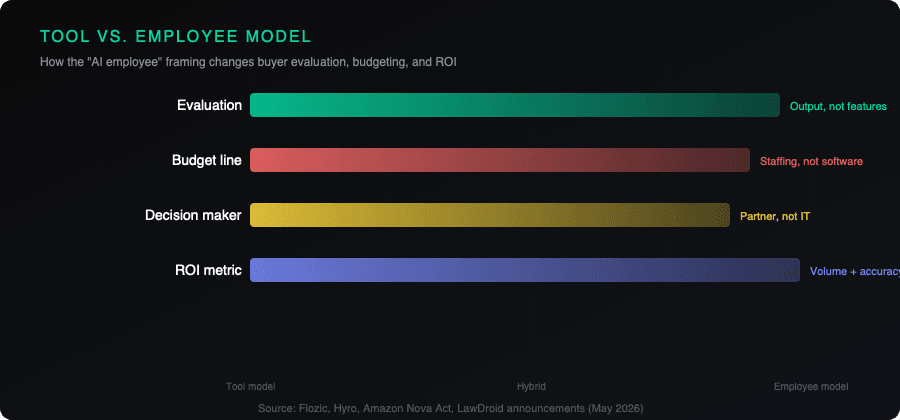
When you buy a tool, you evaluate features. When you hire a worker, you evaluate output. Flozic's AI Specialist does not compete with Clio on CRM features. It competes with a paralegal on whether the morning's contract reviews are done accurately and the afternoon billing summary hits Slack by 5 PM.
Budget allocation shifts too. A tool gets purchased from the software line. A worker gets budgeted from staffing. That is a different conversation with a different decision-maker. A $999/month AI Specialist does not need IT approval. It needs the managing partner to decide whether the intake bottleneck is worth solving.
And ROI measurement flips from adoption dashboards to output metrics: volume completed, error rates, time to completion. The accountability is clearer because you are measuring what matters to the business, not whether someone logged in.
For businesses evaluating AI intake automation right now, the practical question has shifted. Stop comparing feature lists. Start writing job descriptions for the work you need done. Then ask whether a human or an AI agent fills that role more reliably for the budget you have.
Sources
- Flozic AI Specialist launch (May 22, 2026): Web & IT News
- Amazon Nova Act HIPAA eligibility (May 21, 2026): AWS Machine Learning Blog
- Hyro + Five9 partnership (May 20, 2026): PR Newswire
- LawDroid Legal Aid Plugin (May 20, 2026): LawSites