When AI Agents Need Their Own AI Agent: Fin Operator Changes the Game
Intercom renamed itself Fin and launched an AI agent whose only job is managing its customer-facing AI agent.
By Springvanta
Something shifted this week in how companies think about AI agents. It wasn't another chatbot launch or a new voice feature. It was the arrival of an AI agent whose sole job is to manage another AI agent.
Intercom , now officially renamed Fin , announced Fin Operator on May 15 at a live event in San Francisco. Operator is a back-office AI system designed to configure, monitor, debug, and improve the company's customer-facing Fin agent. It doesn't talk to customers. It talks to the teams who keep the customer-facing agent running.
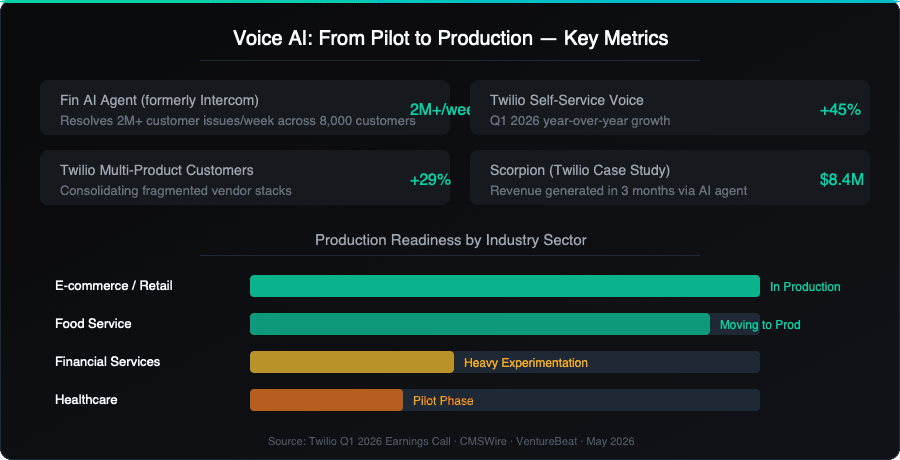
The timing matters. Fin just crossed $100 million in annual recurring revenue, growing at 3.5x, and now accounts for roughly a quarter of the company's $400 million total ARR. Two million customer issues resolved every week across 8,000 businesses including Anthropic, DoorDash, and Mercury. When your AI agent handles that volume, the question stops being "is the agent good enough?" and becomes "who keeps it good?"
The hidden crisis in AI customer service
Support operations teams are drowning. Every AI agent deployment requires constant tuning , updating knowledge bases, debugging conversation loops, analyzing performance drops, and adjusting configuration rules. The work looks less like configuring SaaS software and more like onboarding a new employee who never stops needing feedback.
As Brian Donohue, Fin's VP of Product, told VentureBeat: "Almost every support ops team is already doing data analysis and knowledge management , that's table stakes today. Where teams struggle is the agent builder work. It's a new skill set, and most don't have enough time for it. They get their first iteration up and running, and then they get stuck."
This is the operational debt that accumulates behind every AI agent deployment. Fin Operator attempts to collapse that debt into a conversational interface that plays three roles simultaneously.
Three roles, one system
Data Analyst. Ask Operator "How did my team perform last week?" and it generates charts, trend reports, and drill-down analyses from your workspace data. No dashboard configuration needed.
Knowledge Manager. Feed it a three-page product update PDF and Operator searches your entire content library, identifies gaps, drafts new articles, suggests edits, and presents everything in a diff-style review. Donohue says this compresses work that took "certainly hours, sometimes days, into the space of about 10 minutes."
Agent Builder / Debugger. Paste a link to a conversation where Fin misbehaved. Operator traces every step of the agent's internal reasoning, identifies the root cause , often a guidance rule that unintentionally creates an infinite loop , proposes a fix, back-tests it against the original conversation, and suggests a production monitor to catch similar issues.
The debugger is particularly telling. Donohue acknowledged that this is "literally what our professional services team does" , meaning Operator is automating work that previously required human consultants.
The pull-request model for AI changes
The most consequential design decision is what Fin calls its proposal system. Every change Operator recommends , an edited help article, a rewritten guidance rule, a new QA monitor , appears as a proposal with a full diff view. Nothing goes live until a human clicks "Apply."
"Right now, we're taking zero risk on this : Fin cannot make any changes to the system without human approval," Donohue emphasized. "Nothing goes live until a human clicks apply."
For enterprises evaluating AI tools, this architectural choice matters. It's the difference between an AI system that proposes changes and one that enacts them , a distinction compliance teams and security officers will scrutinize. The model mirrors how software engineering adopted pull requests: AI writes the code, humans approve the merge.
Why Operator runs Claude, not Fin's own models
In a revealing technical detail, Operator runs on Anthropic's Claude rather than Fin's proprietary Apex models. Donohue's explanation: Apex models are optimized for resolving customer conversations with minimal hallucination. Operator's tasks , analyzing data, debugging reasoning chains, writing configuration logic , are closer to software engineering, where Claude excels.
This tells us something important about the emerging AI agent stack. The models that serve customers well may not be the same models that manage the systems serving customers. Specialization is already happening at the model-selection layer.
The production signal from Twilio
Fin Operator doesn't exist in a vacuum. The same week, Twilio reported Q1 2026 earnings showing voice revenue grew 20% year-over-year , its fastest growth in 19 quarters. Self-service voice was up 45%. Multi-product customer count grew 29%.
Twilio's Chief Revenue Officer Thomas Wyatt described three production-scale use cases driving the numbers: self-service AI agents for SMBs handling customer interactions 24/7, AI co-pilots for live contact center agents, and AI-assisted inbound sales qualification with human handoff , voice AI crossing from customer service into revenue generation.
The Scorpion case study is striking: by integrating Twilio voice, messaging, and Conversation Relay, a single AI agent boosted booking rates by 39%, captured 6,500 appointments that would have been lost, and generated $8.4 million in revenue in three months.
What this means for SpringVanta buyers
If you're evaluating AI automation for intake, lead qualification, or customer support, three shifts this week should shape your thinking:
1. The management layer is now a product category. It's no longer enough to ask "which AI agent platform should I use?" You also need to ask "how will my team keep it running?" Platforms that bake operations tooling into the agent ecosystem , like Fin Operator, Twilio's Conversation Intelligence, and Quiq's governance layer , reduce the hidden cost of agent maintenance.
2. Production data is replacing vendor promises. Twilio's 20% voice growth isn't a projection. Fin's $100M ARR isn't a pitch. These are real businesses processing real volume. When evaluating platforms, weight demonstrated production scale over feature roadmaps.
3. The approval-gate model is becoming standard. Fin Operator's proposal system, where AI suggests changes and humans approve them, mirrors the pattern AI coding agents established. Expect every serious enterprise AI platform to adopt some version of this. If a vendor offers fully autonomous AI changes without human review, ask harder questions about governance.
Sources
- VentureBeat: Intercom, now called Fin, launches an AI agent whose only job is managing another AI agent (May 15, 2026)
- CMSWire: Twilio's Q1 2026: Voice AI Hits a 5-Year High as CX Orchestration Race Intensifies (May 1, 2026)
- SiliconANGLE: Quiq extends its AI agent platform into voice as enterprise rollouts move past pilots (May 11, 2026)
- CXM Today: Chatbase Launches Voice AI Agents for Customer Support (May 11, 2026)
- Twilio: Infrastructure for the agentic era : SIGNAL 2026 announcements (May 6, 2026)