AI coding agents get metered, governed, and production-ready
Anthropic splits agent billing, VS Code ships air-gapped agents, Dropbox builds an internal agent platform. Three structural changes in one week.
By Springvanta
Three things happened in the same week, and if you squint, they tell you where AI developer tooling is actually going.
On June 2, GitHub Copilot switched to usage-based billing. A few days later, Anthropic announced that starting June 15, Claude's Agent SDK and claude -p usage will draw from a separate credit pool instead of your regular subscription. And on June 5, Dropbox published details about Nova, an internal platform that runs coding agents inside its own infrastructure with propose-validate-iterate loops tied to real CI.
None of these are feature announcements. They are structural changes to how agent work gets metered, governed, and run in production.
The billing split: your agents now have their own meter
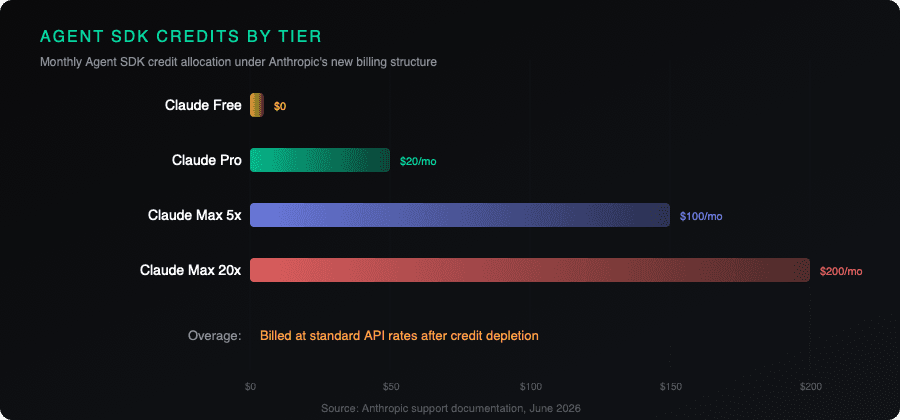
Anthropic's June 15 change is the sharpest signal. Claude Pro users get $20/month in Agent SDK credits. Max 5x users get $100. Max 20x users get $200. These credits cover claude -p, the Agent SDK, Claude Code GitHub Actions, and third-party frameworks like OpenClaw and Zed.
Before this, programmatic and interactive usage shared one pool. You could run agents against your subscription limit alongside your regular chat sessions. For developers building CI pipelines, scheduled automations, or long-running coding agents, that made Claude plans unusually good value.
That arrangement was also unsustainable. Heavy agentic users were burning through compute that far exceeded what a $20 or $100 subscription could support. Anthropic's April cut of OpenClaw access was the first warning shot. The June 15 split is the structural fix.
The developer reaction has been blunt. Senior data scientist Yadesh Salvi wrote on X that the monthly credit "won't even last a day of serious work." Advait Patel, a senior SRE at Broadcom, pointed out that credits are per user and don't pool, making shared team automations awkward. A runaway agent or a bad prompt can burn through credit and either stop your pipeline or quietly start racking up overage charges.
Greyhound Research analyst Sanchit Vir Gogia framed it as an industry-wide shift, not an Anthropic-specific one. OpenAI has long used usage-based API pricing. GitHub just moved Copilot to a credit system. His prediction: "Over the next 12 to 24 months, enterprises should expect more vendors to create separate consumption pools for agents, premium models, tool use, background tasks, and third-party integrations. Some will call them credits. Some will call them requests. Some will hide the meter inside bundles. The vocabulary will vary. The direction will not."
Paul Chada, co-founder of Doozer AI, put it more concisely: "Stop optimizing for the subsidy and start optimizing for the token."
VS Code agents go stable, and finally work offline
While Anthropic was putting agents on a meter, Microsoft was removing the last barrier to running them inside regulated networks.
Four VS Code releases, versions 1.120 through 1.123, shipped between May 13 and early June. Together they achieved something the editor had been approaching for over a year: AI-assisted coding in fully isolated environments with zero outbound tokens.
The centerpiece is the Agents window, promoted from experimental to Stable preview in version 1.120. It is a dedicated surface for directing multi-step coding tasks, reviewing changes across projects, and managing parallel agent sessions. You can run multiple agents side by side, each in its own session, comparing approaches or monitoring a background refactor while you work on something else.
The bigger structural change arrived in version 1.122. Before it, BYOK (bring your own key) model support required a GitHub OAuth handshake before VS Code's Chat view would activate. The actual inference request went to your configured provider, but the Chat view itself demanded a call to github.com. For air-gapped networks, that single dependency made BYOK unusable.
Version 1.122 decoupled Chat view activation from GitHub OAuth. Configure at least one BYOK model through the Command Palette, and the Chat view opens without a sign-in prompt. For genuinely air-gapped deployments, you can point it at a local Ollama or vLLM instance and set COPILOT_OFFLINE=true to disable telemetry. Zero outbound traffic.
On June 5, GitHub added enterprise-managed plugins in public preview. Administrators at Copilot Business and Enterprise organizations can now configure custom agents, Copilot skills, and MCP configurations for every developer from a single policy layer. The settings live in .github-private/.github/copilot/settings.json and can auto-install when developers authenticate.
This is the infrastructure that enterprises need to roll agentic coding out to hundreds of developers inside a network-isolated environment, rather than a handful of early adopters running personal experiments.
Dropbox's Nova: agents as infrastructure, not tools
Dropbox's Nova platform, detailed in a June 5 engineering blog post, approaches the same problem from the opposite direction. Instead of governing off-the-shelf agents, they built an internal platform that runs agents inside their own infrastructure.
Each Nova session operates in an isolated environment tied to a specific repository commit. Agents execute validation commands, iterate on failures, and automatically refine solutions when tests or builds fail. Dropbox calls this a "propose, validate, iterate" workflow. The agent proposes changes, the CI system validates them deterministically, and the agent iterates until it either succeeds or hits a retry limit.
The most successful Nova deployments aren't feature work. They are operational tasks: flaky test remediation, dependency migrations, framework conversions, and production incident investigation. One internal workflow called Deflaker analyzes passing and failing test logs, proposes fixes through Nova, validates them through repeated CI runs, and iterates until a stable fix is found.
Dropbox deliberately separated code publication from agent execution. Branching and merge operations remain deterministic and externally controlled. The agent can propose, but only existing engineering workflows can accept and merge.
A study published in April 2026 on internal coding agents (arxiv:2604.09805) found that workflow integration, safety guardrails, deterministic tooling, and human oversight have more impact on reliability than the model itself. Nova was built around that premise. The platform infrastructure matters as much as the LLM.
What these three moves share
Anthropic metering agent usage. VS Code enabling governed, air-gapped agent deployment. Dropbox building an internal agent platform with deterministic validation loops.
These are not "AI got smarter this week" stories. They are "the industry figured out that agents need operational infrastructure" stories. The model quality race continues, but the practical bottleneck has shifted. Running an agent in production, with cost controls, governance, validation loops, and auditability, turns out to be a different problem than generating good code in a chat session.
For teams evaluating AI automation, this week's convergence points to specific questions: What is your token cost per agent workflow? Can you set hard budget alerts? Do your agents run inside your CI system, or do they operate in a sandbox that doesn't see your real build pipeline? Can your governance controls scale beyond a handful of early adopters?
The tools for answering those questions are arriving. The free ride is not.
Sources
- Anthropic puts Claude agents on a meter across its subscriptions, InfoWorld, June 2026
- VS Code Agents Hit Stable: Air-Gapped BYOK Unlocks Enterprise AI Coding, Tech Times, June 8, 2026
- GitHub Copilot in Visual Studio Code, May releases, GitHub Blog, June 3, 2026
- Dropbox Introduces Nova, an Internal Platform for Running AI Coding Agents at Scale, InfoQ, June 5, 2026
- Claude Plan Change: Agent SDK Credit, Anthropic support documentation