Bots Pass Humans, ChatGPT Ads Hit UK, Google Adds AI Search Controls
Cloudflare says bots now drive 57.4% of web traffic. Google gave publishers new AI search controls. ChatGPT ads landed in the UK. What this convergence means for how businesses get found.
By Springvanta
Three things happened between June 3 and June 8 that belong in the same conversation, even though most coverage treated them separately.
Cloudflare's Radar data showed bots now generate 57.4% of all web traffic. Google gave website owners new Search Console controls for managing how their content appears in AI Overviews and AI Mode. OpenAI activated ChatGPT ads in the UK, tested multi-advertiser placements, and a feature called AI Brief surfaced that could replace keywords entirely.
Any one of these would be worth a post. Together they describe a week where the infrastructure of online discovery changed pretty fast.
The web is now majority nonhuman
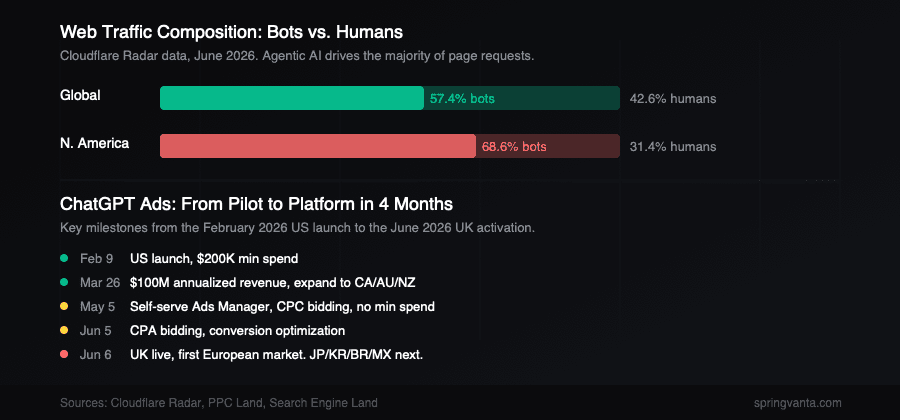
On June 4, Cloudflare CEO Matthew Prince posted on X: "Welp, that happened faster than I predicted." His company's data showed 57.4% of web requests coming from bots, compared to 42.6% from humans. Prince had expected this crossover in late 2027. It arrived 18 months early.
The driver is agentic AI. When someone asks ChatGPT or Google AI Mode to research a product, the underlying agent might visit thousands of webpages to compile an answer. A human shopping for shoes might browse five sites. The AI agent serving that same request could crawl five thousand. North America skews even higher: 68.6% bot traffic.
If you run a website, this changes what "traffic" means. Your server logs are no longer primarily a record of human visitors. They are a record of machines reading your content on someone else's behalf. Infrastructure costs go up. Analytics get noisier. And almost nobody is talking about it.
Google hands publishers new AI controls
On June 3, Google published a blog post titled "New opportunities, control and insights for website owners." The announcement covered new Search Console features that let publishers manage how their content appears in Google's generative AI features.
Website owners can now toggle whether their content shows up in AI Overviews and AI Mode responses. Google also expanded its Preferred Sources program, which gives publishers more say over when and how they get cited in AI-generated answers. The company disclosed that AI Overviews now reaches 2.5 billion monthly users, and AI Mode has passed 1 billion.
What's interesting here is the admission. Google spent years avoiding the implication that AI-generated search results are fundamentally different from blue links. Giving site owners a toggle is an acknowledgment that not every publisher wants their content used this way. The posture shifted. That matters more than the feature itself.
ChatGPT ads land in the UK, and the ad stack matures fast
On June 6, OpenAI confirmed that ChatGPT ads are now live in the United Kingdom. VP of Monetization Benji Shomair announced the activation via LinkedIn. The UK is the first European market, following launches in the US (February), Canada, Australia, and New Zealand (March).
The buildout speed is unusual. Between May 5 and June 5, PPC Land documented six major product additions: self-serve Ads Manager, CPC bidding, Conversions API, custom audience targeting, daily budgets with geo-targeting, and conversion optimization. The minimum spend dropped from $200,000 to zero. CPC rates settled around $3 to $5 per click. Criteo's data from 500 US retailers shows ChatGPT-referred users convert at roughly 1.5 times the rate of other referral channels.
OpenAI also began testing multi-advertiser placements in early June. Instead of a single sponsored result, the new format groups multiple relevant ads in one placement, priced through a second-price auction. A mature advertising platform is being assembled in about four months.
Meanwhile, Search Engine Land's Frederick Vallaeys argued on June 8 that Google's new "AI Brief" feature may be the replacement keywords never had. AI Brief lets advertisers describe their business goals and audience context in natural language rather than selecting individual keywords. If this model takes hold, it changes how discovery works across AI platforms, not just how ads get bought.
What the convergence means
Three data points, one direction:
- More machines than humans are visiting your website. Your content is being consumed by agents acting on behalf of users, not by users directly. This changes how you think about analytics, server costs, and content format.
- Google is building infrastructure for AI-era search visibility. The new Search Console controls and Preferred Sources expansion mean publishers can participate in AI search results on their own terms, or opt out entirely.
- ChatGPT is becoming an advertising channel with real conversion data behind it. The platform moved from closed pilot with six-figure minimums to self-serve CPA bidding in under four months. The UK launch means the international expansion has started.
For businesses evaluating AI automation: your discoverability strategy can no longer be Google-only. You need to understand how your content surfaces in AI Overviews, how AI agents interact with your site, and whether ChatGPT ads are a viable acquisition channel. The tools for all three of those things either launched or matured in the past week.
Sources
- Cloudflare bot traffic data: Search Engine Land, NBC News, SiliconANGLE
- Google Search Console AI controls: Google Blog, Search Engine Land
- ChatGPT ads UK launch: PPC Land, Search Engine Land, Digiday
- Google AI Brief: Search Engine Land