AI Intake: The Deployments That Worked, and the One That Didn't
Three healthcare AI intake deployments hit production this week while an undisclosed real estate AI agent got caught recording calls. Here is what separates the wins from the disaster.
By Springvanta
On June 1, a home health startup called Enzo Health launched an AI-native EHR that takes patient intake from 70 minutes to five. Two days later, an AI agent named "Daniel" cold-called prospective apartment buyers on Australia's Gold Coast, pretending to be a human real estate agent. It recorded the conversations without telling them.
Same week. Same technology category. Two very different results.
The difference was the deployment, not the AI.
What Enzo Health actually shipped
Enzo Health rolled out what it calls the first agentic EHR built specifically for home health agencies. The system reads incoming referral packages, surfaces key information for admission decisions, matches clinicians to patients by availability and location, documents visits in real time from conversation audio, tracks care plans, and prepares billing claims with denial-prevention built in.
The numbers from their early adopter: intake decisions dropped from 15-20 minutes to 1-2 minutes. Clinician charting time fell by 75%. The company raised $26M total (including a $20M Series A in early May), grew revenue 40X in twelve months, and now covers 500,000 patients across more than 100 organizations.
Here is what caught my attention: Enzo's CEO Zach Newman told Fierce Healthcare that home health agencies were paying for their EHR and then stacking three to five additional products on top of it. The context between those tools got lost at every handoff. Enzo's pitch is consolidation, one agentic system replacing the patchwork.
What Tanner Health went live with
On May 29, Tanner Health, a five-hospital nonprofit system in west Georgia and east Alabama, went live with Hyro's AI voice assistant. They call it Clara. It answers inbound calls in English and Spanish, handles appointment scheduling and prescription management without human involvement, integrates with Epic EHR and Cisco phone systems, and texts patients their updated appointment details automatically.
Tanner's director of population health and innovation, Tee Ogletree, said Clara is "already making a significant difference in our daily operations." Their plan is to expand Clara from voice to web chat and then into more specialties.
Tanner is a nonprofit system serving rural communities. Not a coastal academic medical center with a Silicon Valley innovation lab. Hyro's integration with Epic took the deployment from what used to be a two-week project to roughly an hour. That compression is what moves AI from pilot territory into something a 5-hospital system in Carrollton, Georgia can actually buy and run.
What "Daniel" did wrong
On June 2, ABC Brisbane reported that an AI agent calling itself "Daniel" from Colliers real estate had been phoning prospective buyers of a Gold Coast apartment tower called Bilinga House. Daniel introduced himself as a real estate agent. He did not mention he was an AI system. He also did not mention the call was being recorded.
When ABC presenter Ellen Fanning asked "Are you a person, Daniel?" he admitted: "I'm actually an AI system designed to help you with your inquiry about Bilinga House."
Several listeners called in to say they had received the same call. After the story aired, Daniel's phone number was disconnected. Colliers has not responded to ABC's repeated requests for comment.
Queensland's Real Estate Institute chief executive Antonia Mercorella said agents have "at least a moral duty" to disclose AI use. Lawyers interviewed by ABC said it is unclear whether an AI counts as a "party" under Queensland's one-party consent recording laws.
The regulation is catching up
Two state AI laws signed in May 2026 add weight to the disclosure question. Colorado governor Jared Polis signed SB 26-189 on May 14, overhauling the state's 2024 Colorado AI Act. Connecticut's SB 5, the Artificial Intelligence Responsibility and Transparency Act, passed the legislature on May 1 and is expected to be signed by Governor Lamont.
Connecticut's SB 5 covers any AI that "communicates with individuals in natural language and simulates human conversation." That definition would cover Daniel. Colorado's law strengthens disclosure requirements for AI systems interacting with consumers. Both laws create compliance obligations for any business deploying AI that talks to customers.
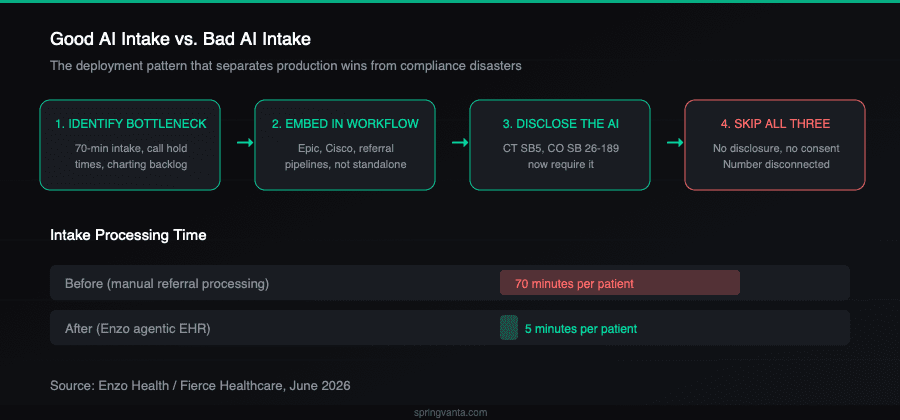
What separates the deployments that work
Enzo and Tanner both started from a specific operational problem. Enzo's was referral processing that took 70 minutes per patient. Tanner's was call center hold times that kept patients waiting. Neither tried to deploy a general-purpose AI and hope it figured out the industry. Both embedded the AI inside existing workflows (Epic, Cisco, referral pipelines) rather than bolting on a standalone tool.
Daniel started from a sales target. The problem it solved was "call more prospects." The AI was deployed outside any regulated framework, with no disclosure, no consent, and no fallback. When it got caught, the phone number vanished.
For businesses evaluating AI intake, the pattern is clear. Start with the bottleneck. Embed in the workflow. Disclose the AI. Let the regulation guide the deployment rather than treating it as something to work around.
Sources:
- Enzo Health launches agentic EHR for home health agencies, Fierce Healthcare, June 1, 2026
- Tanner Health goes live with Hyro AI voice assistant, Las Vegas Sun / Business Wire, May 29, 2026
- 'Daniel' is a fake AI real estate agent, ABC News, June 2, 2026
- Two major state AI laws signed in May 2026, Dickinson Wright, May 2026