The Problem Isn't the AI. It's the Data It Can Reach.
ZoomInfo GTM.AI, Zoho Bigin Zia Agents, Microsoft D365 Sales Qualification Agent, and Conversion.ai all shipped agent features in the same window. The common thread: data access, not model capability, is the new moat.
By Springvanta
The problem isn't the AI. It's the data it can reach.
ZoomInfo just made its entire B2B intelligence graph, 100 million companies, 500 million contacts, billions of buying signals, available to AI agents through a single MCP connection. The product is called GTM.AI, it went generally available on June 2, and it plugs directly into Claude, ChatGPT, Microsoft Copilot, Salesforce Agentforce, HubSpot Breeze, Outreach, Gong, and about two dozen other platforms.
ZoomInfo is positioning GTM.AI as a "headless context layer" for go-to-market AI. Any agent, on any platform, can query verified company data, contact records, intent signals, and technographic profiles without building a custom pipeline. CEO Henry Schuck put it plainly: "Reasoning without that foundation is fluent guesswork."
Within the same two-week window, three other GTM platforms shipped agent features that depend on exactly this kind of data access:
-
Zoho Bigin (May 28) launched Zia Agents for small business CRM: a Reply Assistant that auto-responds to customer emails in brand voice, a Churn Analyzer that diagnoses why deals were lost, and a CrossSell Genie that identifies upsell opportunities after close. They also shipped Zia Agent Studio, which lets small businesses build custom agents without code.
-
Microsoft Dynamics 365 (June 1) upgraded its Sales Qualification Agent to pull lead assessment data from any source, including public web search and custom data connectors through Copilot Studio. Sellers now see AI-researched lead insights, priority rankings, and "next best actions" directly in Sales Home.
-
Conversion.ai (May 19) shipped Conversion Agents, the first agent layer built natively into a marketing automation platform. Marketers describe what they want and AI agents handle segmentation, nurture QA, list cleanup, and reporting. They call it "vibe marketing."
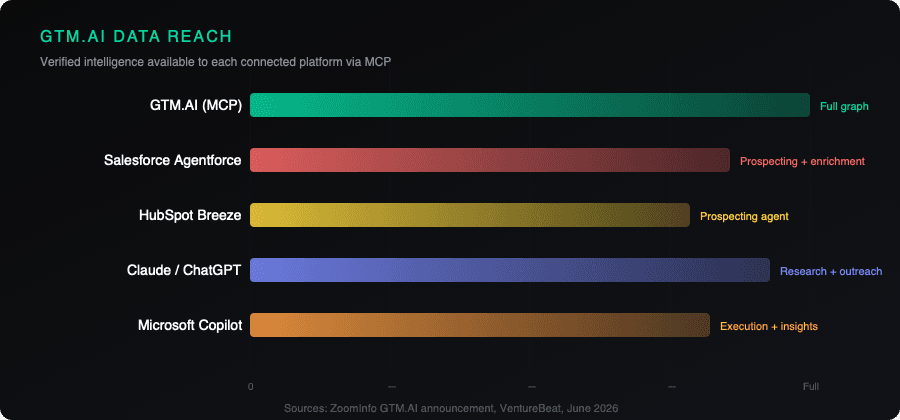
Why data access is the new moat
Here is the thing nobody in GTM wants to admit out loud: most CRM data is garbage. By widely cited industry estimates, roughly 70% of B2B contact data goes stale every year. That means the Salesforce instance your sales team relies on, the HubSpot portal your marketing team runs campaigns from, the Outreach sequences your SDRs send, they are all working with partially rotten information.
When a human rep calls a stale number, one conversation dies. When an AI agent operates on stale data, it produces bad outcomes at machine speed. It calls the wrong people, qualifies the wrong leads, enriches records with outdated titles, and routes prospects to dead ends. Scale is the enemy when your foundation is wrong.
ZoomInfo's pitch is that GTM.AI fixes this by giving every connected agent access to continuously verified data through a single MCP endpoint. The GTM Context Graph connects companies, contacts, buying signals, IP-to-organization mappings, and employment history into one queryable structure. When an agent asks for "VP-level marketing leaders at fast-growing fintechs that moved their data warehouse to Snowflake and have a champion who just changed jobs," the system returns a ranked, verified, contactable list.
That is the theory. In practice, ZoomInfo data quality varies depending on the segment. Enterprise and mid-market records tend to be solid. Small business and international coverage is thinner. The 70% annual decay rate ZoomInfo cites applies to the industry overall, not just to their competitors. Their own verification pipeline, built over 15+ years of proprietary collection, machine learning, and a contributory network, is good enough that Forrester named them a Leader in Intent Data. But "leader" in B2B data still means "best of a messy category."
What this means for small and mid-market teams
The platforms shipping agent features this week, Zoho Bigin, Microsoft Dynamics, Conversion.ai, ZoomInfo itself, are not just targeting enterprise. Zoho Bigin is explicitly built for small businesses. Conversion.ai is going after teams that found Marketo and HubSpot too heavy. Microsoft's Sales Qualification Agent works on standard Dynamics licenses.
Six months ago, the narrative was "enterprise deploys Agentforce." Now the small business CRM has an agent that auto-replies to emails, a mid-market marketing automation tool has agents that build segments from a natural language prompt, and the data provider has opened its entire graph to whatever AI assistant you happen to be using.
For teams evaluating AI automation for intake, lead qualification, or customer support, the practical question is simple: the AI model matters less than the data it can reach. Before investing in an agent platform, ask where its data comes from, how often it refreshes, and whether it can pull from your existing CRM or requires a parallel data layer. The announcements this week all point in the same direction: agents that can query live, verified data will outperform agents that can't. The question is whether your data is clean enough for an agent to use it.
Sources
- ZoomInfo Launches GTM.AI — VentureBeat / BusinessWire, June 2, 2026
- ZoomInfo Is the Verified Data Foundation for the Agentic Era — ZoomInfo Pipeline blog, May 30, 2026
- Less Busywork, More Business: Bigin's Latest AI Features — Zoho Blog, May 28, 2026
- Dynamics 365 Sales Qualification Agent: Lead Assessment — Microsoft Learn, June 2026
- Introducing Conversion Agents — Conversion.ai blog, May 19, 2026