AI Search Reached 60% of Adults. Trust Fell to 54%.
Pew found 60% of adults read AI summaries. Fractl found trust dropped from 82% to 54%. USA Today now races a 4-hour clock before AI Overviews summarize the news.
By SpringVanta
Three data points landed between June 17 and 18 that, read together, describe where AI search actually is right now.
Pew Research Center surveyed 5,119 U.S. adults and found that 60% read AI-generated summaries at the top of their search results. Forty percent use chatbots to find information. ChatGPT alone reaches 44% of American adults, up from 34% a year ago. Searching for information is now the single most common thing people do with AI chatbots, ahead of entertainment, image creation, medical advice, and everything else.
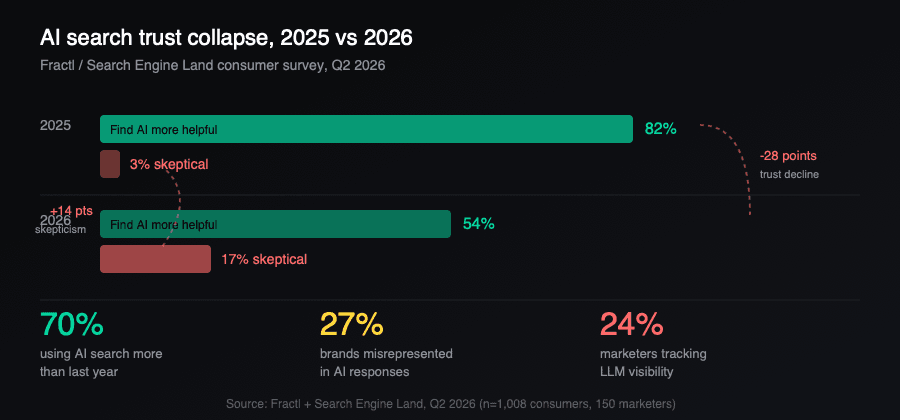
The same week, a Fractl survey of 1,008 consumers published on Search Engine Land found that the share of people who consider AI search "more helpful than traditional search" dropped from 82% to 54% in twelve months. Seventy percent say they use AI tools for search more than last year. They're using it more and trusting it less.
And USA Today told Digiday they're now pre-writing automated "shell files" for breaking sports news so reporters can publish before Google generates an AI Overview. Barry Adams, a news SEO consultant, estimated that AI Overviews appear for breaking news events within about four hours. The traffic window publishers used to count on is shrinking to hours, not days.
Adoption saturated. Trust eroding. The operational consequences arrived. That's the state of AI search in mid-2026.
Pew: AI summaries reach most adults
Pew's survey ran February 17 through 23, 2026, through its nationally representative American Trends Panel, with a margin of error of 1.6 percentage points.
Six in ten adults have read AI summaries in search results. Another 10% weren't sure whether they had, which suggests the actual exposure rate is higher. Some people don't recognize AI-generated content when they see it.
About half of U.S. adults now use AI chatbots, up from one-third in 2024. Roughly one in four use them daily. Searching for information is the most common activity Pew measured, ahead of entertainment, image and video creation, medical advice, fitness information, news, emotional support, and companionship.
Among employed adults, 38% use chatbots for work-related tasks.
ChatGPT dominates with 44% adult reach, more than double its 2023 share. Gemini ranks second at roughly 25%. Copilot and Meta AI follow. Grok, Claude, and Character.ai sit at about 10% or less.
Pew also found a demographic surprise: men were slightly more likely than women to report reading AI summaries (63% vs 57%), but baby boomers now find AI more helpful than Gen Z, 63% to 47%. The assumption that younger users automatically embrace AI while older generations lag doesn't hold up.
Fractl: usage up, confidence down
The Fractl study, conducted with Search Engine Land in Q2 2026, compared findings against the same questions asked in 2025. The tension between adoption and trust is the story.
Seventy percent of consumers report using AI tools for search more than last year. Only 3% decreased usage.
But the percentage who find AI "more helpful than traditional search" fell from 82% to 54%. The AI skeptic camp grew from 3% to 17% in one year. People who still find AI helpful are hedging: 37% say "somewhat more helpful," while only 17% say "much more helpful." Hallucinations are now widely enough recognized that enthusiasm is cooling.
For marketers, the more alarming findings involve brand safety. Twenty-seven percent of brands have been misrepresented in AI-generated responses. Fourteen percent say an AI inaccuracy affected a customer relationship, sale, or PR situation. Yet only 24% of marketers track their brand's visibility in LLM responses, barely up from 22% a year ago.
More brands have been burned by AI hallucinations than have a process to catch them.
Fifty percent of marketers report organic traffic declines since AI Overviews launched. Sixty-one percent blame AI directly. But the same group reports growth elsewhere: 57% from social platforms (TikTok, Reddit, YouTube), 40% from AI assistants, 31% from direct traffic. Only 10% report no visibility growth anywhere.
The Fractl authors framed it this way: the shift is from search as a destination to search as a behavior. People still look things up. They just do it across more surfaces before deciding.
USA Today's four-hour clock
The Pew and Fractl data describe what consumers and marketers experience. The USA Today story shows what happens when a publisher does the math and builds a counter-strategy.
USA Today Co. operates the flagship site plus more than 200 local publications. For breaking news, they create AI-assisted "shell files" for likely events. The system pulls subheads, photos, and archive links automatically. Editors shape that material into ready-to-publish templates. When news breaks, reporters add fresh details, update the headline, and publish.
Alicia DelGallo, USA Today Sports editorial director, told Digiday the goal is to publish while search interest is still rising, before Google has enough information to generate an AI Overview. Barry Adams estimated AI Overviews appear for breaking news within about four hours, and no later than half a day.
USA Today tested the system during the 2026 Winter Olympics and generated 116 million page views across its network between January and February. The flagship site drew 91 million, up 82% from 2022. They're now running five shell files daily for World Cup coverage, with reporters in all 16 host cities.
DelGallo was honest about the ceiling. She told Digiday that AI Overviews have "likely lowered the traffic ceiling compared with a year ago." USA Today still expects "massive audience" spikes. But the traffic math is different when 60% of people read the AI summary instead of clicking through.
The shell-file strategy isn't about producing the best content. It's about being first. In a world where Google summarizes the story within four hours, speed with solid information beats slow perfection.
What this means for your pipeline
Read together, these three stories describe a market in a specific phase. Adoption has crossed the majority threshold. Trust hasn't caught up. And the operational consequences are now visible in how publishers work.
Your customers are reading AI summaries instead of clicking through to your site. They're cross-checking what AI says about you across two or three platforms before they contact you. If AI hallucinates about your brand, you're losing deals you can't see.
A few concrete steps, drawn from the data:
Query your brand name across ChatGPT, Gemini, Perplexity, and Google AI Overviews. Document what's accurate, what's missing, and what's wrong. The Fractl data puts the odds of misrepresentation at about one in four.
Invest in original research and proprietary data. Fractl found that original research is the least-prioritized content strategy among marketers (15%) but the hardest for AI to replicate. Survey data you collected, expert analysis you commissioned, case studies you ran. AI can't generate these from scratch.
Distribute across platforms. Consumers check 2.4 platforms before making a purchase decision, consistently across every generation. If you're visible on Google but absent from Reddit, YouTube, and AI assistant responses, you're losing to competitors who spread out.
Build GEO measurement now. Only 12% of marketers have measurable GEO results. The teams that can connect AI search visibility to leads and revenue will be the ones who can justify budget when the rest of the industry is still guessing.
The adoption data is settled. The trust data is a warning. The USA Today story is a preview of what happens when you wait too long to adapt.
Sources: Pew Research Center, Americans and AI 2026; Search Engine Land / Fractl study; Digiday / USA Today World Cup coverage.