Voice AI Goes Native: The Bolt-On Era Is Over
Jio and Zendesk built voice AI into their core infrastructure on the same day. The bolt-on era is ending. Here is what changes for buyers.
By SpringVanta
Voice just refused to die. For a decade, the prediction was that phone calls would disappear, replaced by chat, email, and messaging. Voice still accounts for 40% of contact center volume, according to Zendesk research published June 19. And on that same day, two platforms from completely different layers of the communications stack made the same bet: voice AI belongs in the infrastructure, not bolted on top of it.
The carrier goes native: Jio Call Agent
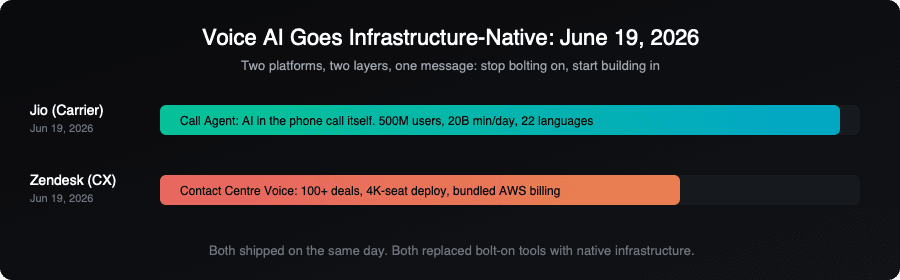
Reliance's Jio, the Indian telecom with more than 500 million subscribers, launched Call Agent on June 19 at its 49th annual general meeting. The product is unusual because it does not require an app download. Users say "Hey Jio" during any phone call, and the AI activates inside the call itself. It transcribes the conversation in real time, identifies up to 10 speakers, generates summaries and action items, and can take actions on behalf of the user: booking cabs, ordering food, reserving restaurant tables, adding participants to the call.
The scale is what stops you. Jio carries 20 billion minutes of voice traffic every day. The company committed $110 billion to AI infrastructure earlier this year and is building a 120 MW AI compute facility that will scale to 200,000 H100-equivalent GPUs. Call Agent supports 22 Indian languages and launched alongside AI Vyapar, a companion product for small businesses that handles customer conversations and operational tasks.
Here is the structural shift that matters: the AI lives in the carrier network. It is not a third-party app reading your call logs after the fact. It is in the call, at the carrier level, from the first word. That changes who controls the voice AI experience. The telecom owns it, not the software vendor.
The platform goes native: Zendesk Contact Centre Voice
Also on June 19, Zendesk disclosed that its contact center voice business has passed 100 sales opportunities in the past year. The milestone included individual seven-figure annual recurring revenue agreements and a 4,000-seat deployment. Demand came strongest from organizations with 250 to 750 agents, and the service now supports HIPAA-enabled accounts.
Zendesk Contact Centre launched after the company acquired Local Measure and integrated a native voice offering into its Resolution Platform. CEO Tom Eggemeier framed it directly: "Voice can no longer live in an isolated operational silo." The product combines telephony infrastructure from Amazon Connect with Zendesk's AI tools, sold through a single bundled contract with AWS. Telephony, platform minutes, and AI services all appear on one bill.
The market data behind this is blunt. 75% of contact center leaders told Zendesk that legacy technology prevents them from delivering true omnichannel service. The companies buying Zendesk's voice product are the ones who have been running phone support on a completely separate system from their digital channels. Agents switch between tools. Customers repeat information. That divide is exactly what "native" means here: voice and digital channels sharing the same customer history, the same context, the same interface.
Why bolt-on voice AI loses
Both announcements share a pattern. Voice AI spent the last three years as a bolt-on product. You bought your PBX from one vendor, your CRM from another, then layered a voice AI tool on top to handle calls. Multiple contracts. Multiple dashboards. Multiple integration projects that broke every time either side updated.
Jio and Zendesk are betting that this model is structurally broken. Jio embeds AI at the carrier level, where it can access the call in real time without any integration work. Zendesk embeds it in the CX platform, where it shares customer history and context with every other channel. In both cases, the AI is part of the infrastructure that was already there. Not a separate product. A feature of the system you already pay for.
This matters for buyers because the procurement question is changing. It used to be "which voice AI tool should we buy?" Now it is becoming "which infrastructure layer do we want our voice AI to live in?"
How to decide
If your voice traffic runs through a traditional PBX or a legacy contact center platform, the Zendesk model is the migration path. You move voice into the same platform that handles your tickets, your knowledge base, and your customer history. Bundled AWS billing means one contract instead of several.
If you operate in markets where the carrier network is the primary communications infrastructure (most of South Asia, Southeast Asia, and Africa), the Jio model matters more. When the carrier owns the AI layer, you do not need to deploy a separate voice AI product. The carrier provides it. The question becomes whether your carrier's AI is good enough, not which vendor to buy from.
Voice AI is becoming an infrastructure feature, not a standalone product. Vendors selling it as a separate layer, whether standalone platforms or API wrappers, are competing against carriers and platforms building it natively. That is a hard fight to win.
Sources
- Zendesk contact centre voice passes 100 sales leads - TelcoNews, June 19, 2026
- Zendesk Relate 2026: Autonomous Service Workforce announcement - Zendesk press release, May 2026
- What's new in Zendesk: June 2026 - Zendesk Help Center, May 29, 2026
- Jio Call Agent launch at 49th AGM - AichatDaily, June 19, 2026