AI stopped helping and started working this week
Legal, healthcare, and real estate AI platforms all crossed the same line in one week: from assisting humans to executing workflows autonomously.
By Springvanta
Something shifted this week
Three unrelated companies in three different industries shipped the same thing: AI that does the work instead of suggesting what you should do.
On June 2, Filevine launched LOIS console, a legal AI that writes back to a firm's case management system. It sets tasks, moves deadlines, generates documents, and updates contact records on its own. A lawyer asks which open matters need a demand letter this week, and the drafts are waiting for review within minutes. This is not a chatbot that summarizes cases. It takes action inside the firm's system of record.
On June 5, Tanner Health System went live with Clara, a bilingual AI voice assistant built by Hyro. Clara answers inbound calls at Tanner's clinics across west Georgia and east Alabama, handles appointment management, scheduling, and prescription refills without human involvement. It integrates directly with Epic EHR and Cisco phone systems. Staff at Tanner described early adoption as strong. One director said the AI "intercepts and resolves the repetitive tasks so our staff doesn't have to."
Also June 5, Ascendix Technologies released AscendixRE AI Suite, an add-on for its commercial real estate CRM. One module reads incoming emails, extracts contacts and lease terms, and creates draft CRM records for broker review. Another lets brokers speak instructions to update deal stages, log tours, and generate documents. Nothing writes to the system without the broker approving it, but the AI handles the data entry and document assembly that brokers typically avoid.
Three verticals. Same week. Same shift.
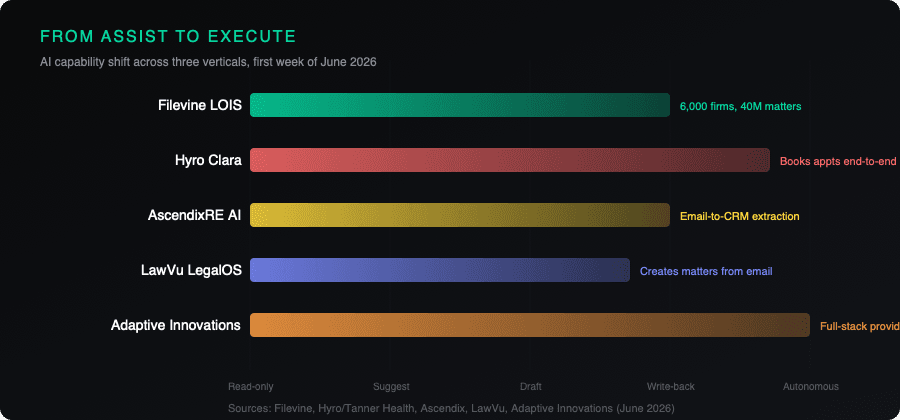
From read to write
Until recently, vertical AI in law firms, clinics, and brokerages operated in what Filevine CEO Ryan Anderson called "read-only" mode. You could ask questions and get summaries. The AI could tell you what was in a 5,000-page claim file. But it could not act on what it found.
LOIS console is built on Filevine's structured legal matter graph, which contains patterns from over 40 million legal matters across 6,000 firms. That data foundation is what makes write-back possible. The system has enough context to know what actions are appropriate, what fields to update, and what deadlines to set. At Kopka Law Group, senior attorney Kyle Hall described taking a 5,000-page claim file and getting "a couple hundred pages of tailored summaries" that let him start case work days earlier than before.
The same thing is happening in healthcare. Clara at Tanner Health does not just route calls to the right department. It manages the appointment itself: finding open slots, booking the patient, confirming via text, and updating the Epic record. Tee Ogletree, Tanner's executive director of population health and innovation, said the goal is for staff to "stop acting as human routers and focus on actual patient care."
In commercial real estate, the AscendixRE Connector puts CRM data inside ChatGPT and Claude so brokers can ask questions about deals, pull client history, and make CRM updates without switching applications. The Harvest module extracts deal intelligence from forwarded emails. The Composer module fills document templates from live CRM data. The AI is not replacing the broker's judgment. It is eliminating the data entry that was never the point of the job.
Why this week
The timing is not a coincidence. Each of these platforms spent years building a domain-specific data foundation before they could safely write back to production systems.
Filevine has been collecting structured legal workflow data for a decade. Hyro spent years getting HIPAA-compliant and integrating with Epic, Cisco, and Five9. Ascendix has worked in commercial real estate CRM since 1996. The AI layer on top is new, but the data and workflow understanding underneath is not.
The money followed. On June 3, Adaptive Innovations raised $50M to operate as a full-stack AI-native healthcare provider for home care, handling intake, scheduling, charting, and billing. The same day, LawVu launched LegalOS, an operating system for in-house legal teams that picks up incoming emails, creates matters, generates tasks, and drafts responses. On June 4, Kirkland and Ellis partnered with Palantir on an AI-driven PE fundraising platform, part of Kirkland's $500 million AI strategy.
Platforms with deep vertical data added an execution layer, and the funding went to the ones that could prove it works.
If you run intake, scheduling, or case management
The question changed this week. It is no longer "should I add AI to assist my team?" The platforms that shipped answer a different question: "what work can I stop doing entirely?"
- Legal practices can evaluate whether their case management system supports write-back AI, or if they need to migrate to one that does. Filevine's LOIS is the first to do this at scale, but Clio, MyCase, and others are moving the same direction.
- Healthcare clinics with Epic or Cisco phone infrastructure can deploy Hyro-style voice agents relatively quickly. Tanner Health's go-live shows integration time has dropped from months to weeks.
- Real estate brokerages sitting on CRM data that nobody updates can look at tools like AscendixRE or HouseWhisper's Lead Engine to automate the data entry that brokers always skip.
The through-line: the AI that shipped this week does not need your staff to copy its suggestions into your systems. It writes to those systems itself, within guardrails you define. That is a different category of product than what was available a month ago.
Sources
- Filevine Launches LOIS Console (Filevine, June 2, 2026)
- Tanner Introduces AI Voice Chat Assistant (StarNews, June 5, 2026)
- Ascendix Launches AscendixRE AI Suite for CRM (OpenPR, June 5, 2026)
- Adaptive Innovations Raises $50M Series A (CXO Digital Pulse, June 3, 2026)
- LawVu Introduces LegalOS (LawVu, June 3, 2026)
- Kirkland and Palantir Launch AI-Led PE Fundraising Platform (Law.com, June 4, 2026)