Five coding agent platforms shipped in five days: SDKs, security, GPUs, and a new model
GitHub Copilot SDK GA, OpenAI Codex goes cross-role, Google Colab CLI for agents, Microsoft MAI-Code-1-Flash, and Salt Code security enforcement all landed between June 1-5.
By Springvanta
Five announcements, one direction
Between June 1 and June 5, five separate companies shipped something for AI coding agents. None of them are small tweaks.
GitHub made its Copilot SDK generally available on June 2, giving developers programmatic access to the agent runtime behind Copilot in six languages. OpenAI expanded Codex with role-specific plugins for analysts, sales teams, and designers, not just developers, and said 5 million people now use it weekly. Google open-sourced a Colab CLI that lets any terminal-based agent spin up GPUs on demand. Microsoft released MAI-Code-1-Flash, a coding model built for the Copilot harness that outperforms Claude Haiku 4.5 on every benchmark tested. And Salt Security launched Salt Code, a product that enforces security policies inside every AI coding assistant at the moment of code generation.
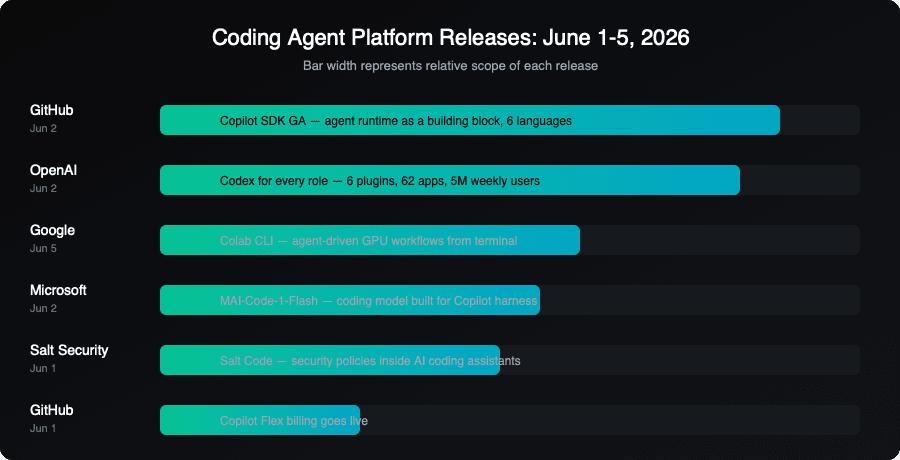
Each one on its own is a vendor doing vendor things. Together they point somewhere specific: coding agents are becoming programmable platforms with their own SDKs, security layers, and model stacks.
GitHub Copilot SDK: the agent runtime as a building block
The Copilot SDK has been in preview since late 2025. The GA release on June 2 stabilizes the API and adds Rust and Java bindings.
What makes it worth paying attention to is the architectural model. The SDK does not give you a chat interface. It gives you Copilot's planning loop, tool invocation engine, file editor, and streaming session manager. You register your own tools, connect MCP servers, override built-in tools like grep and edit_file, and intercept agent behavior through a hook system at pre/post tool use, session start, and permission requests.
Authentication supports GitHub OAuth, GitHub Apps, environment tokens, and BYOK for OpenAI, Anthropic, Microsoft Foundry, and others. OpenTelemetry tracing covers the full lifecycle. Cloud-backed sessions can run with repository metadata attached.
The pricing model is notable: the SDK is available to all Copilot subscribers, including Copilot Free, and to non-Copilot users via BYOK. That removes a significant adoption barrier.
Source: GitHub Blog, June 2, 2026
Codex goes beyond developers
OpenAI's June 2 announcement is less about a single feature and more about a positioning shift. Codex now has six role-specific plugins: data analytics, creative production, sales, product design, research, and finance. Together they bundle 62 apps and 110 skills. The pitch is explicit: non-developers now make up 20% of Codex users and are growing 3x faster than developers.
The new Sites feature lets teams create interactive web apps shareable via URL. Annotations let you mark up Codex output inline. Plugins connect Codex to Salesforce, Snowflake, Figma, HubSpot, and dozens of other tools that have nothing to do with writing code in the traditional sense.
Five million weekly users is the number OpenAI is emphasizing. Whether that reflects active coding or general ChatGPT usage routed through Codex is less clear, but the plugin strategy is unambiguous. OpenAI is building Codex into a general-purpose work platform that happens to be powered by a coding agent.
Source: OpenAI Blog, June 2, 2026
Google Colab CLI: agents getting GPUs
Google's Colab CLI, announced June 5, is the most architecturally interesting release of the week. It bridges local terminals to remote Colab runtimes, and it was designed with agents in mind.
The CLI ships with a prepackaged skill file for AI agents. You can tell Antigravity, Claude Code, or Codex to "fine-tune Gemma 3-1B on a Text-to-SQL dataset using QLoRA on a T4 GPU," and the agent runs colab new --gpu T4, installs packages, executes the script, downloads the adapter, and shuts down the instance. All from a terminal prompt.
This matters because it gives agents access to GPU compute without manual cloud provisioning. The Colab free tier includes GPU access, which means agents can prototype ML workflows at zero marginal cost. For teams building AI automation pipelines that need to train or fine-tune models as part of a larger workflow, this removes an entire infrastructure layer.
Source: Google Developers Blog, June 5, 2026
MAI-Code-1-Flash: Microsoft's coding model
Also on June 2, Microsoft's Superintelligence team released MAI-Code-1-Flash, a coding model built for the GitHub Copilot harness. It is rolling out to Copilot individual users in VS Code.
The benchmark claims are aggressive: MAI-Code-1-Flash outperforms Claude Haiku 4.5 across SWE-Bench Verified, SWE-Bench Pro, SWE-Bench Multilingual, and Terminal Bench 2. The widest gap is on SWE-Bench Pro, where it scores 51.2% vs. Haiku's 35.2%. It also uses up to 60% fewer tokens on SWE-Bench Verified, which means lower latency and cost per task.
What is more interesting than the benchmarks is the training approach. Microsoft says the model was trained directly with the Copilot production harness, evaluated on telemetry-grounded tasks adapted from real Copilot usage, and designed with "adaptive solution length control" that lets it spend more reasoning budget on complex tasks and stay concise for simple ones.
This is the first model I have seen that is explicitly optimized for an agent runtime rather than a benchmark suite. Whether that translates to real developer productivity is an open question, but the design philosophy is worth watching.
Source: Microsoft AI Blog, June 2, 2026
Salt Code: security at the point of generation
Salt Security launched Salt Code on June 1, and the data in the announcement is worth reading carefully.
Veracode tested over 100 large language models on security-sensitive coding tasks. 45% of the generated code introduced OWASP Top 10 vulnerabilities. CodeRabbit found that AI pull requests contain 2.74x more vulnerabilities than human-written ones. CVE counts traced to AI-generated code rose nearly 6x year over year. March 2026 alone disclosed 35 new CVEs from AI coding tools, exceeding all of 2025 combined.
Salt Code addresses this by enforcing security policies inside the coding assistant at the moment of code generation, using MCP servers as the integration layer. It supports Claude Code, Cursor, Copilot, Windsurf, Kiro, Codex, Gemini CLI, and Antigravity. The same policy model extends into CI/CD pipelines and runtime monitoring.
For organizations standardizing on AI coding tools, this is the first product I have seen that treats security as a property of the generation process rather than a post-hoc review gate. Whether it works as advertised is something each team will need to validate, but the problem statement is real and getting worse fast.
Source: Salt Security, June 1, 2026
What this week means
Three patterns stand out.
Agents have SDKs now. GitHub's Copilot SDK, combined with Codex's plugin architecture and the Colab CLI's skill file system, means agents are not just tools you use. They are platforms you build on. The infrastructure layer for agent-native applications is starting to take shape.
Security is catching up to adoption. Salt Code launching the same week as the Copilot SDK GA is not a coincidence. As agents write more code, the attack surface expands. 45% of AI-generated code introducing known vulnerabilities is a number that should make every engineering lead stop and check what their team is actually shipping.
The model layer is diversifying. MAI-Code-1-Flash is purpose-built for the Copilot harness. Google is positioning Colab as agent-accessible compute. OpenAI is turning Codex into a cross-functional work platform. One general model doing everything is giving way to specialized models and toolchains optimized for specific workflows.
Teams evaluating AI coding tools have a different decision to make now. It is not just "which assistant do I use?" anymore. It is "which agent platform do I build on, and how do I secure what it generates?"
Sources: