AI Won in Court and Raised $30M on the Same Day
On June 22, Prosper AI raised $30M from a16z while Garfield AI won the first AI-drafted court case. Both prove vertical AI owns outcomes end-to-end.
By SpringVanta
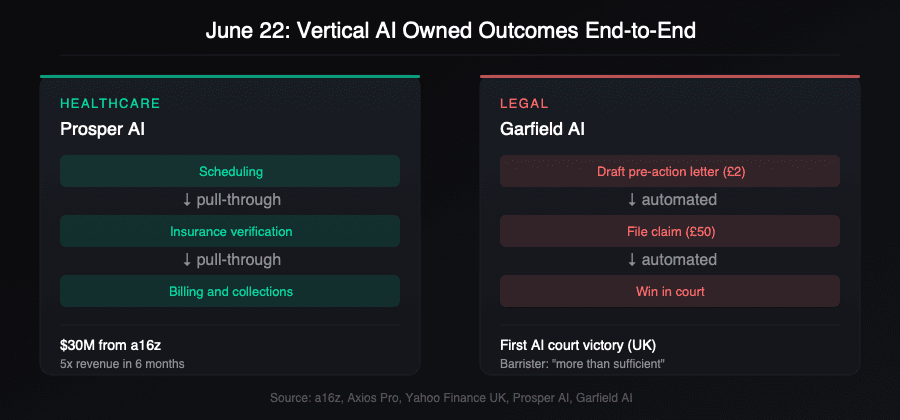
Two things happened on June 22 that make a good case for vertical AI having crossed a line it cannot uncross. Andreessen Horowitz led a $30 million Series A into Prosper AI, a healthcare platform that runs patient scheduling, insurance verification, and billing in a single workflow. Hours earlier, a UK court became the first in history to let an AI-drafted legal case win at trial.
One story is about capital betting that AI can run healthcare's operational backbone. The other is about a legal system accepting AI-drafted court filings as good enough to win. Different verticals, different countries, same shift: vertical AI stopped being a tool professionals use and started being the professional service itself.
$30M says healthcare providers want one platform, not five
Prosper AI's Series A is the straightforward part. a16z led the round, with Base10, Emergence Capital, Y Combinator, and Company Ventures participating. The company grew revenue five times in six months, added more than 40 healthcare organizations as customers, and now covers 150,000 providers. It claims to win 80% of competitive evaluations.
The expansion pattern a16z partner Jay Rughani described is the real signal. Providers deploy Prosper for scheduling, then quickly ask it to handle insurance verification, then billing, then collections. That pull-through does not happen with point tools. It happens when the platform can actually complete each step, and the customer trusts it enough to hand over the next one.
Co-founder and co-CEO Xavier de Gracia put it bluntly: "Healthcare providers don't want separate tools for scheduling, insurance verification, and billing. They want a single platform capable of managing the workflows that determine whether care happens and whether providers ultimately get paid."
The operational data backs this up. At Northeast OB/GYN, a six-location practice in Texas with 30 providers and 4,500 weekly calls, Prosper resolves 50% of calls end-to-end, cut operational costs by 40%, and reduced call abandonment by 89%. The practice now has 24/7 coverage including weekends. These are not pilot metrics. They are production numbers from a practice that was losing patients to hold times.
Prosper integrates with more than 80 EHR systems and goes live in about three weeks. It handles benefits verification through payer APIs for 80% of cases and calls the payer directly for the remaining 20%. The platform powers more than $1.3 billion in patient care. That is not a deployment metric or a pipeline number. It is care that actually happened because the scheduling, verification, and billing got done.
An AI law firm won in court
Across the Atlantic, Garfield AI did something no AI law firm had done before. It won a court case.
The case was modest in financial terms: a £7,000 small claims dispute between a freelance HR executive named Tamires Camal Taquidir and a hospitality business that owed her unpaid fees. But the mechanics of the victory are what matter. Taquidir used Garfield AI's chatbot to draft her pre-action letters, file the claim, and prepare the case for a three-hour trial at Wandsworth County Court involving seven witnesses.
The opposing side had a traditional Manchester law firm and a barrister. Taquidir had Dominic Li, a recently qualified barrister at One Essex Court, who used the AI-drafted documents to argue the case in court.
After winning, Li said the AI-drafted documents were "more than sufficient for the purposes of this trial." That is a barrister, trained in one of the most document-intensive legal systems in the world, calling AI output trial-ready.
Garfield AI's pricing model is what makes this structural, not just novel. Pre-action letters cost £2. Claim forms cost £50. The platform handles claims up to £10,000. Traditional law firms charge hundreds of pounds for the same work. For someone owed £7,000, the choice between spending £2 on an AI-drafted letter or £500 on a solicitor is obvious, and it changes who can afford to enforce their rights at all.
The company was approved by the Solicitors Regulation Authority in May 2025 and remains the only law firm that relies on AI alone. It does not draft letters and hand them to a human lawyer for review. The AI is the lawyer.
What both prove
These are not the same story. Prosper AI is an enterprise platform processing millions of calls across 150,000 providers. Garfield AI is a consumer-facing chatbot handling small claims for people who cannot afford a solicitor. They operate at opposite ends of the market.
But they prove the same thing: vertical AI can now own an outcome end-to-end, and the institutions that gatekeep those outcomes have accepted it.
For healthcare, the gating institution was the payer. Prosper AI does not just schedule appointments. It verifies benefits, calls insurers when APIs fail, and handles billing outreach. The payer interaction, which used to require a human on hold for 40 minutes, is now an automated call that runs in the background.
For legal services, the gating institution was the court. Garfield AI's documents were accepted by a trial judge, cross-examined against opposing counsel's filings, and the AI-drafted arguments held up. The court system, not a regulator reviewing a sandbox pilot, validated the work.
This matters for anyone evaluating AI for their own operations. The question is no longer whether AI can draft a document, answer a call, or schedule an appointment. Those are table stakes. The question is whether it can take the work from the first interaction through to the outcome, whether that outcome is a financially cleared appointment or a court judgment. On June 22, both of those outcomes were achieved by AI, on the same day, in different industries, validated by different authorities.
The major firms are already moving. Freshfields struck a deal with Anthropic in April. Kirkland & Ellis signed with Palantir in June. But those are top-tier firms adding AI to their existing workflows. Garfield AI replaced the law firm entirely. Prosper AI replaced the scheduling team, the benefits verification team, and the billing outreach team. The disruption is not at the top of the market. It is in the operational layer where most of the cost lives.