9 Open Source AI Tools Hitting GitHub Trending This Week
Token compression, agent security scanning, and a free Zendesk alternative all broke into GitHub's top trending spots this week. Nine repos worth your attention.
By SpringVanta
9 Open Source AI Tools Hitting GitHub Trending This Week
The GitHub trending page this week tells you where AI infrastructure money is going. Token compression, agent security scanning, and a free Zendesk alternative all broke into the top spots. Here's what caught my attention and why each one matters if you're building or buying AI automation.
The cost cutters
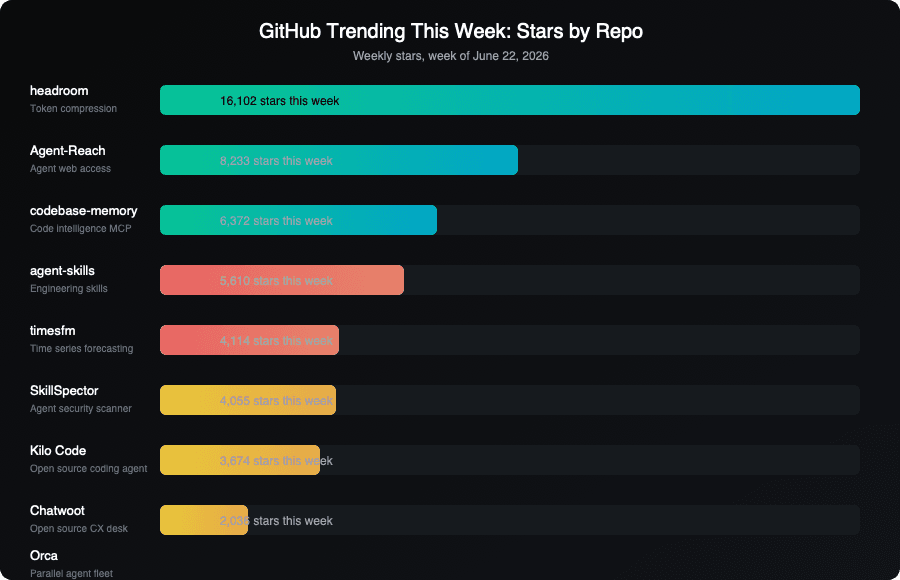
1. headroom — 44.4K stars, 16,102 this week
headroom sits between your AI agent and the LLM API, compressing everything the agent reads before it gets sent. Tool outputs, logs, files, RAG chunks, conversation history. Six compression algorithms claim 60 to 95 percent fewer tokens with the same answers.
What got me: it runs as a proxy. One command, zero code changes. You point your agent at the proxy port and it starts cutting costs. It also wraps Claude Code, Codex, Cursor, and Copilot out of the box. The compression is reversible, so the LLM can request the full content on demand if the compressed version isn't enough.
For any team paying per-token API bills, this is the repo to watch this week. License: Apache-2.0.
2. codebase-memory-mcp — 10.3K stars, 6,372 this week
codebase-memory-mcp indexes codebases into a persistent knowledge graph using tree-sitter AST analysis. It supports 158 languages, full-indexes the Linux kernel (28 million lines of code) in 3 minutes, and answers structural queries in under a millisecond.
The pitch: instead of having an agent grep through thousands of files (burning hundreds of thousands of tokens), it runs one graph query. That's roughly 120x fewer tokens for architecture questions. It ships as a single static binary with zero dependencies and auto-configures for 11 different coding agents including Claude Code, Codex, and Cursor.
If headroom compresses what agents read, codebase-memory-mcp changes what they need to read in the first place. License: MIT.
Agent infrastructure
3. Agent-Reach — 36.9K stars, 8,233 this week
Agent-Reach gives AI agents the ability to read content from 14+ platforms: Twitter, Reddit, YouTube, GitHub, Bilibili, RSS feeds, and more. No API keys, no paid subscriptions. It auto-selects and health-checks the best free scraping and transcription tools for each platform.
The auto-failover design is clever. Each platform has primary and backup backends. When one stops working (and they always do), it switches automatically. There's a built-in diagnostic command that tells you which platforms are healthy.
For building competitive intelligence or customer sentiment agents without paying for Twitter API access or YouTube Data API, this removes a real barrier. License: MIT.
4. NVIDIA SkillSpector — 9K stars, 4,055 this week
SkillSpector is a security scanner for AI agent skills. NVIDIA's own research found that 26.1 percent of agent skills contain vulnerabilities and 5.2 percent show likely malicious intent. This tool scans for 64 vulnerability patterns across 16 categories before you install a skill.
It checks for prompt injection, data exfiltration, privilege escalation, supply chain risks, and MCP tool poisoning. You can scan Git repos, URLs, zip files, or directories. Output goes to terminal, JSON, Markdown, or SARIF for CI/CD integration. Risk scoring runs 0 to 100 with clear go/no-go recommendations.
NVIDIA backing this is the signal. Agent skills are the new npm packages, and we know how that story goes. License: Apache-2.0.
Coding agents and dev tools
5. Kilo Code — 23.6K stars, 3,674 this week
Kilo Code is an open-source coding agent for VS Code, JetBrains, and CLI. The differentiator: it supports 500+ models with mid-task switching. You can start a task with a cheap model for boilerplate and switch to a more expensive one for architecture decisions.
Pricing is at provider rates with zero markup. Five specialized agents handle different phases: code, plan, ask, debug, and review. There's also an autonomous CI/CD mode that runs tests and fixes failures on its own.
The model-agnostic approach is the real value here. No vendor lock-in, and teams can optimize cost per task instead of committing to one provider's pricing tier. License: MIT.
6. Orca — 5.8K stars, 997 this week
Orca is an agent development environment for running a fleet of parallel coding agents. You fan one prompt across multiple agents, each in its own git worktree, then compare and merge the winner. Works with Codex, Claude Code, OpenCode, or any CLI agent.
It has a mobile companion for monitoring agents from your phone, a design mode for clicking UI elements to send HTML and screenshots to agents, and native GitHub and Linear integration.
If you've been running multiple terminal sessions manually to compare agent outputs, this is the tool version of that workflow. License: MIT.
7. addyosmani/agent-skills — 64.8K stars, 5,610 this week
agent-skills packages production-grade engineering skills for AI coding agents. Eight slash commands cover the full development lifecycle: spec, plan, build, test, review, web performance, code simplification, and ship.
The skills activate automatically based on context. API design work triggers the API and interface design skill. UI work triggers frontend engineering skills. The skills encode the workflows senior engineers actually use, so agents follow consistent quality standards instead of freestyling.
Addy Osmani (Google Chrome team) authored this, which explains the web performance focus. Works with Claude Code, Cursor, Gemini CLI, Copilot, Windsurf, and others. License: MIT.
Business operations
8. Chatwoot — 33.1K stars, 2,036 this week
Chatwoot is an open-source, self-hosted alternative to Intercom, Zendesk, and Salesforce Service Cloud. Live chat, email, WhatsApp, Instagram, Facebook, Telegram, and SMS all feed into one inbox.
The Captain AI agent handles common queries automatically. There's a help center portal for self-service, auto-assignment, canned responses, team collaboration with private notes and mentions, and integrations with Slack, Dialogflow, Shopify, and Linear.
For an SMB evaluating AI customer support, Chatwoot gives you the infrastructure without the per-seat pricing of commercial tools. You own your data, you control the deployment, and the AI layer is built in. License: MIT.
9. SurfSense — 15.1K stars, 555 this week
SurfSense is a privacy-focused, self-hostable alternative to Google's NotebookLM. No data limits, no file size caps, and 25+ external data source integrations including Google Drive, OneDrive, Dropbox, and Notion.
The interesting feature for teams: AI automations that trigger on document events. A file gets added to a folder, an agent processes it and writes results to Notion or Slack. There's a deliverable studio for generating reports, podcasts, and presentations from your sources.
If your team has been running into NotebookLM's limits or wants to keep research data on your own infrastructure, this fills that gap. License: Apache-2.0.
What the trending page tells you
Token optimization is becoming its own category. Headroom and codebase-memory-mcp both attack the same problem from different angles, and both landed in the top 5. When token costs are the bottleneck, tools that reduce tokens get stars.
Agent security arrived as infrastructure. NVIDIA shipping a skill scanner means the industry has accepted that agent skills need vetting the same way npm packages do. That was a niche concern six months ago.
And open-source alternatives to commercial SaaS keep gaining ground. Chatwoot competing with Zendesk, Kilo Code competing with Cursor, SurfSense competing with NotebookLM. Same playbook each time: own the data, skip the markup, deploy where you want.