Anthropic Goes Deep, OpenAI Goes Wide, Microsoft Picks Sides
Three announcements in 24 hours reveal where AI agent tools are heading: Anthropic bets on depth, OpenAI bets on breadth, and Microsoft drops Claude Code for Copilot CLI.
By SpringVanta
June 2 was a weird day in AI tooling. Anthropic gave Claude Code the ability to write its own multi-agent orchestration scripts on the fly. OpenAI turned Codex into a platform for non-developers, shipping 62 app integrations and a hosted web app builder. And Microsoft told thousands of its own engineers to stop using Claude Code by June 30 and switch to GitHub Copilot CLI instead.
The three announcements weren't coordinated. But read together, they describe a market that is splitting in two directions at once.
Anthropic's bet: depth
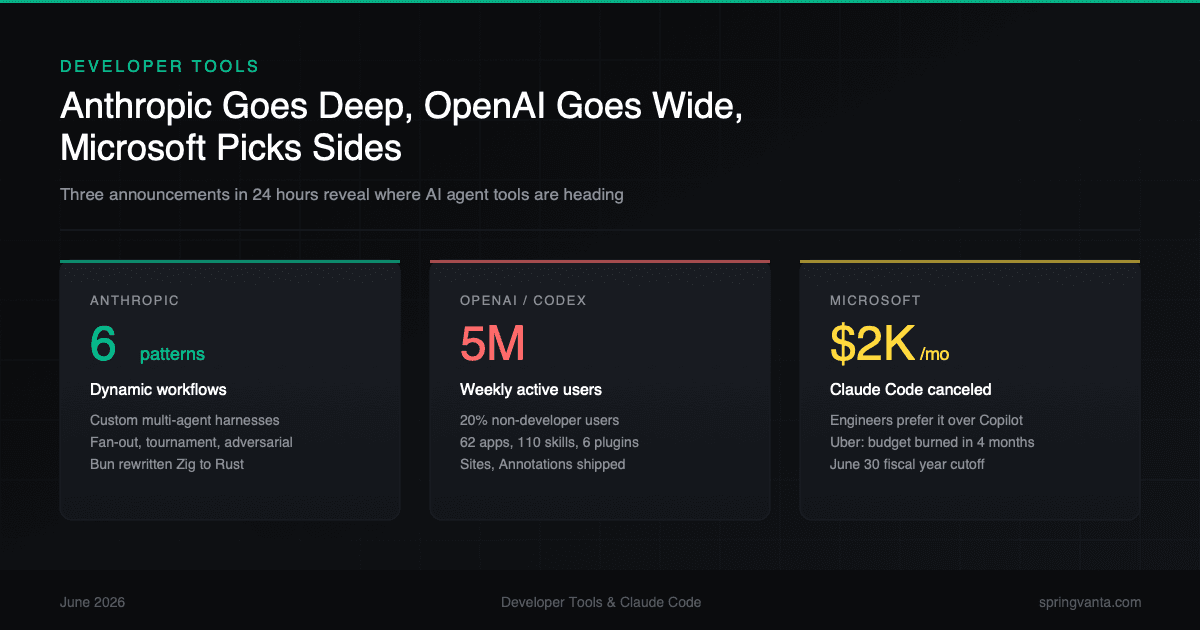
Claude Code's dynamic workflows are the most technically ambitious thing that shipped this week. Instead of a fixed agent harness for every task, Claude now writes a custom JavaScript orchestration script built around whatever you asked it to do.
The orchestration patterns are flexible. Fan-out-and-synthesize splits work across subagents and merges the results. Adversarial verification has one agent build and another attack. Tournaments spawn competing agents and a judge picks the winner. Loop-until-done keeps going until a stop condition is met.
Anthropic's own examples reveal what they think this is for: reproducing a flaky test by spawning competing theories and running them until one survives the evidence. Mining 50 past sessions for recurring corrections. Having different agents tear apart a business plan from an investor's, a customer's, and a competitor's perspective simultaneously.
The Bun project used workflows to rewrite its runtime from Zig to Rust, according to creator Jarred Sumner. That's not a toy demo. That's a production migration on a widely-used JavaScript runtime.
This is a depth play. Anthropic is betting that the value in AI agent tools comes from getting better at hard, specific tasks: large migrations, security audits, root-cause analysis, multi-file refactoring. Each task gets its own purpose-built harness with isolated context windows, so subagents can't contaminate each other.
The tradeoff is token cost. Anthropic's own blog post warns that workflows "often use more tokens and are best suited for complex, high value tasks." You would not use this to fix a typo.
OpenAI's bet: breadth
OpenAI went the opposite direction on the same day.
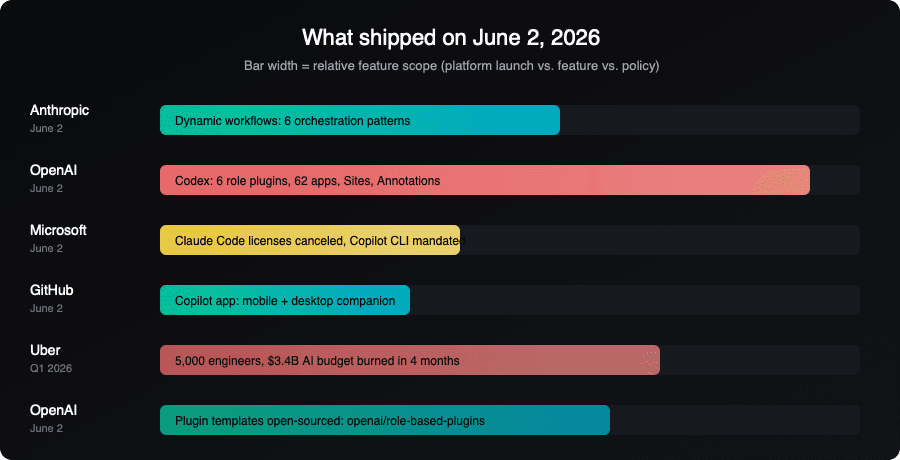
Codex now has 5 million weekly active users, up sixfold since the desktop app launched in February. The number that matters more: non-developers (analysts, marketers, salespeople, designers, researchers, bankers) make up 20% of users and are growing three times faster than the developer base.
The six new role-specific plugins tell you the strategy. Data analytics connects to Snowflake, Databricks, Hex, and Tableau. Sales connects to Salesforce, HubSpot, and Outreach. Creative production uses Figma, Canva, and Shutterstock. Sixty-two apps and 110 skills total, bundled by role rather than by technology.
Then there is Sites, which lets Codex output interactive hosted web apps instead of static files. An analyst can take a spreadsheet and get a live dashboard with a shareable URL. And Annotations lets users highlight a specific section of a document and have Codex edit only that section, rather than regenerating the whole file. VentureBeat's Carl Franzen noted that this solves one of the most annoying problems with AI-generated documents: asking for one chart update and getting back a completely rewritten file with broken formatting.
This is a breadth play. OpenAI is betting that the next hundred million users of AI agent tools are not developers. They are knowledge workers who want to turn spreadsheets into dashboards, briefs into campaigns, and research into pitch decks, without learning to code.
OpenAI also open-sourced the plugin templates on GitHub (openai/role-based-plugins), which means the ecosystem will grow beyond the initial six. Corporate finance, private equity, marketing strategy, strategy consulting, and legal plugins are all on the roadmap.
Microsoft picks a side (and the cost problem surfaces)
Microsoft's decision to cancel Claude Code licenses for its Experiences and Devices division adds a data point that neither vendor blog post mentions: token-based billing at enterprise scale is expensive.
The Verge's Tom Warren reported that Microsoft gave thousands of engineers, designers, and project managers access to Claude Code in December. Six months later, Claude Code "proved very popular," per Warren's sources. Engineers preferred it over GitHub Copilot CLI for daily work. The internal memo from EVP Rajesh Jha frames the switch as "toolchain unification," but Warren's sources say it is also financial. The June 30 cutoff aligns exactly with Microsoft's fiscal year end.
Microsoft is not breaking up with Anthropic. Claude models will still be available through Copilot CLI. The company continues to use Claude inside Microsoft 365 Copilot, where Anthropic's models handle certain tasks better than OpenAI's. But when it comes to the command-line coding agent that its own engineers use every day, Microsoft wants its own product to win.
The Uber comparison is hard to ignore. Uber reportedly gave Claude Code to 5,000 engineers and burned through its entire 2026 AI coding budget in four months, with per-engineer costs running $500 to $2,000 per month. Microsoft apparently hit a similar wall.
What to do with this
The split is real and it is structural, not temporary. Anthropic and OpenAI are building for different users doing different kinds of work.
If your team does deep, structured work (migrations, security audits, complex debugging) and can manage token costs, Claude Code's workflow approach handles that better. The isolated context windows and adversarial patterns are designed for tasks where planning and execution need to be separated.
If your team includes non-developers who need to turn business data into dashboards, campaigns into assets, or research into presentations, Codex's plugin approach gets there faster. The role bundles and 62 app integrations mean less setup time for common workflows.
Microsoft's internal data is the most concrete cost signal we have: its own engineers preferred Claude Code, and Microsoft is paying the fiscal-year-end bill to switch them back. If you are evaluating these tools, the practical question is whether your usage pattern looks more like Microsoft's (heavy, daily, expensive) or like OpenAI's new non-developer segment (lighter, role-specific, growing fast).
Either way, budget for token costs before you commit. The Uber and Microsoft examples are not outliers.
Sources:
- Anthropic, "A harness for every task: dynamic workflows in Claude Code", June 2, 2026
- OpenAI, "Codex for every role, tool, and workflow", June 2, 2026
- The Verge, "Microsoft starts canceling Claude Code licenses", Tom Warren
- VentureBeat, "OpenAI's Codex update lets agents build interactive enterprise workspaces", June 2, 2026
- TNW, "OpenAI Codex expands to enterprise with Sites, plugins, non-dev users", June 2, 2026
- Sesame Disk, "Microsoft Starts Canceling Claude Code Licenses", June 2026