Google Lets Websites Opt Out of AI Search — But Should You?
Google's new Search Console toggle lets sites opt out of AI Overviews and AI Mode. New AI visibility reports show impressions but no clicks. What this means for your business.
By Springvanta
Google now lets you opt your website out of AI Overviews and AI Mode. A toggle in Search Console. One click. You disappear from 3.5 billion monthly AI search users.
That's the headline from June 3, when Google announced the control alongside new AI visibility reports in Search Console. The UK's Competition and Markets Authority forced the move, calling it a "world first" in publisher rights. The CMA had designated Google as having "strategic market status" last October and has been pushing since January for publishers to get a say in how their content feeds AI features.
Before anyone rushes to flip that switch, it's worth understanding what the toggle actually does and what the new reports leave out.
What shipped on June 3
Two things landed at the same time. The first is an opt-out toggle in Search Console that lets site owners remove their domain from AI Overviews, AI Mode, and AI Overviews in Google Discover. Google says the opt-out won't affect your regular search rankings. Sites that opt out simply stop appearing in AI-generated responses. No traffic from those surfaces, no impressions.
The second is a new generative AI performance report in Search Console. For the first time, you can see how often your URLs appear in AI Overviews and AI Mode as a separate view from your regular search performance. The report shows impressions, which pages appeared, which countries, which devices, and date trends. Barry Schwartz at Search Engine Roundtable confirmed with Google that the report does not include click data. Data starts from May 18, 2026.
Google also updated its user numbers. AI Overviews now has 2.5 billion monthly active users. AI Mode has passed 1 billion. The company framed the announcement around "opportunity" and "control," pointing to increased inline links, Preferred Sources labels, and website previews as evidence that AI search drives real traffic to sites.
Why this happened now
The opt-out isn't a product Google decided to build out of goodwill. The UK's CMA imposed conduct requirements on Google in October 2025 after designating it as a company with "strategic market status." In January 2026, the CMA formally pushed Google to give publishers a choice about whether their content gets aggregated into AI search. In March, Google said it would develop the controls. On June 3, they shipped, starting with a subset of UK site owners.
Sarah Perez at TechCrunch reported that the CMA sees this as giving publishers "stronger bargaining power" to negotiate content deals with Google for use in AI features. The regulation also requires Google to ensure proper attribution with clear links in AI responses, which is why Google has been increasing inline links and adding website previews.
The rollout is UK-first. Global expansion comes later, after what Google calls "thorough testing."
What the new report covers, and what it doesn't
The generative AI performance report gives you five dimensions: impressions in AI Overviews, impressions in AI Mode, impressions in Discover AI features, which pages appeared, and which countries. For the first time, you can see whether Google's AI surfaces are picking up your content at all.
What you can't see: clicks, click-through rate, revenue, conversions, or which specific queries triggered your pages to appear. You also can't see anything about ChatGPT, Perplexity, Claude, or Copilot, because those platforms don't have a Search Console equivalent. They use different retrieval architectures and operate entirely outside Google's data pipeline.
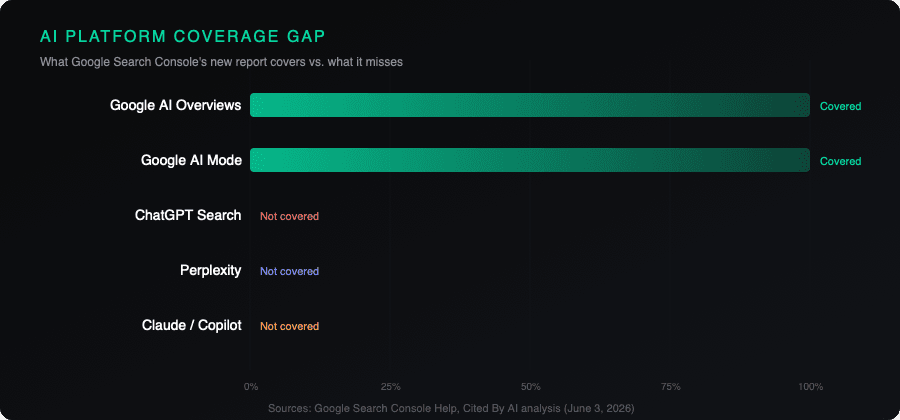
The cross-platform gap is real. Research from Lee (2026) found that cross-platform URL overlap between AI search engines is 1.4%. The Ahrefs AI Benchmark Report, published May 28, 2026, confirmed that 71% of cited sources appear on only one AI platform. A strong Google AI Overviews impression count tells you nothing about what ChatGPT or Perplexity are doing with your brand. Two buyers asking the same question on two platforms may get answers citing completely different sources.
The Cited By AI analysis published the same day put it plainly: the report is a genuine step forward for understanding your position on Google's AI surfaces, but it measures nothing outside of Google.
The opt-out decision for small businesses
If you run a service business, a law firm, a healthcare practice, or a real estate agency, the question isn't abstract. Google's AI surfaces now touch 3.5 billion users per month. Opting out means you stop appearing there entirely. You keep your regular search rankings, but you lose a discovery surface that's growing faster than anything else in search right now.
For most businesses, opting out is the wrong move. A low AI impression count usually means something specific: your content isn't structured for AI retrieval, your entity signals aren't strong enough, or your pages don't meet the citability threshold that separates pages AI systems cite from pages they skip. Fixing those things makes more sense than walking away from 3.5 billion users.
The specific causes vary. Content with no clear answer structure, low fact density, or paragraphs that don't work as standalone claims tends to get skipped. Pages where the brand's entity signals are weak, meaning AI systems don't confidently associate your domain with the queries you want to own, also get skipped. A technical crawl issue is different from a content citability problem, which is different from weak entity signals. The impression number alone doesn't tell you which of these is the problem.
If you're in a category where AI Overviews rarely appear, a low impression count might just mean your queries haven't been heavily featured yet. That will probably change as Google expands AI Mode coverage.
What to do this week
Check Search Console for the new generative AI section. If you don't see it yet, you're in the group that hasn't been activated. That doesn't mean your AI visibility is zero. It means Google hasn't given you the dashboard yet.
If the report is live, read the impression numbers as a starting point. A high count means you're showing up. A low count means something needs fixing. Neither tells you how you compare to competitors on ChatGPT or Perplexity, or whether AI is describing your brand accurately when it does cite you.
Don't flip the opt-out toggle reactively. The right move for most businesses is to diagnose why the impression count is where it is and fix the underlying content or entity problem. The toggle exists because UK regulators demanded it, not because Google thinks you should use it.
Track your AI visibility across multiple platforms, not just Google. Google's report covers Google. Your buyers are spread across ChatGPT, Perplexity, Gemini, and Copilot too, and the citation graphs are almost entirely separate.
Sources
- Google Blog, "New opportunities, control and insights for website owners," June 3, 2026. blog.google
- TechCrunch, Sarah Perez, "Publishers will be able to opt out of AI Search, thanks to new regulation," June 3, 2026. techcrunch.com
- Search Engine Roundtable, Barry Schwartz, "Google Search Console AI Performance Report & AI Blocking Controls," June 3, 2026. seroundtable.com
- Engadget, Igor Bonifacic, "Google will allow websites to exclude themselves from AI search results," June 3, 2026. engadget.com
- 9to5Google, Abner Li, "Google will let sites opt-out of AI Mode and Overviews in Search," June 3, 2026. 9to5google.com
- Cited By AI, "Google Just Launched AI Visibility Reports in Search Console," June 3, 2026. citedbyai.info
- Lee, A. (2026), "Query Intent and Google Rank as Joint Predictors of AI Citation." DOI: 10.5281/zenodo.18653093