Block Ships 15% of Production Code Through AI Agents
Block ships 15% of production code via AI agents. JetBrains Junie hits GA at number one on SWE-Rebench. Claude Code adds parameter-level permission rules.
By SpringVanta
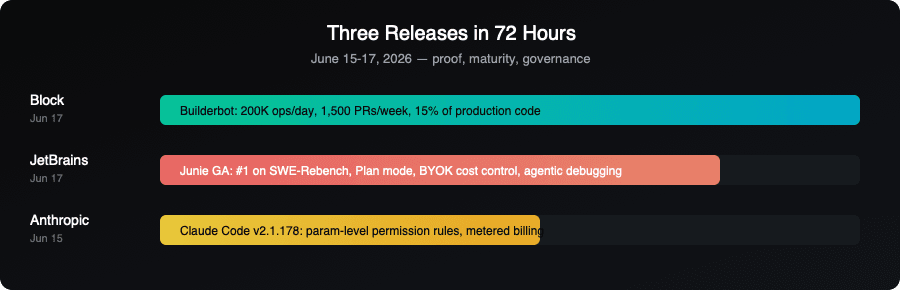
Block ships 15% of its production code through AI agents. 1,500 pull requests a week, merged by a system that picks up Jira tickets, creates branches, writes the implementation, watches CI, and iterates on review feedback. The company behind Square and Cash App published those numbers on June 17.
Two other releases landed in the same 72-hour window. JetBrains shipped Junie out of beta with a plan-before-code architecture and a benchmark win. Anthropic shipped Claude Code v2.1.178 with parameter-level permission rules that let you block specific models from spawning as subagents. Each addresses a different question: does it work at scale, is the tooling mature enough to buy, and can you control what it costs.
Block's 200,000 operations a day
Builderbot is an orchestration layer that runs inside Slack. Anyone at Block tags @builderbot with a task description and it gets to work in the thread. It picks up tickets from Linear and Jira, creates a branch, writes the code, opens the PR, watches CI, and iterates based on feedback. Multiple engineers can collaborate with it in the same thread at the same time.
What sets it apart from a coding assistant is scope. Builderbot understands the full context of Block's codebase: every service, every API, every convention. An engineer on Cash App can use it to make a change in a Square service they have never touched, because the system already knows how that service works.
Brad Axen, Block's head of AI capabilities, called it "the missing layer between AI coding tools and how engineering actually works at scale." On the Square side, he said engineers pulled a list of features sellers had been waiting on for months and shipped them in days. Builderbot handled the scaffolding and repetitive work. Engineers made the decisions that shaped the product.
The tool operates on source code and system configuration only. No customer data, no payment information, no PII.
Builderbot runs on goose, an open-source agent framework Block developed and contributed to the Agentic AI Foundation under the Linux Foundation. The integration challenges Block hit building goose led to its collaboration with Anthropic on MCP, now an industry standard for connecting agents to tools and data sources.
Frederic Lardinois at The New Stack pointed out that Block is running this with a far smaller team than a year ago. The company laid off more than 4,000 people in February, over 40% of its workforce, in a restructuring CEO Jack Dorsey tied directly to the AI bet. He told shareholders he expected most companies to reach the same conclusion within a year.
Builderbot itself is not a product anyone can buy. Block is sharing the architecture and the argument behind it.
JetBrains Junie goes GA
JetBrains shipped Junie out of beta on June 17 with a different bet than Block's internal tool. Junie is a product you can install today, in any JetBrains IDE or from the terminal via Junie CLI.
On the latest SWE-Rebench cycle, an independent agent benchmark that draws fresh tasks each run, Junie placed first among coding agents: 61.6% resolved, 72.7% pass@5. Alexander Golubev, research lead at Nebius, noted it was competitive with raw frontier models, not just other agent harnesses.
The GA version adds Plan mode, which forces the agent to produce a structured plan before writing code. The plan is a real document that lives in .junie/plans. You can commit it. You edit it in your editor. You approve it. Then Junie implements.
JetBrains built the pricing around this idea. Plan on a powerful model, implement on a cheap one. Because Junie supports any model via BYOK (bring your own key), you can plan on Opus and implement on Flash, cutting the token bill without losing quality. The agent also asks clarifying questions when requirements are ambiguous instead of guessing and burning tokens on the wrong path.
Pricing starts free with BYOK, which means provider-rate pricing with zero JetBrains markup. AI Pro is $8.33 per month with 10 credits. AI Ultimate is $25 per month with 35 credits. An independent review from Altaitools pegged the real-world cost at about $1.14 per task, roughly 4x cheaper than the nearest competitor on the same benchmark.
Two features beyond the benchmark caught my attention. First, agentic debugging: Junie drives the IDE's real debugger, setting breakpoints in project code, library code, even decompiled class files, and inspecting actual runtime state instead of adding print statements. Second, remote control: you start a migration from your laptop, check progress from your phone, and review the PR later. These are the features that make an agent something you delegate to rather than something you babysit.
Claude Code gets parameter-level governance
On June 15, Anthropic shipped Claude Code v2.1.178 with a feature that looks modest in the changelog but matters for cost control. The new Tool(param:value) permission rule syntax lets you match a tool's input parameters, not just the tool name.
Before this, permission rules were coarse. Allow Agent and you allowed any subagent, including expensive Opus-powered ones. Block it and you killed all subagents, even the cheap ones you needed for parallel work.
Now you can write Agent(model:opus) to deny Opus subagents specifically while allowing everything else. The * wildcard extends it: Bash(command:npm test*) to whitelist test commands, Bash(command:rm *) to block destructive ones.
This matters because June 15 was also the day Anthropic's billing change took effect. Claude Code and Agent SDK usage moved off flat-rate subscription pools onto a separate metered credit system. Heavy agent users now pay full API rates out of limited monthly credits. A single Opus subagent can burn through $20 of API credits in minutes. Parameter-level permission rules are the governance layer that makes that cost manageable.
The release also closed a security gap in auto mode: subagent spawns are now evaluated by the classifier before launch, preventing a subagent from requesting a blocked action without review. Nested .claude/skills directories now load properly when working on files in those directories, with the closest definition taking priority on name conflicts.
What this means
Block published the first production-scale numbers for AI coding agents at a public company. 200,000 operations a day across hundreds of services. The tooling is not for sale, but the architecture and the argument are.
JetBrains made Junie available to anyone with a JetBrains IDE or a terminal. It placed first on SWE-Rebench at about $1.14 per task. Plan mode forces a structured plan before code. BYOK lets you plan on Opus and implement on Flash.
Anthropic shipped parameter-level permission rules the same day metered billing took effect. You can block Opus subagents while allowing cheaper ones. A single Opus subagent costs $20 in API credits in minutes. Now you can prevent that without killing all subagents.
The question stopped being whether agents can write code. Block put that to rest with 1,500 merged PRs a week. The questions now are about what each task costs, whether you can verify the output, and how the agent fits into the tools your team already uses.
Sources:
- Block: Builderbot announcement
- The New Stack: How Block manages its fleet of AI coding agents from Slack
- JetBrains: Junie leaves beta
- Junie pricing and features
- Claude Code v2.1.178 release notes
- Claude Code permissions documentation
- Altaitools: Junie review and cost analysis
- DevelopersIO: Claude Code v2.1.178 analysis