Buyers Drive AI Adoption Across Legal, Healthcare, and Real Estate
Two legal AI surveys and healthcare/real estate integration moves reveal the same pattern: clients now dictate AI tool adoption. What it means for intake-heavy businesses.
By Springvanta
The people buying AI-powered services have started telling their providers what tools to use. That inversion showed up in three places this week across legal, healthcare, and real estate. If you sell or buy intake-heavy services, the pattern is worth understanding.
Two legal surveys, one message
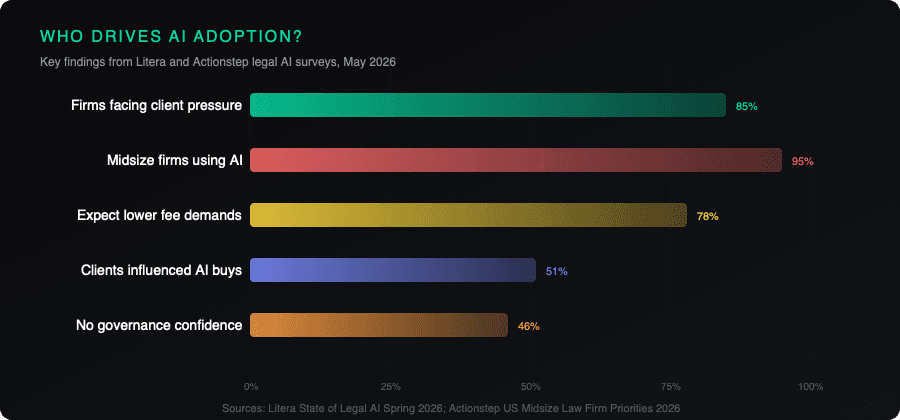
Litera released its State of Legal AI: Spring 2026 Market Sentiment Report on May 20. The headline: 85% of law firms are feeling or expecting direct client pressure on their AI strategy. More than half (51%) say a client has directly influenced an AI investment decision in the past year. Only 15% describe their AI spending as entirely self-directed.
A day earlier, Actionstep published its fourth annual US Midsize Law Firm Priorities Report. The numbers line up. 78% of midsize firms expect clients to demand lower fees and faster turnaround because of AI. 95% now use AI in some form. Yet 46% say they lack confidence that their firm has adequate policies to govern how AI gets used.
Both reports point to the same thing: the firms' own clients, whether that's corporate legal departments, insurance carriers, or businesses with recurring legal needs, are the ones pushing AI adoption. Not the technology teams. Not the vendors. The people paying the bills.
Casey Flaherty, a partner at Baretz+Brunelle, put it plainly in the Litera report: "Client pressure is no longer theoretical."
ROI ranked last on two separate questions in the Litera survey. What firms value is time recaptured: hours they can redirect toward billable work or client relationships. Firms don't want cheaper operations. They want more capacity without more headcount.
Healthcare: integration speed becomes the differentiator
The same buyer-driven pressure is reshaping healthcare AI. On May 20, Hyro announced a partnership with Five9 to deliver healthcare-specific AI agents into contact centers. Integration time: one hour, down from the two-week deployment that was standard for healthcare contact center AI.
Healthcare systems have been stuck choosing between generic contact center tools (fast to deploy, bad at clinical workflows) and healthcare-native platforms (good at clinical workflows, slow to integrate). Hyro's pitch is that you shouldn't have to choose. Five9, which runs contact centers for a large share of US health systems, now agrees.
Same pattern as the legal surveys. The buyer, in this case health system operations leaders, is out of patience with "we can integrate that in six months." Organizations buying AI intake and access tools want vertical-specific behavior, and they want it this quarter.
This follows Amazon Connect Health's March launch of five HIPAA-eligible AI agents for patient verification, appointment management, and ambient documentation. AWS wouldn't have shipped a healthcare-specific product line if its enterprise buyers weren't demanding one.
Real estate: the transaction gets automated
On May 21, SkySlope and Cloze expanded their integration to let real estate agents create and fill transaction paperwork directly from a client record, with data pre-filled from the MLS. Buyer agreements, listing agreements, purchase offers. No switching systems. No re-keying information.
The integration is a small thing on its own. In context, it's another data point for the same trend. Real estate agents and brokerages have been sold "AI-powered" tools for years, most of which generate listing copy or suggest comparable properties. The operational bottleneck has always been the paperwork between signed offer and close, the part where agents spend hours staring at forms and retyping client details.
NAR's 2025 Technology Survey reports 36% of agents now use AI tools weekly, up from 13% in 2023. But the adoption is concentrated in content generation and search. Transaction coordination, where the actual money and time live, is still mostly manual.
The SkySlope-Cloze integration targets that gap. It's not AI writing a poem about the kitchen. It's AI removing the data entry between "we have a deal" and "here are the signed documents." Buyers are starting to ask for this by name.
What this means for intake-heavy businesses
If you run a business that takes in client information (legal matters, patient histories, real estate leads, insurance claims) and turns it into structured work, three things are true right now:
Your clients have opinions about your technology stack. They may not say "use AI for intake," but they are asking why response times are slow, why they have to repeat information, and why your process feels like 2019. Those complaints are technology questions in disguise.
Vertical-specific integrations are shipping fast. Hyro's one-hour healthcare deployment. SkySlope's pre-filled real estate forms. Checkbox's AI Legal Front Door that turns a Slack message into a structured matter. The infrastructure is available now, not in a roadmap deck.
Governance is the gap, not technology. Both the Litera and Actionstep surveys flagged this. Firms are adopting AI faster than they're building policies to govern it. The 46% who lack governance confidence in the Actionstep data are a liability to themselves and their clients. If you're deploying AI intake, build the review and escalation process before you go live.
Across all three verticals, the people paying for services have stopped waiting for providers to modernize. They're telling them to. The question isn't whether to automate intake. It's whether you'll do it before your clients ask why you haven't.
Sources:
- Litera, State of Legal AI: Spring 2026 (Business Wire, May 20, 2026)
- Actionstep, US Midsize Law Firm Priorities 2026 (PR Newswire, May 19, 2026)
- Hyro + Five9 Partnership (PR Newswire, May 20, 2026)
- SkySlope and Cloze Expand Integration (RISMedia, May 21, 2026)
- Forbes, "How AI Could Finally Help Solve the Bottleneck in Mass Tort Intake" (May 20, 2026)