$80B Saved, $3 Per Resolution: Voice AI's Cost Paradox
Gartner projected $80B in contact center AI savings, then warned GenAI will cost more than offshore agents by 2030. Both are correct. Here is why.
By Springvanta
Two Gartner forecasts, four years apart, tell a story that anyone deploying voice AI needs to understand.
In August 2022, Gartner predicted that conversational AI would reduce contact center agent labor costs by $80 billion in 2026. The number landed in every board presentation and vendor pitch deck. In January 2026, the same firm published a correction: by 2030, the cost per resolution for generative AI will exceed $3, making it more expensive than many offshore human agents.
Both predictions can be true at the same time. That tension is the most important thing happening in voice AI right now, and almost nobody is talking about it.
What the $80B actually means
The $80 billion figure comes from compounding small savings across a massive workforce. There are roughly 17 million contact center agents worldwide. Labor makes up 95% of contact center costs. If AI handles even 10% of interactions, that is billions in displaced wages.
And the per-call economics are not subtle. A US-based agent costs $7 to $12 per call, fully loaded. A voice AI agent costs $0.20 to $0.60 per call on infrastructure-layer platforms like Vapi or Retell AI. Managed platforms with more hand-holding run $1 to $2 per call. Either way, the gap is 10x to 30x.
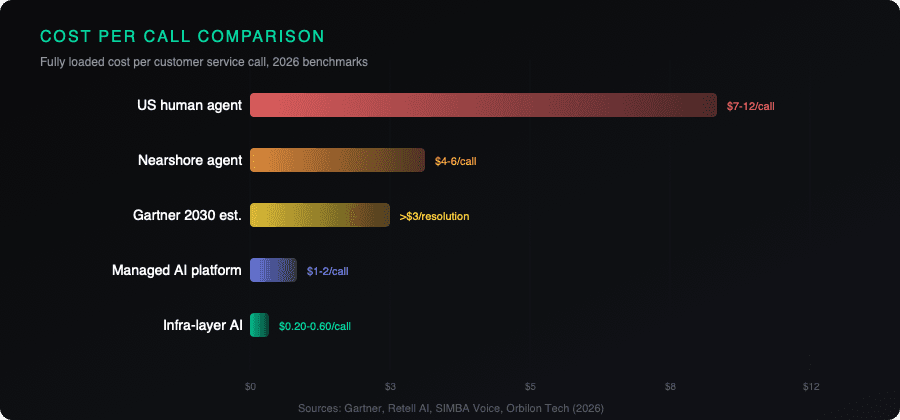
Retell AI published a cost breakdown in May 2026 that is unusually honest for a vendor. Their number: $0.11 per minute for AI voice, versus $2.70 to $5.60 per human-handled call. The fully loaded cost of a US agent, they found, is $29 to $42 per hour when you add benefits, turnover replacement, management overhead, and training. Not the $18 to $22 on the offer letter.
Where the money actually disappears
So if the per-call math is this compelling, why did Gartner walk back its optimism?
Ender Turing, a conversation intelligence company that has worked across millions of contact center interactions, published an analysis that cuts through the noise. Their finding: 56% of contact centers are failing to realize expected ROI from their AI implementations. That is from COPC's 2025 global survey. Worse, 42% of companies abandoned most of their AI initiatives in 2025, up from 17% in 2024. That is a 2.5x increase in abandonment in a single year.
Three things went wrong at once.
Implementation costs ballooned. Enterprise AI deployments run $500,000 to $2 million, with integration adding another 20 to 50 percent on top.
Maintenance turned out to be ongoing, not one-time. Knowledge graphs, training data, and model updates require continuous investment. A voice AI agent that was accurate in January can be confidently wrong by March if the knowledge base has not been updated.
And the big one: token costs fell 280x over two years, but total enterprise AI spend rose 320% in the same period. Cheaper inputs, higher total bills. Agentic AI models consume 5 to 30x more tokens per task than the chatbots they replaced. The ambition scaled faster than the efficiency.
Klarna's arc: from poster child to cautionary tale
Klarna is the case study everyone references now, and for good reason. In February 2024, the Swedish fintech company announced that AI had handled 2.3 million customer conversations, effectively replacing 700 agents. Their CEO declared that AI could do "all human jobs." They were OpenAI's "favorite guinea pig," and they wanted everyone to know it.
By 2025, screenshots went viral showing Klarna's AI inventing policies that did not exist. Customers hit walls when their issues touched refund policy, account state, or anything requiring judgment beyond a script. By 2026, Klarna was rehiring human customer service agents, shifting from full AI replacement to a hybrid model.
Forbes, eMarketer, and Customer Experience Dive all covered the reversal. The lesson was not that AI customer service fails. It was that full automation fails for anything beyond routine inquiries, while hybrid models succeed.
Tripadvisor, Thumbtack, and ClickUp noticed. They built parallel AI-plus-human teams where each side amplifies the other, rather than one trying to replace the other.
PolyAI ships Agent Studio as the "how to do it right" counterpoint
On May 21, 2026, PolyAI unveiled Agent Studio, a voice-first omnichannel platform that gives enterprises a toolkit to build, manage, and optimize customer service AI agents. It is positioned as a control layer: visibility into how agents behave, why they respond the way they do, and how to tune them over time.
PolyAI raised an $86 million Series D, bringing total funding past $200 million. Over 100 enterprises use their platform for customer interactions. Agent Studio is their answer to the Klarna problem: instead of replacing humans entirely, give organizations the tools to run AI alongside human agents with real oversight.
Their approach starts with voice because, in their experience, voice is the hardest channel. If you can build a robust AI brain for phone conversations, you can extend it across chat, email, and other channels. It is a "solve the hard problem first" philosophy, and the production data backs it up.
The hybrid model is what actually works
The organizations generating real savings from voice AI in 2026 are running a 60/40 or 70/30 split. AI handles routine, high-volume interactions: password resets, order status, appointment scheduling, balance inquiries, basic troubleshooting. Humans handle escalations, complex cases, emotional situations, and high-value customer interactions.
Salesforce Agentforce has emerged as the enterprise standard for this architecture. Its outcome-based approach connects AI agent actions directly to CRM data, giving agents context that standalone chatbots lack. Bank of America's Erica handles 58 million interactions per month through a similar hybrid model, equivalent to 11,000 agents' daily workload, with human agents available for anything the AI cannot resolve.
The ROI numbers from well-executed hybrid deployments are consistent: 331% to 391% three-year ROI, according to a Forrester Consulting study. One composite organization saved $10.3 million in agent labor costs over three years while cutting call abandonment rates by 50%.
What to take away
The $80 billion in savings is real, but it accrues to organizations that deploy AI with the right architecture. Full automation for simple tasks. Human backup for everything else. Real investment in knowledge management, because a voice agent that cannot access current, accurate information creates more problems than it solves.
The cost per resolution warning is also real. If your AI deployment requires expensive models, complex integrations, and constant maintenance, the unit economics can flip. The organizations saving money started simple: one high-volume, low-complexity interaction type, measured rigorously, then expanded from there.
For businesses considering voice AI for customer intake, lead qualification, or support automation, the takeaway is straightforward. The technology works. The economics work. But the implementation matters more than the vendor you choose, and the hybrid model is the one that survives contact with reality.
Sources: Gartner (January 2026), PolyAI Agent Studio announcement, Klarna reversal via Forbes, Retell AI cost model, Ender Turing analysis, AgentMarketCap market data