74% of Contact Center AI Deployments Got Reversed. CCW 2026 Showed the Fix.
Salesforce, Talkdesk, RingCentral, and 8x8 each shipped a different answer to the same problem: why AI agent deployments fail after go-live and what makes them survive.
By SpringVanta
74% of enterprise AI agent deployments have been reversed after go-live. That is not a blogger's hot take. It is from a Sinch report published this year, and it was one of the most talked-about data points at Customer Contact Week Las Vegas last week.
Another one: not a single contact center agent in a UJET study describes AI as essential to their daily work. Zero percent. At the largest customer experience event in the United States, the professionals closest to the customer have delivered a verdict, and the verdict is: this stuff is not working the way the slide decks promised.
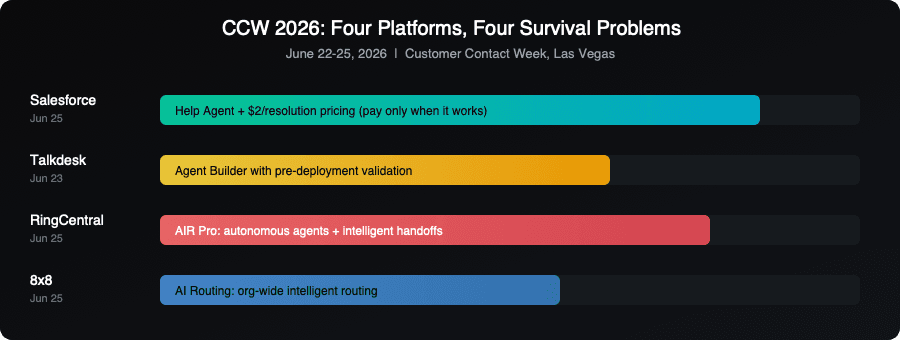
But CCW 2026 also produced something else. Four contact center platforms used the week to ship products that, taken together, read like a direct response to those numbers. Salesforce launched Help Agent with $2-per-resolution pricing. Talkdesk shipped Agent Builder with pre-deployment validation. RingCentral expanded AIR Pro with autonomous agents and intelligent handoffs. And 8x8 introduced AI Routing that reaches beyond the contact center into the entire organization.
Each one answers a different part of the same question: why do deployments fail after they go live, and what would make them survive?
What the data actually said
A few more numbers from CCW, because they set up the rest of this.
CX Today tracked narrative volume around "autonomous AI agents" in CX. It went from 23 instances in February 2026 to 893 in June. A 38-fold increase in five months. The technology arrived faster than the governance.
The Sinch report found that governance failures, not deployment failures, were the primary cause of reversals. The agents worked fine in testing. They broke when they hit edge cases in production or caused brand damage no checklist had anticipated. Gartner estimates the average failed enterprise software deployment costs millions once remediation and reputational damage are included.
A Front Research survey of 700 B2B CX leaders coined a phrase worth remembering: "coordination tax." AI tools were supposed to reduce operational burden. Instead, tool proliferation added management complexity. Teams spent more time managing the AI than the AI spent helping customers.
The thread connecting all of this is not that AI agents are bad. It is that the industry optimized for deployment speed when it should have optimized for deployment survival.
Salesforce: pay only when it works
Salesforce launched Help Agent, a prebuilt customer service agent that sits on top of Agentforce. You connect it to company knowledge, set up the channels (web, text, voice), and it starts working. It can provision its own phone number. You do not need to build telephony integration.
The interesting part is the pricing. Salesforce charges $2 per resolution. Not per conversation, not per token, not per minute. The agent has to resolve the issue autonomously, end to end, or you do not pay.
Kishan Chetan, EVP and GM of Agentforce Service, told SiliconANGLE: "Just consuming a token doesn't mean they get a return on investment. You can attribute your spend to value."
This matters because it shifts the risk. If 74% of deployments are being reversed, the cost of failure currently sits with the buyer. Pay-per-resolution moves some of that risk to the vendor. Salesforce is betting it can build agents reliable enough to eat the cost of the ones that do not resolve. That is a strong claim about product confidence.
Help Agent and the redesigned Customer Service Portal are generally available in July 2026.
Talkdesk: prove it works before a customer ever calls
Talkdesk's launch at CCW tackled the other side of the reversal problem. Most failed deployments broke in testing nobody bothered to do properly, or in testing nobody had time to do.
Agent Builder is a natural-language tool for building, testing, and validating AI agents before they go live. You describe the outcome you want in plain language. The platform ingests your standard operating procedures and policies, converts them into guardrails, then runs the agent through simulated interactions to find gaps before a real customer hits them.
Munil Shah, chief product, technology, and customer officer at Talkdesk, said it plainly: "You cannot simply deploy an AI agent into the wild and hope for the best. Organizations need proof that an agent will follow instructions, stay on brand, and handle pressure before a real customer ever experiences it."
The tool diagnoses underperforming agents in production too, recommending fixes and re-validating after changes. The highest-scoring agent version goes to a human for approval. That human-in-the-loop gate is the governance layer the Sinch report said most deployments were missing.
RingCentral: agents that act, then hand off cleanly
RingCentral used CCW to expand AIR Pro with agentic AI capabilities built into RingCX. The update includes native AI agents that do more than recommend next steps to human agents. They can independently execute processes like appointment confirmations, customer verification, and CRM updates during a live interaction.
The company also added autonomous outreach, letting AI agents proactively contact customers based on business events (payment reminders, appointment notifications) and complete actions like processing payments over the phone.
The part that addresses the reversal problem is intelligent handoffs. When an AI agent escalates to a human, it transfers the full conversation with customer history, CRM data, connected application data, and recordings attached. The customer does not have to repeat themselves.
Jim Dvorkin, SVP of Customer Experience Products at RingCentral, framed the shift: "Our announcement today is about expanding AIR Pro and adding key updates to RingCX as we make progress toward our vision of AI agents and humans working together."
The handoff problem is one of the most common reasons deployments get pulled. Customers get bounced between an AI that cannot resolve the issue and a human who has no context for the conversation that already happened. Clean transfers with full context directly attack that failure mode.
8x8: route to the right person, even outside the contact center
8x8 announced AI Routing, an org-wide intelligent routing engine. The pitch is that most routing systems do not actually route. They queue. Agents get assigned based on manually entered skills, updated rarely, calibrated to who is available rather than who is best suited.
8x8 AI Routing analyzes interaction transcripts, sentiment, and historical data to suggest skills for each agent. It evaluates each inbound interaction and determines who across the entire enterprise, not just the contact center, is best equipped to resolve it. A billing specialist in the back office. A technical expert on the engineering team.
Analyst Sheila McGee-Smith, founder of McGee-Smith Analytics, said: "What is even more powerful is that 8x8 can evaluate each inbound interaction and determine who, across the entire enterprise, not just the contact centre, is best equipped to resolve the customer's intent."
Supervisors get audit trails showing why each interaction went to each resource, including confidence scores. You can pilot on a single queue before full rollout.
The reason this matters for deployment survival: IDC research found organizations using five or more disconnected customer service tools spend 30% more time resolving issues. If the AI agent resolves the query but the routing layer sends the customer to the wrong human when escalation happens, the deployment gets blamed and pulled.
The question that changed
At CCW, one unnamed attendee said something that captures the whole problem: "The question we thought we needed to answer was, can we deploy this. The question we actually needed to answer was, can we govern this once it is running. We are only just realizing those are different questions."
That is the thread connecting all four launches. Salesforce is betting its own money that agents can resolve (pay-per-resolution). Talkdesk is building the validation layer so governance starts before go-live. RingCentral is fixing the handoff seam where AI-to-human transitions break. And 8x8 is solving the routing problem that makes disconnected tools fail at the moment of escalation.
If you are evaluating contact center AI right now, the four questions these products answer are the ones worth asking any vendor. How do you price failure? How do you test before launch? What happens at the handoff? Where does the customer go when the AI cannot finish the job?
The vendors who can answer those are the ones betting they will not end up in the 74%.